

134 ◾ Fundamental Food Microbiology
dehydrogenase and xylulose phosphoketolase enzymes, which enable them to metabolize hexoses
through the phosphogluconate-phosphoketolase pathway (or hexose monophosphate shunt) to
generate energy.
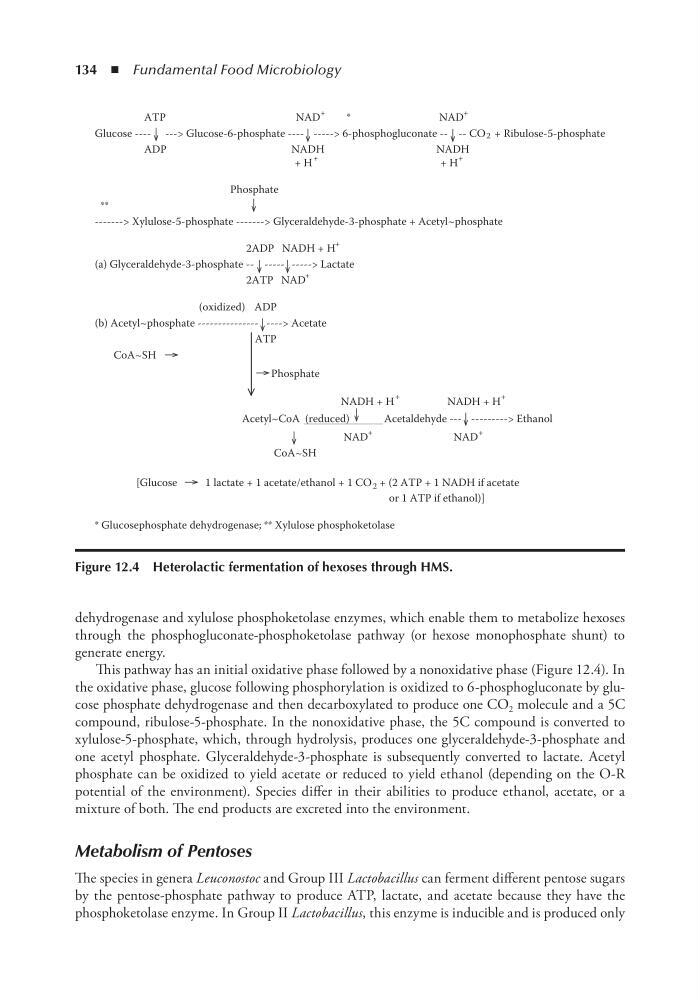
This pathway has an initial oxidative phase followed by a nonoxidative phase (Figure 12.4). In
the oxidative phase, glucose following phosphorylation is oxidized to 6-phosphogluconate by glucose phosphate dehydrogenase and then decarboxylated to produce one CO 2 molecule and a 5C
compound, ribulose-5-phosphate. In the nonoxidative phase, the 5C compound is converted to
xylulose-5-phosphate, which, through hydrolysis, produces one glyceraldehyde-3-phosphate and
one acetyl phosphate. Glyceraldehyde-3-phosphate is subsequently converted to lactate. Acetyl
phosphate can be oxidized to yield acetate or reduced to yield ethanol (depending on the O-R
potential of the environment). Species differ in their abilities to produce ethanol, acetate, or a
mixture of both. The end products are excreted into the environment.
Metabolism of Pentoses
The species in genera Leuconostoc and Group III Lactobacillus can ferment different pentose sugars
by the pentose-phosphate pathway to produce ATP, lactate, and acetate because they have the
phosphoketolase enzyme. In Group II Lactobacillus, this enzyme is inducible and is produced only
+ Ribulose-5-phosphate
ATP
NAD
+
*
NAD
+
Glucose ---- ---> Glucose-6-phosphate ---- -----> 6-phosphogluconate -- -- CO2
ADP
NADH
NADH
+ H
+
+ H
+
Phosphate
**
-------> Xylulose-5-phosphate -------> Glyceraldehyde-3-phosphate + Acetyl~phosphate
2ADP NADH + H
+
(a) Glyceraldehyde-3-phosphate -- ----- -----> Lactate
2ATP NAD
+
(oxidized) ADP
(b) Acetyl~phosphate --------------- ----> Acetate
ATP
CoA~SH
Phosphate
NADH + H
+
NADH + H
+
Acetyl~CoA (reduced)
Acetaldehyde --- ---------> Ethanol
NAD
+
NAD
+
CoA~SH
[Glucose
1 lactate + 1 acetate/ethanol + 1 CO 2 + (2 ATP + 1 NADH if acetate
or 1 ATP if ethanol)]
* Glucosephosphate dehydrogenase; ** Xylulose phosphoketolase
Figure 12.4 Heterolactic fermentation of hexoses through HMS.
dehydrogenase and xylulose phosphoketolase enzymes, which enable them to metabolize hexoses
through the phosphogluconate-phosphoketolase pathway (or hexose monophosphate shunt) to
generate energy.
This pathway has an initial oxidative phase followed by a nonoxidative phase (Figure 12.4). In
the oxidative phase, glucose following phosphorylation is oxidized to 6-phosphogluconate by glucose phosphate dehydrogenase and then decarboxylated to produce one CO 2 molecule and a 5C
compound, ribulose-5-phosphate. In the nonoxidative phase, the 5C compound is converted to
xylulose-5-phosphate, which, through hydrolysis, produces one glyceraldehyde-3-phosphate and
one acetyl phosphate. Glyceraldehyde-3-phosphate is subsequently converted to lactate. Acetyl
phosphate can be oxidized to yield acetate or reduced to yield ethanol (depending on the O-R
potential of the environment). Species differ in their abilities to produce ethanol, acetate, or a
mixture of both. The end products are excreted into the environment.
Metabolism of Pentoses
The species in genera Leuconostoc and Group III Lactobacillus can ferment different pentose sugars
by the pentose-phosphate pathway to produce ATP, lactate, and acetate because they have the
phosphoketolase enzyme. In Group II Lactobacillus, this enzyme is inducible and is produced only
+ Ribulose-5-phosphate
ATP
NAD
+
*
NAD
+
Glucose ---- ---> Glucose-6-phosphate ---- -----> 6-phosphogluconate -- -- CO2
ADP
NADH
NADH
+ H
+
+ H
+
Phosphate
**
-------> Xylulose-5-phosphate -------> Glyceraldehyde-3-phosphate + Acetyl~phosphate
2ADP NADH + H
+
(a) Glyceraldehyde-3-phosphate -- ----- -----> Lactate
2ATP NAD
+
(oxidized) ADP
(b) Acetyl~phosphate --------------- ----> Acetate
ATP
CoA~SH
Phosphate
NADH + H
+
NADH + H
+
Acetyl~CoA (reduced)
Acetaldehyde --- ---------> Ethanol
NAD
+
NAD
+
CoA~SH
[Glucose
1 lactate + 1 acetate/ethanol + 1 CO 2 + (2 ATP + 1 NADH if acetate
or 1 ATP if ethanol)]
* Glucosephosphate dehydrogenase; ** Xylulose phosphoketolase
Figure 12.4 Heterolactic fermentation of hexoses through HMS.