

136 ◾ Fundamental Food Microbiology
carbohydrate metabolism (Chapter 8). However, Lac. lactis ssp. lactis biovar diacetylactis and
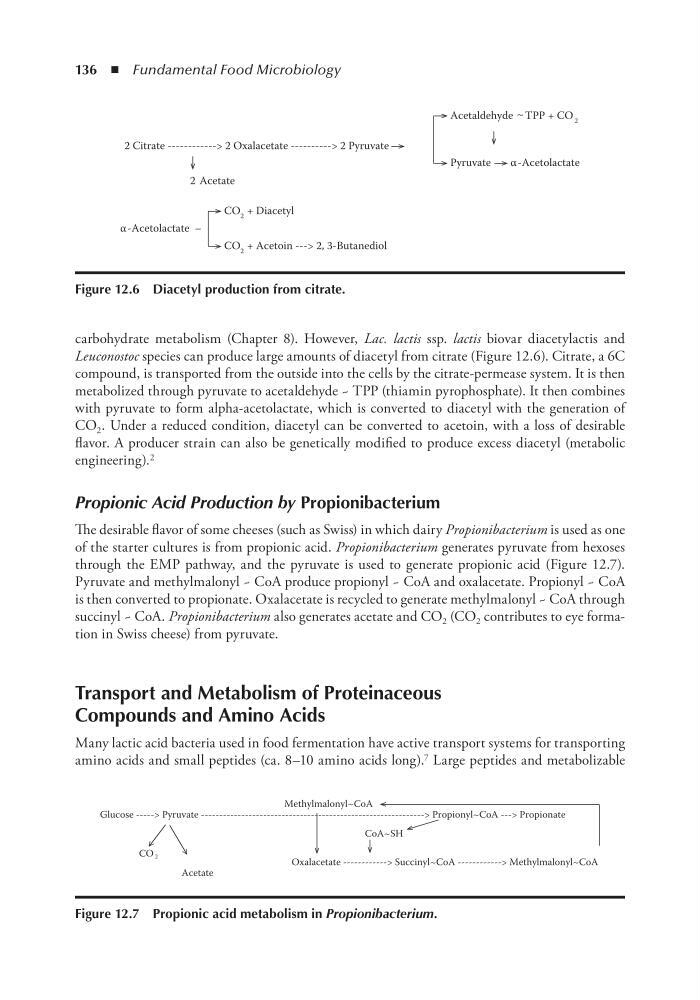
Leuconostoc species can produce large amounts of diacetyl from citrate (Figure 12.6). Citrate, a 6C
compound, is transported from the outside into the cells by the citrate-permease system. It is then
metabolized through pyruvate to acetaldehyde ~ TPP (thiamin pyrophosphate). It then combines
with pyruvate to form alpha-acetolactate, which is converted to diacetyl with the generation of
CO 2 . Under a reduced condition, diacetyl can be converted to acetoin, with a loss of desirable
flavor. A producer strain can also be genetically modified to produce excess diacetyl (metabolic
engineering). 2
Propionic Acid Production by Propionibacterium
The desirable flavor of some cheeses (such as Swiss) in which dairy Propionibacterium is used as one
of the starter cultures is from propionic acid. Propionibacterium generates pyruvate from hexoses
through the EMP pathway, and the pyruvate is used to generate propionic acid (Figure 12.7).
Pyruvate and methylmalonyl ~ CoA produce propionyl ~ CoA and oxalacetate. Propionyl ~ CoA
is then converted to propionate. Oxalacetate is recycled to generate methylmalonyl ~ CoA through
succinyl ~ CoA. Propionibacterium also generates acetate and CO 2 (CO 2 contributes to eye formation in Swiss cheese) from pyruvate.
transport and Metabolism of Proteinaceous
Compounds and Amino Acids
Many lactic acid bacteria used in food fermentation have active transport systems for transporting
amino acids and small peptides (ca. 8–10 amino acids long). 7 Large peptides and metabolizable
Methylmalonyl~CoA
Glucose -----> Pyruvate -------------------------------------------------------------> Propionyl~CoA ---> Propionate
CoA~SH
CO 2
Oxalacetate ------------> Succinyl~CoA ------------> Methylmalonyl~CoA
Acetate
Figure 12.7 Propionic acid metabolism in Propionibacterium.
Acetaldehyde TPP + CO 2
2 Citrate ------------> 2 Oxalacetate ----------> 2 Pyruvate
Acetate
2
Pyruvate
α-Acetolactate
CO 2 + Diacetyl
α-Acetolactate –
CO 2 + Acetoin ---> 2, 3-Butanediol
~
Figure 12.6 Diacetyl production from citrate.
carbohydrate metabolism (Chapter 8). However, Lac. lactis ssp. lactis biovar diacetylactis and
Leuconostoc species can produce large amounts of diacetyl from citrate (Figure 12.6). Citrate, a 6C
compound, is transported from the outside into the cells by the citrate-permease system. It is then
metabolized through pyruvate to acetaldehyde ~ TPP (thiamin pyrophosphate). It then combines
with pyruvate to form alpha-acetolactate, which is converted to diacetyl with the generation of
CO 2 . Under a reduced condition, diacetyl can be converted to acetoin, with a loss of desirable
flavor. A producer strain can also be genetically modified to produce excess diacetyl (metabolic
engineering). 2
Propionic Acid Production by Propionibacterium
The desirable flavor of some cheeses (such as Swiss) in which dairy Propionibacterium is used as one
of the starter cultures is from propionic acid. Propionibacterium generates pyruvate from hexoses
through the EMP pathway, and the pyruvate is used to generate propionic acid (Figure 12.7).
Pyruvate and methylmalonyl ~ CoA produce propionyl ~ CoA and oxalacetate. Propionyl ~ CoA
is then converted to propionate. Oxalacetate is recycled to generate methylmalonyl ~ CoA through
succinyl ~ CoA. Propionibacterium also generates acetate and CO 2 (CO 2 contributes to eye formation in Swiss cheese) from pyruvate.
transport and Metabolism of Proteinaceous
Compounds and Amino Acids
Many lactic acid bacteria used in food fermentation have active transport systems for transporting
amino acids and small peptides (ca. 8–10 amino acids long). 7 Large peptides and metabolizable
Methylmalonyl~CoA
Glucose -----> Pyruvate -------------------------------------------------------------> Propionyl~CoA ---> Propionate
CoA~SH
CO 2
Oxalacetate ------------> Succinyl~CoA ------------> Methylmalonyl~CoA
Acetate
Figure 12.7 Propionic acid metabolism in Propionibacterium.
Acetaldehyde TPP + CO 2
2 Citrate ------------> 2 Oxalacetate ----------> 2 Pyruvate
Acetate
2
Pyruvate
α-Acetolactate
CO 2 + Diacetyl
α-Acetolactate –
CO 2 + Acetoin ---> 2, 3-Butanediol
~
Figure 12.6 Diacetyl production from citrate.