

397
Saturated Fatty Acids
Saturated fatty acids are fatty acids that predominantly contain only single bonds
between carbon atoms. They are completely saturated with hydrogen molecules;
hence they contain no carbon-carbon double bonds. Majority of the naturally occurring saturated fatty acids are unbranched with even number of carbon atoms (Chow
2007). Saturated fats are having higher melting point and less reactive than unsaturated fats. Coconut oil, palm oil, butter, tallow are few of the sources of saturated
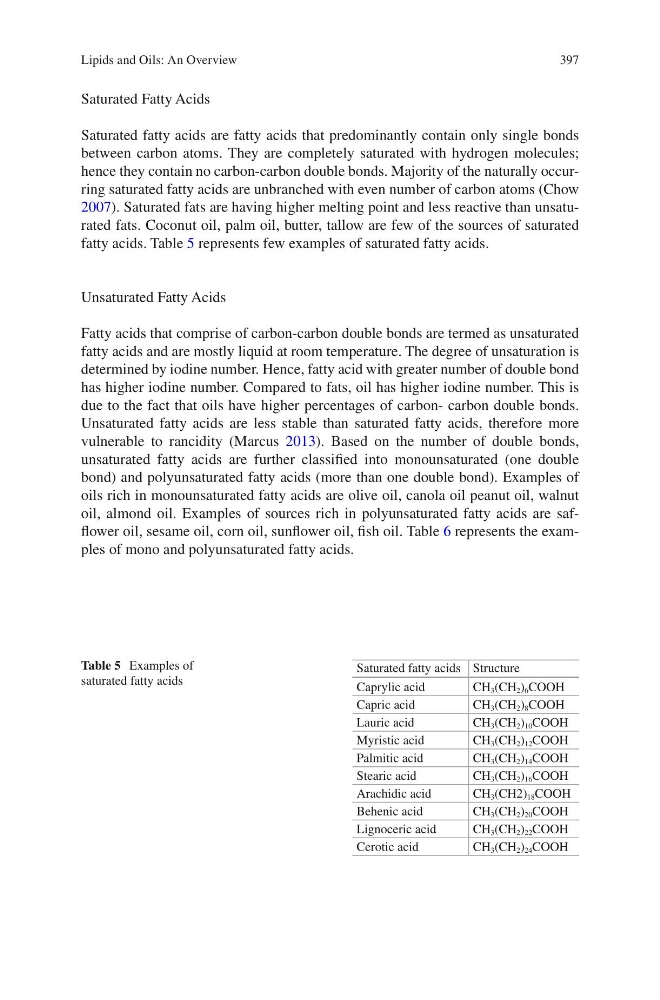
fatty acids. Table 5 represents few examples of saturated fatty acids.
Unsaturated Fatty Acids
Fatty acids that comprise of carbon-carbon double bonds are termed as unsaturated
fatty acids and are mostly liquid at room temperature. The degree of unsaturation is
determined by iodine number. Hence, fatty acid with greater number of double bond
has higher iodine number. Compared to fats, oil has higher iodine number. This is
due to the fact that oils have higher percentages of carbon- carbon double bonds.
Unsaturated fatty acids are less stable than saturated fatty acids, therefore more
vulnerable to rancidity (Marcus 2013). Based on the number of double bonds,
unsaturated fatty acids are further classified into monounsaturated (one double
bond) and polyunsaturated fatty acids (more than one double bond). Examples of
oils rich in monounsaturated fatty acids are olive oil, canola oil peanut oil, walnut
oil, almond oil. Examples of sources rich in polyunsaturated fatty acids are safflower oil, sesame oil, corn oil, sunflower oil, fish oil. Table 6 represents the examples of mono and polyunsaturated fatty acids.
Table 5 Examples of
saturated fatty acids
Saturated fatty acids Structure
Caprylic acid
CH 3 (CH 2 ) 6 COOH
Capric acid
CH 3 (CH 2 ) 8 COOH
Lauric acid
CH 3 (CH 2 ) 10 COOH
Myristic acid
CH 3 (CH 2 ) 12 COOH
Palmitic acid
CH 3 (CH 2 ) 14 COOH
Stearic acid
CH 3 (CH 2 ) 16 COOH
Arachidic acid
CH 3 (CH2) 18 COOH
Behenic acid
CH 3 (CH 2 ) 20 COOH
Lignoceric acid
CH 3 (CH 2 ) 22 COOH
Cerotic acid
CH 3 (CH 2 ) 24 COOH
Lipids and Oils: An Overview
Saturated Fatty Acids
Saturated fatty acids are fatty acids that predominantly contain only single bonds
between carbon atoms. They are completely saturated with hydrogen molecules;
hence they contain no carbon-carbon double bonds. Majority of the naturally occurring saturated fatty acids are unbranched with even number of carbon atoms (Chow
2007). Saturated fats are having higher melting point and less reactive than unsaturated fats. Coconut oil, palm oil, butter, tallow are few of the sources of saturated
fatty acids. Table 5 represents few examples of saturated fatty acids.
Unsaturated Fatty Acids
Fatty acids that comprise of carbon-carbon double bonds are termed as unsaturated
fatty acids and are mostly liquid at room temperature. The degree of unsaturation is
determined by iodine number. Hence, fatty acid with greater number of double bond
has higher iodine number. Compared to fats, oil has higher iodine number. This is
due to the fact that oils have higher percentages of carbon- carbon double bonds.
Unsaturated fatty acids are less stable than saturated fatty acids, therefore more
vulnerable to rancidity (Marcus 2013). Based on the number of double bonds,
unsaturated fatty acids are further classified into monounsaturated (one double
bond) and polyunsaturated fatty acids (more than one double bond). Examples of
oils rich in monounsaturated fatty acids are olive oil, canola oil peanut oil, walnut
oil, almond oil. Examples of sources rich in polyunsaturated fatty acids are safflower oil, sesame oil, corn oil, sunflower oil, fish oil. Table 6 represents the examples of mono and polyunsaturated fatty acids.
Table 5 Examples of
saturated fatty acids
Saturated fatty acids Structure
Caprylic acid
CH 3 (CH 2 ) 6 COOH
Capric acid
CH 3 (CH 2 ) 8 COOH
Lauric acid
CH 3 (CH 2 ) 10 COOH
Myristic acid
CH 3 (CH 2 ) 12 COOH
Palmitic acid
CH 3 (CH 2 ) 14 COOH
Stearic acid
CH 3 (CH 2 ) 16 COOH
Arachidic acid
CH 3 (CH2) 18 COOH
Behenic acid
CH 3 (CH 2 ) 20 COOH
Lignoceric acid
CH 3 (CH 2 ) 22 COOH
Cerotic acid
CH 3 (CH 2 ) 24 COOH
Lipids and Oils: An Overview