

398
Steroids
Steroids are one of the most important biomolecules. They are insoluble in water
but highly soluble in non-polar organic solvents. The structure of steroids is different from other lipids. They do not have any fatty acid but categorized under lipids
due to their similar characteristics as lipids. They are non-saponifiable. Steroids can
be separated from fat after saponification. Steroids are made of fused and fully saturated ring called cycloperhydrophenanthrene or sterane. It consists of 17 carbon
atoms bonded in four fused rings: three cyclohexane ring (six-carbon) and one
cyclopentane ring (five-carbon). The hexagonal ring structure of steroids is different
from benzene ring as the carbon atom is fully saturated with hydrogen atom and the
double bonds. Steroids have a wide range of biological activity and occur in higher
animals. Cholesterol is one of the common steroids in animals and found in cell
membrane of all human body and transported in the blood plasma of all animals
(Mu and Plummer 1988).
Terpenes
Terpenes are also non-saponifiable lipids that include certain fat soluble vitamins,
carotenoids and certain co-enzymes. Terpenes are the diverse group of plant secondary compounds and a major component of essential oils. The basic structure of terpenes is the isoprene units. The larger structures are assembled from several isoprene
units, usually by “head-to-tail” linked isoprene units.
Carotenoids
Carotenoids are fat soluble pigments widely present in plants, animals, algae and
bacteria. They are long aliphatic polyene chain composed of eight isoprene units. It
is composed of 40 carbon atoms (tetraterpenes), with a structure characterized by an
extensive conjugated double-bond system which is responsible for its color. As the
number of conjugated double-bond increases, color changes from pale yellow, to
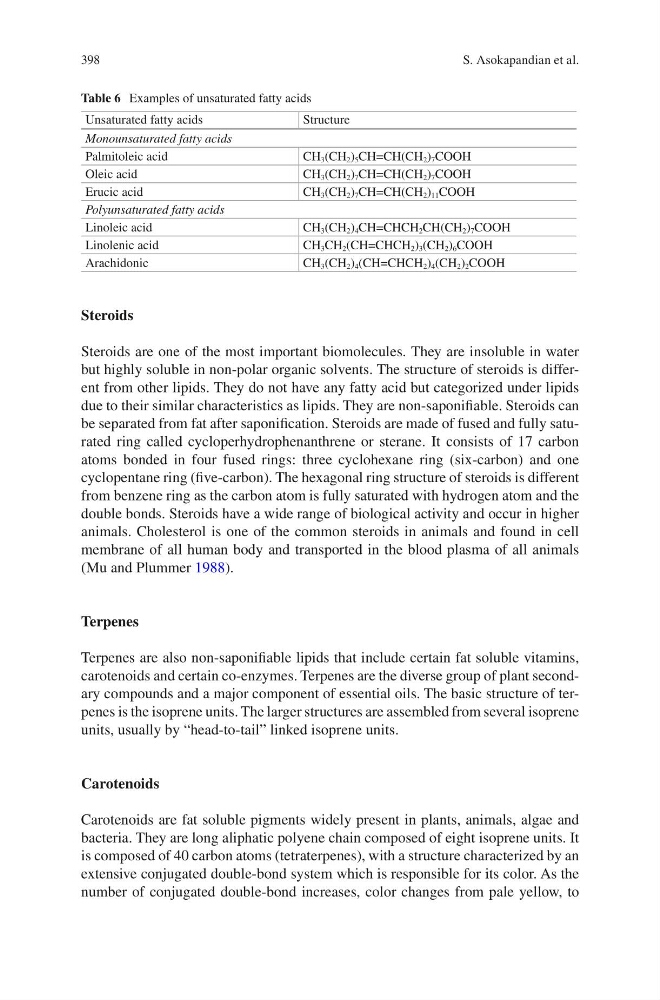
Table 6 Examples of unsaturated fatty acids
Unsaturated fatty acids
Structure
Monounsaturated fatty acids
Palmitoleic acid
CH 3 (CH 2 ) 5 CH=CH(CH 2 ) 7 COOH
Oleic acid
CH 3 (CH 2 ) 7 CH=CH(CH 2 ) 7 COOH
Erucic acid
CH 3 (CH 2 ) 7 CH=CH(CH 2 ) 11 COOH
Polyunsaturated fatty acids
Linoleic acid
CH 3 (CH 2 ) 4 CH=CHCH 2 CH(CH 2 ) 7 COOH
Linolenic acid
CH 3 CH 2 (CH=CHCH 2 ) 3 (CH 2 ) 6 COOH
Arachidonic
CH 3 (CH 2 ) 4 (CH=CHCH 2 ) 4 (CH 2 ) 2 COOH
S. Asokapandian et al.
Steroids
Steroids are one of the most important biomolecules. They are insoluble in water
but highly soluble in non-polar organic solvents. The structure of steroids is different from other lipids. They do not have any fatty acid but categorized under lipids
due to their similar characteristics as lipids. They are non-saponifiable. Steroids can
be separated from fat after saponification. Steroids are made of fused and fully saturated ring called cycloperhydrophenanthrene or sterane. It consists of 17 carbon
atoms bonded in four fused rings: three cyclohexane ring (six-carbon) and one
cyclopentane ring (five-carbon). The hexagonal ring structure of steroids is different
from benzene ring as the carbon atom is fully saturated with hydrogen atom and the
double bonds. Steroids have a wide range of biological activity and occur in higher
animals. Cholesterol is one of the common steroids in animals and found in cell
membrane of all human body and transported in the blood plasma of all animals
(Mu and Plummer 1988).
Terpenes
Terpenes are also non-saponifiable lipids that include certain fat soluble vitamins,
carotenoids and certain co-enzymes. Terpenes are the diverse group of plant secondary compounds and a major component of essential oils. The basic structure of terpenes is the isoprene units. The larger structures are assembled from several isoprene
units, usually by “head-to-tail” linked isoprene units.
Carotenoids
Carotenoids are fat soluble pigments widely present in plants, animals, algae and
bacteria. They are long aliphatic polyene chain composed of eight isoprene units. It
is composed of 40 carbon atoms (tetraterpenes), with a structure characterized by an
extensive conjugated double-bond system which is responsible for its color. As the
number of conjugated double-bond increases, color changes from pale yellow, to
Table 6 Examples of unsaturated fatty acids
Unsaturated fatty acids
Structure
Monounsaturated fatty acids
Palmitoleic acid
CH 3 (CH 2 ) 5 CH=CH(CH 2 ) 7 COOH
Oleic acid
CH 3 (CH 2 ) 7 CH=CH(CH 2 ) 7 COOH
Erucic acid
CH 3 (CH 2 ) 7 CH=CH(CH 2 ) 11 COOH
Polyunsaturated fatty acids
Linoleic acid
CH 3 (CH 2 ) 4 CH=CHCH 2 CH(CH 2 ) 7 COOH
Linolenic acid
CH 3 CH 2 (CH=CHCH 2 ) 3 (CH 2 ) 6 COOH
Arachidonic
CH 3 (CH 2 ) 4 (CH=CHCH 2 ) 4 (CH 2 ) 2 COOH
S. Asokapandian et al.