

395
Phosphatidylcholine are lecithin. Lecithin is the most common
phosphoglycerides.
Sphingophospholipids
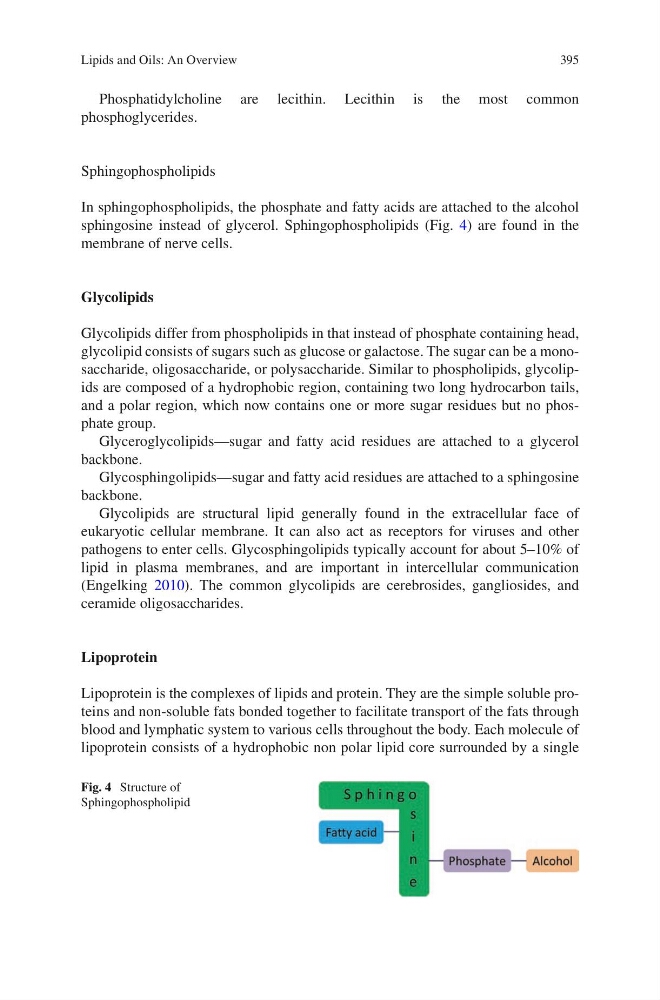
In sphingophospholipids, the phosphate and fatty acids are attached to the alcohol
sphingosine instead of glycerol. Sphingophospholipids (Fig. 4) are found in the
membrane of nerve cells.
Glycolipids
Glycolipids differ from phospholipids in that instead of phosphate containing head,
glycolipid consists of sugars such as glucose or galactose. The sugar can be a monosaccharide, oligosaccharide, or polysaccharide. Similar to phospholipids, glycolipids are composed of a hydrophobic region, containing two long hydrocarbon tails,
and a polar region, which now contains one or more sugar residues but no phosphate group.
Glyceroglycolipids—sugar and fatty acid residues are attached to a glycerol
backbone.
Glycosphingolipids—sugar and fatty acid residues are attached to a sphingosine
backbone.
Glycolipids are structural lipid generally found in the extracellular face of
eukaryotic cellular membrane. It can also act as receptors for viruses and other
pathogens to enter cells. Glycosphingolipids typically account for about 5–10% of
lipid in plasma membranes, and are important in intercellular communication
(Engelking 2010). The common glycolipids are cerebrosides, gangliosides, and
ceramide oligosaccharides.
Lipoprotein
Lipoprotein is the complexes of lipids and protein. They are the simple soluble proteins and non-soluble fats bonded together to facilitate transport of the fats through
blood and lymphatic system to various cells throughout the body. Each molecule of
lipoprotein consists of a hydrophobic non polar lipid core surrounded by a single
Fig. 4 Structure of
Sphingophospholipid
Lipids and Oils: An Overview
Phosphatidylcholine are lecithin. Lecithin is the most common
phosphoglycerides.
Sphingophospholipids
In sphingophospholipids, the phosphate and fatty acids are attached to the alcohol
sphingosine instead of glycerol. Sphingophospholipids (Fig. 4) are found in the
membrane of nerve cells.
Glycolipids
Glycolipids differ from phospholipids in that instead of phosphate containing head,
glycolipid consists of sugars such as glucose or galactose. The sugar can be a monosaccharide, oligosaccharide, or polysaccharide. Similar to phospholipids, glycolipids are composed of a hydrophobic region, containing two long hydrocarbon tails,
and a polar region, which now contains one or more sugar residues but no phosphate group.
Glyceroglycolipids—sugar and fatty acid residues are attached to a glycerol
backbone.
Glycosphingolipids—sugar and fatty acid residues are attached to a sphingosine
backbone.
Glycolipids are structural lipid generally found in the extracellular face of
eukaryotic cellular membrane. It can also act as receptors for viruses and other
pathogens to enter cells. Glycosphingolipids typically account for about 5–10% of
lipid in plasma membranes, and are important in intercellular communication
(Engelking 2010). The common glycolipids are cerebrosides, gangliosides, and
ceramide oligosaccharides.
Lipoprotein
Lipoprotein is the complexes of lipids and protein. They are the simple soluble proteins and non-soluble fats bonded together to facilitate transport of the fats through
blood and lymphatic system to various cells throughout the body. Each molecule of
lipoprotein consists of a hydrophobic non polar lipid core surrounded by a single
Fig. 4 Structure of
Sphingophospholipid
Lipids and Oils: An Overview