

394
• Phospholipids
• Glycolipids
• Lipoproteins
Phospholipids
Phospholipids are the major components of cell membranes of plants, animals, and
microorganisms. Phospholipids are modified triglycerides with one of the fatty acid
chains replaced with a phosphate group. In simpler terms, phospholipids composed
of fatty acids, nitrogenous base, phosphoric acid, and alcohol. The basic structure of
the phospholipid molecule composed of a hydrophilic “head” consisting of a phosphate group and two hydrophobic fatty acid “tails”. These two components are
joined together by a glycerol molecule.
Based on the type of alcohol attached, it is divided into two classes. They are
• Glycerophospholipids
• Sphingophospholipids
Glycerophospholipids
Glycerophospholipids or phosphoglycerides are the most common phospholipids
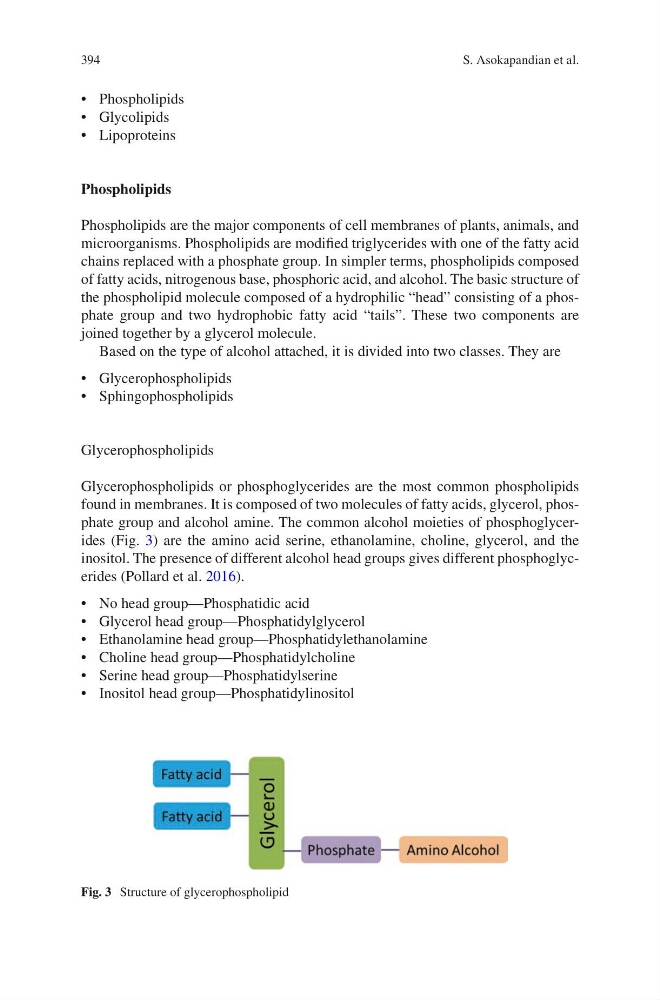
found in membranes. It is composed of two molecules of fatty acids, glycerol, phosphate group and alcohol amine. The common alcohol moieties of phosphoglycerides (Fig. 3) are the amino acid serine, ethanolamine, choline, glycerol, and the
inositol. The presence of different alcohol head groups gives different phosphoglycerides (Pollard et al. 2016).
• No head group—Phosphatidic acid
• Glycerol head group—Phosphatidylglycerol
• Ethanolamine head group—Phosphatidylethanolamine
• Choline head group—Phosphatidylcholine
• Serine head group—Phosphatidylserine
• Inositol head group—Phosphatidylinositol
Fig. 3 Structure of glycerophospholipid
S. Asokapandian et al.
• Phospholipids
• Glycolipids
• Lipoproteins
Phospholipids
Phospholipids are the major components of cell membranes of plants, animals, and
microorganisms. Phospholipids are modified triglycerides with one of the fatty acid
chains replaced with a phosphate group. In simpler terms, phospholipids composed
of fatty acids, nitrogenous base, phosphoric acid, and alcohol. The basic structure of
the phospholipid molecule composed of a hydrophilic “head” consisting of a phosphate group and two hydrophobic fatty acid “tails”. These two components are
joined together by a glycerol molecule.
Based on the type of alcohol attached, it is divided into two classes. They are
• Glycerophospholipids
• Sphingophospholipids
Glycerophospholipids
Glycerophospholipids or phosphoglycerides are the most common phospholipids
found in membranes. It is composed of two molecules of fatty acids, glycerol, phosphate group and alcohol amine. The common alcohol moieties of phosphoglycerides (Fig. 3) are the amino acid serine, ethanolamine, choline, glycerol, and the
inositol. The presence of different alcohol head groups gives different phosphoglycerides (Pollard et al. 2016).
• No head group—Phosphatidic acid
• Glycerol head group—Phosphatidylglycerol
• Ethanolamine head group—Phosphatidylethanolamine
• Choline head group—Phosphatidylcholine
• Serine head group—Phosphatidylserine
• Inositol head group—Phosphatidylinositol
Fig. 3 Structure of glycerophospholipid
S. Asokapandian et al.