

365
produced by this method. Casein nanoparticles were also prepared by simple coacervation for the oral delivery of folic acid (Penalva et al. 2015). Gelatin and gum
acacia nanoparticles were prepared by complex coacervation method to encapsulate
tannins (Xing et al. 2005).
Nano-Precipitation
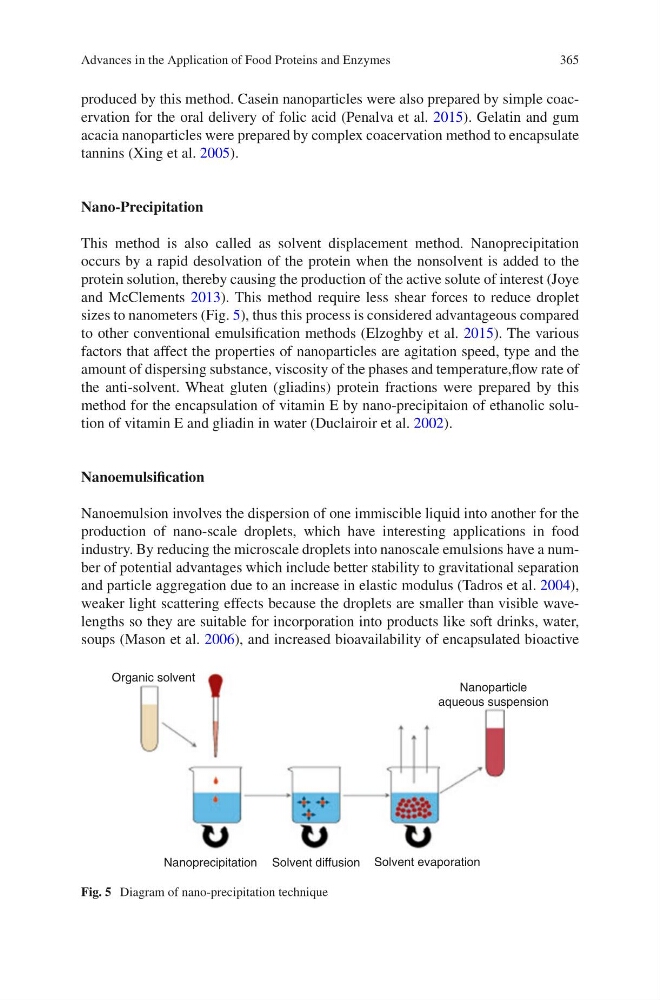
This method is also called as solvent displacement method. Nanoprecipitation
occurs by a rapid desolvation of the protein when the nonsolvent is added to the
protein solution, thereby causing the production of the active solute of interest (Joye
and McClements 2013). This method require less shear forces to reduce droplet
sizes to nanometers (Fig. 5), thus this process is considered advantageous compared
to other conventional emulsification methods (Elzoghby et al. 2015). The various
factors that affect the properties of nanoparticles are agitation speed, type and the
amount of dispersing substance, viscosity of the phases and temperature,flow rate of
the anti-solvent. Wheat gluten (gliadins) protein fractions were prepared by this
method for the encapsulation of vitamin E by nano-precipitaion of ethanolic solution of vitamin E and gliadin in water (Duclairoir et al. 2002).
Nanoemulsification
Nanoemulsion involves the dispersion of one immiscible liquid into another for the
production of nano-scale droplets, which have interesting applications in food
industry. By reducing the microscale droplets into nanoscale emulsions have a number of potential advantages which include better stability to gravitational separation
and particle aggregation due to an increase in elastic modulus (Tadros et al. 2004),
weaker light scattering effects because the droplets are smaller than visible wavelengths so they are suitable for incorporation into products like soft drinks, water,
soups (Mason et al. 2006), and increased bioavailability of encapsulated bioactive
Organic solvent
Nanoprecipitation Solvent diffusion Solvent evaporation
Nanoparticle
aqueous suspension
Fig. 5 Diagram of nano-precipitation technique
Advances in the Application of Food Proteins and Enzymes
produced by this method. Casein nanoparticles were also prepared by simple coacervation for the oral delivery of folic acid (Penalva et al. 2015). Gelatin and gum
acacia nanoparticles were prepared by complex coacervation method to encapsulate
tannins (Xing et al. 2005).
Nano-Precipitation
This method is also called as solvent displacement method. Nanoprecipitation
occurs by a rapid desolvation of the protein when the nonsolvent is added to the
protein solution, thereby causing the production of the active solute of interest (Joye
and McClements 2013). This method require less shear forces to reduce droplet
sizes to nanometers (Fig. 5), thus this process is considered advantageous compared
to other conventional emulsification methods (Elzoghby et al. 2015). The various
factors that affect the properties of nanoparticles are agitation speed, type and the
amount of dispersing substance, viscosity of the phases and temperature,flow rate of
the anti-solvent. Wheat gluten (gliadins) protein fractions were prepared by this
method for the encapsulation of vitamin E by nano-precipitaion of ethanolic solution of vitamin E and gliadin in water (Duclairoir et al. 2002).
Nanoemulsification
Nanoemulsion involves the dispersion of one immiscible liquid into another for the
production of nano-scale droplets, which have interesting applications in food
industry. By reducing the microscale droplets into nanoscale emulsions have a number of potential advantages which include better stability to gravitational separation
and particle aggregation due to an increase in elastic modulus (Tadros et al. 2004),
weaker light scattering effects because the droplets are smaller than visible wavelengths so they are suitable for incorporation into products like soft drinks, water,
soups (Mason et al. 2006), and increased bioavailability of encapsulated bioactive
Organic solvent
Nanoprecipitation Solvent diffusion Solvent evaporation
Nanoparticle
aqueous suspension
Fig. 5 Diagram of nano-precipitation technique
Advances in the Application of Food Proteins and Enzymes