

364
Coacervation
It is chemical method used for separation of two liquid phases,one being the concentrated colloidal phase called as coacervate and another being dilute colloidal
phase. By altering the temperature, dielectric, pH, constant and/or ionic strength of
the protein mixture, results in the reduction of the solubility of the protein leading
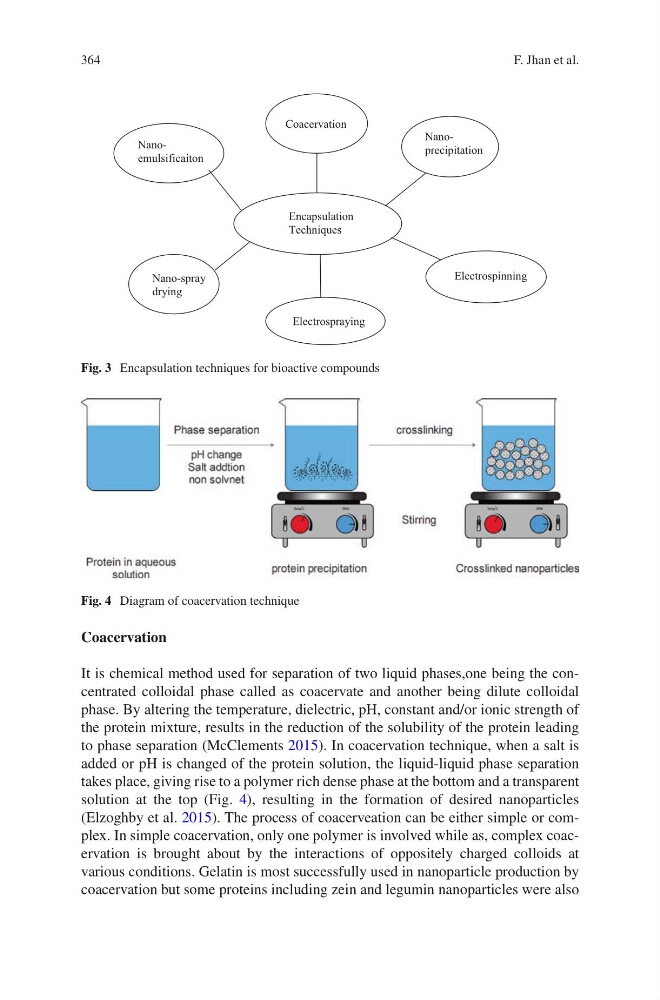
to phase separation (McClements 2015). In coacervation technique, when a salt is
added or pH is changed of the protein solution, the liquid-liquid phase separation
takes place, giving rise to a polymer rich dense phase at the bottom and a transparent
solution at the top (Fig. 4), resulting in the formation of desired nanoparticles
(Elzoghby et al. 2015). The process of coacerveation can be either simple or complex. In simple coacervation, only one polymer is involved while as, complex coacervation is brought about by the interactions of oppositely charged colloids at
various conditions. Gelatin is most successfully used in nanoparticle production by
coacervation but some proteins including zein and legumin nanoparticles were also
Encapsulation
Techniques
Nanoemulsificaiton
Coacervation
Nano-spray
drying
Electrospinning
Nanoprecipitation
Electrospraying
Fig. 3 Encapsulation techniques for bioactive compounds
Fig. 4 Diagram of coacervation technique
F. Jhan et al.
Coacervation
It is chemical method used for separation of two liquid phases,one being the concentrated colloidal phase called as coacervate and another being dilute colloidal
phase. By altering the temperature, dielectric, pH, constant and/or ionic strength of
the protein mixture, results in the reduction of the solubility of the protein leading
to phase separation (McClements 2015). In coacervation technique, when a salt is
added or pH is changed of the protein solution, the liquid-liquid phase separation
takes place, giving rise to a polymer rich dense phase at the bottom and a transparent
solution at the top (Fig. 4), resulting in the formation of desired nanoparticles
(Elzoghby et al. 2015). The process of coacerveation can be either simple or complex. In simple coacervation, only one polymer is involved while as, complex coacervation is brought about by the interactions of oppositely charged colloids at
various conditions. Gelatin is most successfully used in nanoparticle production by
coacervation but some proteins including zein and legumin nanoparticles were also
Encapsulation
Techniques
Nanoemulsificaiton
Coacervation
Nano-spray
drying
Electrospinning
Nanoprecipitation
Electrospraying
Fig. 3 Encapsulation techniques for bioactive compounds
Fig. 4 Diagram of coacervation technique
F. Jhan et al.