

366
compounds(Acosta 2009),better product texture etc. Protein-based nanoemulsion
can also be prepared using high-energy approaches including High Pressure Valve
Homogenizer, Microfluidizers, Ultrasonic Homogenizers (McClements and
Rao 2011).
Nanoemulsions Prepared by High Pressure Homogenisation
This method is the most commonly used for producing nano-emulsion in food
industry now-a-days. An emulsion is directly fed into the high pressure homogeniser,
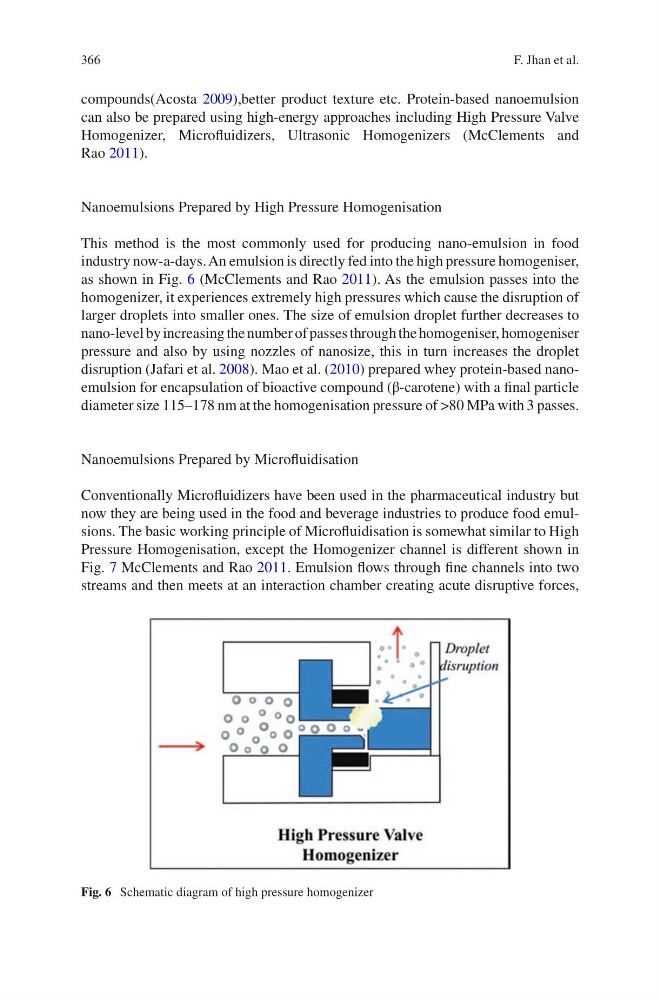
as shown in Fig. 6 (McClements and Rao 2011). As the emulsion passes into the
homogenizer, it experiences extremely high pressures which cause the disruption of
larger droplets into smaller ones. The size of emulsion droplet further decreases to
nano-level by increasing the number of passes through the homogeniser, homogeniser
pressure and also by using nozzles of nanosize, this in turn increases the droplet
disruption (Jafari et al. 2008). Mao et al. (2010) prepared whey protein-based nanoemulsion for encapsulation of bioactive compound (β-carotene) with a final particle
diameter size 115–178 nm at the homogenisation pressure of >80 MPa with 3 passes.
Nanoemulsions Prepared by Microfluidisation
Conventionally Microfluidizers have been used in the pharmaceutical industry but
now they are being used in the food and beverage industries to produce food emulsions. The basic working principle of Microfluidisation is somewhat similar to High
Pressure Homogenisation, except the Homogenizer channel is different shown in
Fig. 7 McClements and Rao 2011. Emulsion flows through fine channels into two
streams and then meets at an interaction chamber creating acute disruptive forces,
Fig. 6 Schematic diagram of high pressure homogenizer
F. Jhan et al.
compounds(Acosta 2009),better product texture etc. Protein-based nanoemulsion
can also be prepared using high-energy approaches including High Pressure Valve
Homogenizer, Microfluidizers, Ultrasonic Homogenizers (McClements and
Rao 2011).
Nanoemulsions Prepared by High Pressure Homogenisation
This method is the most commonly used for producing nano-emulsion in food
industry now-a-days. An emulsion is directly fed into the high pressure homogeniser,
as shown in Fig. 6 (McClements and Rao 2011). As the emulsion passes into the
homogenizer, it experiences extremely high pressures which cause the disruption of
larger droplets into smaller ones. The size of emulsion droplet further decreases to
nano-level by increasing the number of passes through the homogeniser, homogeniser
pressure and also by using nozzles of nanosize, this in turn increases the droplet
disruption (Jafari et al. 2008). Mao et al. (2010) prepared whey protein-based nanoemulsion for encapsulation of bioactive compound (β-carotene) with a final particle
diameter size 115–178 nm at the homogenisation pressure of >80 MPa with 3 passes.
Nanoemulsions Prepared by Microfluidisation
Conventionally Microfluidizers have been used in the pharmaceutical industry but
now they are being used in the food and beverage industries to produce food emulsions. The basic working principle of Microfluidisation is somewhat similar to High
Pressure Homogenisation, except the Homogenizer channel is different shown in
Fig. 7 McClements and Rao 2011. Emulsion flows through fine channels into two
streams and then meets at an interaction chamber creating acute disruptive forces,
Fig. 6 Schematic diagram of high pressure homogenizer
F. Jhan et al.