

196
with Ba
2+
were not reported. The cross linking with trivalent ions were found to possess greater that 75% of drug retention at much lower concentrations as compared
to divalent metal ions (Ba
2+
, Ca
2+
, Cu
2+
and Cd
2+
). This may be due to the high
valency of trivalent ion (Thimma and Tammishetti 2001). Microencapsulation of
Papain with carboxymethylated flamboyant seed gum was found to have a better
papain release rate under simulated Intestinal pH conditions than Carboxymethylated
Guar gum suggesting it could be an effective delivery system in anti-inflammatory
or preventative treatment of gastric or duodenal ulcers (Betancur-Ancona et al. 2011).
Cross-Linking of Gums
The hydrophilicity of natural gums allows them to swell in cold water or other dissolution media. This allows the possibility of entrapped drug leakage prior to the
arrival of drug at the site of absorption. This enormous swelling of the gums can be
reduced by cross linking. The properties of cross linked gum derivatives depends
mainly on their cross linking density, ratio of number of moles of cross linking
agent to the moles of polymer repeating units. The type of interactions forming
depends upon the nature of the cross linking agents in the network. The cross linked
gums or derivatives are of three types: (1) Hybrid polymer network formed by the
reaction between a structural unit of a gum or its derivatives and the structural unit
of another polymeric chain of another type. (2) Semi or fully interpenetrating polymer network contains a non-reacting polymer added to the gum or it’s derivate
before cross linking leading to the formation of cross linked gum in which non
reacting polymer is entrapped (3) ionically cross linked gums may be formed in the
presence of negatively charged entities which form bridges between the positively
charged polymeric chains. Various crosslinking agents are used for cross linking of
different gums.
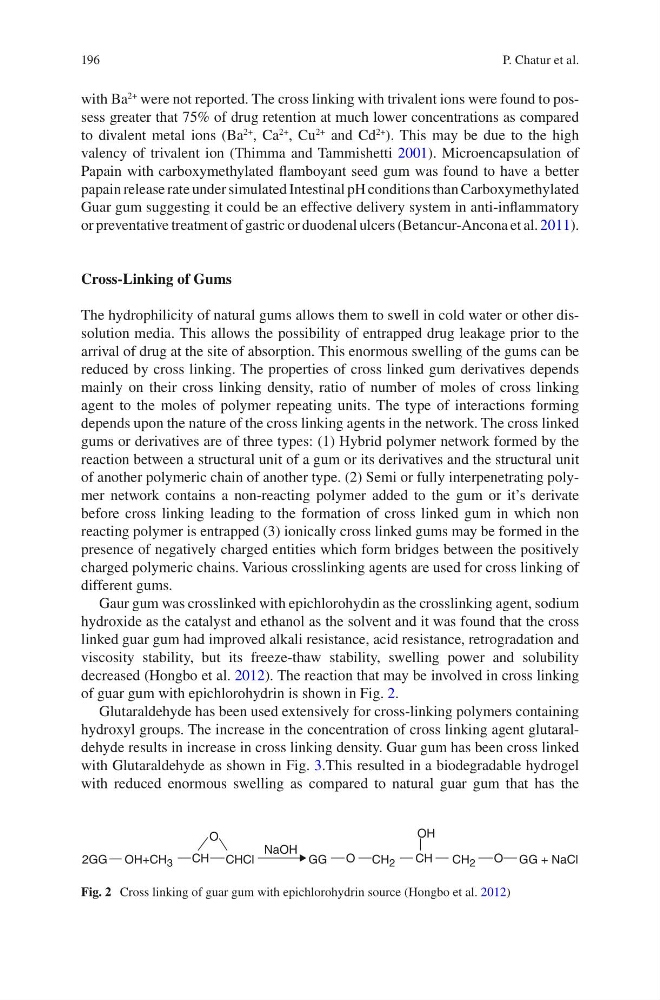
Gaur gum was crosslinked with epichlorohydin as the crosslinking agent, sodium
hydroxide as the catalyst and ethanol as the solvent and it was found that the cross
linked guar gum had improved alkali resistance, acid resistance, retrogradation and
viscosity stability, but its freeze-thaw stability, swelling power and solubility
decreased (Hongbo et al. 2012). The reaction that may be involved in cross linking
of guar gum with epichlorohydrin is shown in Fig. 2.
Glutaraldehyde has been used extensively for cross-linking polymers containing
hydroxyl groups. The increase in the concentration of cross linking agent glutaraldehyde results in increase in cross linking density. Guar gum has been cross linked
with Glutaraldehyde as shown in Fig. 3.This resulted in a biodegradable hydrogel
with reduced enormous swelling as compared to natural guar gum that has the
2GG
CH
CH
GG
GG + NaCl
CHCl
O
OH
O
O
NaOH
OH+CH 3
CH 2
CH 2
Fig. 2 Cross linking of guar gum with epichlorohydrin source (Hongbo et al. 2012)
P. Chatur et al.
with Ba
2+
were not reported. The cross linking with trivalent ions were found to possess greater that 75% of drug retention at much lower concentrations as compared
to divalent metal ions (Ba
2+
, Ca
2+
, Cu
2+
and Cd
2+
). This may be due to the high
valency of trivalent ion (Thimma and Tammishetti 2001). Microencapsulation of
Papain with carboxymethylated flamboyant seed gum was found to have a better
papain release rate under simulated Intestinal pH conditions than Carboxymethylated
Guar gum suggesting it could be an effective delivery system in anti-inflammatory
or preventative treatment of gastric or duodenal ulcers (Betancur-Ancona et al. 2011).
Cross-Linking of Gums
The hydrophilicity of natural gums allows them to swell in cold water or other dissolution media. This allows the possibility of entrapped drug leakage prior to the
arrival of drug at the site of absorption. This enormous swelling of the gums can be
reduced by cross linking. The properties of cross linked gum derivatives depends
mainly on their cross linking density, ratio of number of moles of cross linking
agent to the moles of polymer repeating units. The type of interactions forming
depends upon the nature of the cross linking agents in the network. The cross linked
gums or derivatives are of three types: (1) Hybrid polymer network formed by the
reaction between a structural unit of a gum or its derivatives and the structural unit
of another polymeric chain of another type. (2) Semi or fully interpenetrating polymer network contains a non-reacting polymer added to the gum or it’s derivate
before cross linking leading to the formation of cross linked gum in which non
reacting polymer is entrapped (3) ionically cross linked gums may be formed in the
presence of negatively charged entities which form bridges between the positively
charged polymeric chains. Various crosslinking agents are used for cross linking of
different gums.
Gaur gum was crosslinked with epichlorohydin as the crosslinking agent, sodium
hydroxide as the catalyst and ethanol as the solvent and it was found that the cross
linked guar gum had improved alkali resistance, acid resistance, retrogradation and
viscosity stability, but its freeze-thaw stability, swelling power and solubility
decreased (Hongbo et al. 2012). The reaction that may be involved in cross linking
of guar gum with epichlorohydrin is shown in Fig. 2.
Glutaraldehyde has been used extensively for cross-linking polymers containing
hydroxyl groups. The increase in the concentration of cross linking agent glutaraldehyde results in increase in cross linking density. Guar gum has been cross linked
with Glutaraldehyde as shown in Fig. 3.This resulted in a biodegradable hydrogel
with reduced enormous swelling as compared to natural guar gum that has the
2GG
CH
CH
GG
GG + NaCl
CHCl
O
OH
O
O
NaOH
OH+CH 3
CH 2
CH 2
Fig. 2 Cross linking of guar gum with epichlorohydrin source (Hongbo et al. 2012)
P. Chatur et al.