

195
The various modification methods and their effect on physiochemical properties
of various gums are discussed below:
Methods for Modification of Gums
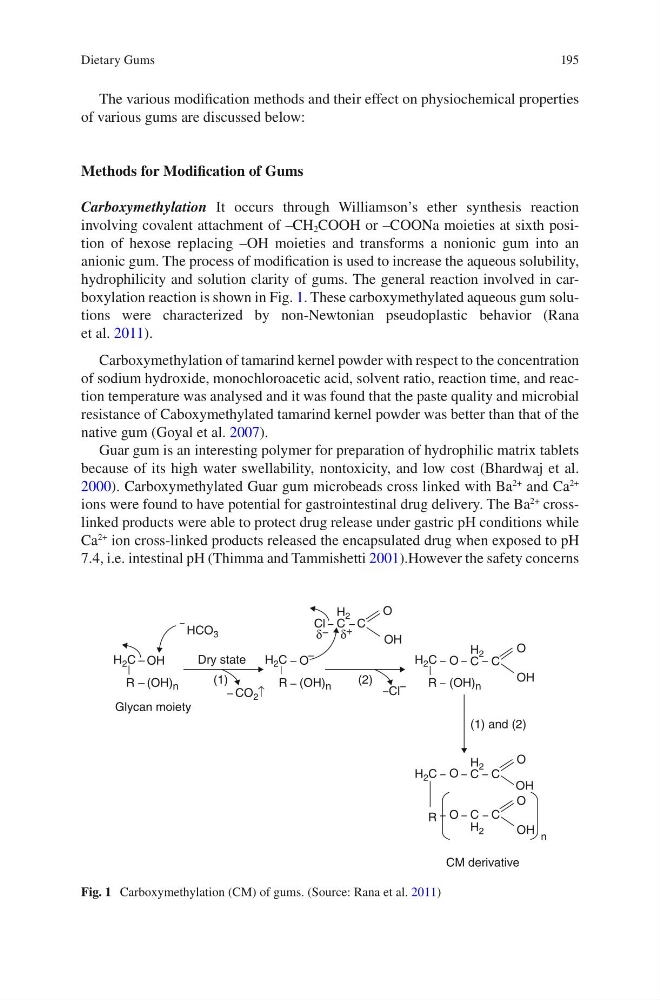
Carboxymethylation It occurs through Williamson’s ether synthesis reaction
involving covalent attachment of –CH 2 COOH or –COONa moieties at sixth position of hexose replacing –OH moieties and transforms a nonionic gum into an
anionic gum. The process of modification is used to increase the aqueous solubility,
hydrophilicity and solution clarity of gums. The general reaction involved in carboxylation reaction is shown in Fig. 1. These carboxymethylated aqueous gum solutions were characterized by non-Newtonian pseudoplastic behavior (Rana
et al. 2011).
Carboxymethylation of tamarind kernel powder with respect to the concentration
of sodium hydroxide, monochloroacetic acid, solvent ratio, reaction time, and reaction temperature was analysed and it was found that the paste quality and microbial
resistance of Caboxymethylated tamarind kernel powder was better than that of the
native gum (Goyal et al. 2007).
Guar gum is an interesting polymer for preparation of hydrophilic matrix tablets
because of its high water swellability, nontoxicity, and low cost (Bhardwaj et al.
2000). Carboxymethylated Guar gum microbeads cross linked with Ba
2+
and Ca
2+
ions were found to have potential for gastrointestinal drug delivery. The Ba
2+
crosslinked products were able to protect drug release under gastric pH conditions while
Ca
2+
ion cross-linked products released the encapsulated drug when exposed to pH
7.4, i.e. intestinal pH (Thimma and Tammishetti 2001).However the safety concerns
+
H 2 C
H 2 C
H 2 C
H 2 C
H 2
HCO 3
CO 2
OH
O
O
Cl
Cl
(1)
(2)
(1) and (2)
↑
δ
δ
Glycan moiety
Dry state
R
R
R
R
(OH) n
(OH) n
(OH) n
OH
OH
O
O
OH
O
OH
O
C
C
H 2
C
O
CM derivative
O
H 2
H 2
C
C C
C
C
n
Fig. 1 Carboxymethylation (CM) of gums. (Source: Rana et al. 2011)
Dietary Gums
The various modification methods and their effect on physiochemical properties
of various gums are discussed below:
Methods for Modification of Gums
Carboxymethylation It occurs through Williamson’s ether synthesis reaction
involving covalent attachment of –CH 2 COOH or –COONa moieties at sixth position of hexose replacing –OH moieties and transforms a nonionic gum into an
anionic gum. The process of modification is used to increase the aqueous solubility,
hydrophilicity and solution clarity of gums. The general reaction involved in carboxylation reaction is shown in Fig. 1. These carboxymethylated aqueous gum solutions were characterized by non-Newtonian pseudoplastic behavior (Rana
et al. 2011).
Carboxymethylation of tamarind kernel powder with respect to the concentration
of sodium hydroxide, monochloroacetic acid, solvent ratio, reaction time, and reaction temperature was analysed and it was found that the paste quality and microbial
resistance of Caboxymethylated tamarind kernel powder was better than that of the
native gum (Goyal et al. 2007).
Guar gum is an interesting polymer for preparation of hydrophilic matrix tablets
because of its high water swellability, nontoxicity, and low cost (Bhardwaj et al.
2000). Carboxymethylated Guar gum microbeads cross linked with Ba
2+
and Ca
2+
ions were found to have potential for gastrointestinal drug delivery. The Ba
2+
crosslinked products were able to protect drug release under gastric pH conditions while
Ca
2+
ion cross-linked products released the encapsulated drug when exposed to pH
7.4, i.e. intestinal pH (Thimma and Tammishetti 2001).However the safety concerns
+
H 2 C
H 2 C
H 2 C
H 2 C
H 2
HCO 3
CO 2
OH
O
O
Cl
Cl
(1)
(2)
(1) and (2)
↑
δ
δ
Glycan moiety
Dry state
R
R
R
R
(OH) n
(OH) n
(OH) n
OH
OH
O
O
OH
O
OH
O
C
C
H 2
C
O
CM derivative
O
H 2
H 2
C
C C
C
C
n
Fig. 1 Carboxymethylation (CM) of gums. (Source: Rana et al. 2011)
Dietary Gums