

197
ability to retain poorly soluble drugs such as indomethacin and budesonide in artificial gastrointestinal fluids (Kabir et al. 1998).
Xanthan gum was modified by treatment with mannitol and the Modified xanthan gum obtained was found to be biodegradable, directly compressible and exhibited desirable swelling dynamics to be used as a hydrophilic excipient for rapidly
disintegrating tablets Roxithromycin. The modified xanthan gum was found to
retain drugs under in-vitro conditions for about 12 months (Sharma and Pathak 2013).
Ultrasonic Modification of Gums
Ultrasonic technology has also been used for the modification of polysaccharides
and certain gums such as pectin, chitin, starch, carrageenan and guar gum. The
ultrasound is capable of causing physical and chemical transformations through
acoustic cavitation (Mohod and Gogate 2011) but require fluid for cavitation to be
generated.
Generally, sonication breaks polymer chains at the center, which structurally is
the weakest point. Molecules with high molecular weight and long chain length are
more often broken at the center, than shorter and stiffer chains. Furthermore, the
linear polymer chains are more easily sonolysed compared to branched ones.
Therefore the initial molecular weight of the polymers play an important role in the
overall degradation rate. As polymers are broken down, a point is reached where the
chains becomes so short and stiff that further degradation is not possible and a lower
molecular weight limit is attained (Zhang et al. 2013). The only way to overcome
the lower limit is to increase the energy density of the sound field. It is worth noting
that longer-chained molecules lead to higher solution viscosity which also affects
the rate of cavitation (Sotanaphun et al. 2012).
The degradation of carrageenan by sonication was investigated and it was found
that the rate of degradation increased with increased intensity, time, and reduced pH
and concentration (Zhou and Ma 2006). The degradation was found more in
+
+
+
+
+
+
+
O
HC(CH 2 ) 3 CH+
HC(CH 2 ) 3 CH
HC(CH 2 ) 3 CH
C(CH 2)3C
C(CH 2)3C
-2H2O
HC(CH 2 ) 3 CH
2H +
O
O
O
O
O
O
O
OH
OH
OH
OH
OH
OH
OH
OH
OH
OH
OH
HO
H
H
H
H
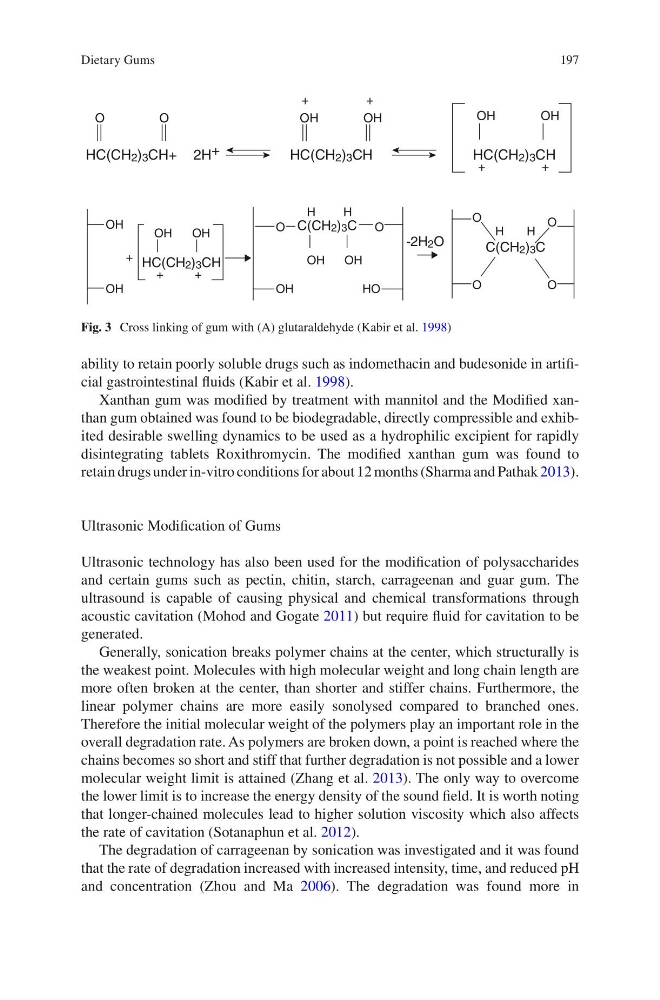
Fig. 3 Cross linking of gum with (A) glutaraldehyde (Kabir et al. 1998)
Dietary Gums
ability to retain poorly soluble drugs such as indomethacin and budesonide in artificial gastrointestinal fluids (Kabir et al. 1998).
Xanthan gum was modified by treatment with mannitol and the Modified xanthan gum obtained was found to be biodegradable, directly compressible and exhibited desirable swelling dynamics to be used as a hydrophilic excipient for rapidly
disintegrating tablets Roxithromycin. The modified xanthan gum was found to
retain drugs under in-vitro conditions for about 12 months (Sharma and Pathak 2013).
Ultrasonic Modification of Gums
Ultrasonic technology has also been used for the modification of polysaccharides
and certain gums such as pectin, chitin, starch, carrageenan and guar gum. The
ultrasound is capable of causing physical and chemical transformations through
acoustic cavitation (Mohod and Gogate 2011) but require fluid for cavitation to be
generated.
Generally, sonication breaks polymer chains at the center, which structurally is
the weakest point. Molecules with high molecular weight and long chain length are
more often broken at the center, than shorter and stiffer chains. Furthermore, the
linear polymer chains are more easily sonolysed compared to branched ones.
Therefore the initial molecular weight of the polymers play an important role in the
overall degradation rate. As polymers are broken down, a point is reached where the
chains becomes so short and stiff that further degradation is not possible and a lower
molecular weight limit is attained (Zhang et al. 2013). The only way to overcome
the lower limit is to increase the energy density of the sound field. It is worth noting
that longer-chained molecules lead to higher solution viscosity which also affects
the rate of cavitation (Sotanaphun et al. 2012).
The degradation of carrageenan by sonication was investigated and it was found
that the rate of degradation increased with increased intensity, time, and reduced pH
and concentration (Zhou and Ma 2006). The degradation was found more in
+
+
+
+
+
+
+
O
HC(CH 2 ) 3 CH+
HC(CH 2 ) 3 CH
HC(CH 2 ) 3 CH
C(CH 2)3C
C(CH 2)3C
-2H2O
HC(CH 2 ) 3 CH
2H +
O
O
O
O
O
O
O
OH
OH
OH
OH
OH
OH
OH
OH
OH
OH
OH
HO
H
H
H
H
Fig. 3 Cross linking of gum with (A) glutaraldehyde (Kabir et al. 1998)
Dietary Gums