

6
Amylose and amylopectin molecules are packaged into semi-crystalline aggregates and these aggregates are systematically packaged into starch granules. In
these tightly packaged starch granules, the starch molecules have little affinity for
water and are not functional (Blanshard 1987). The amylose content of starch varies: waxy, normal, and high-amylose starch consist of 0–8%, 20–30%, and more
than 40% amylose, respectively (Li et al. 2008a, b). Branch chains of amylopectin
form double helices and contribute to the crystalline structure of the granules,
whereas amylose is amorphous and interspersed among amylopectin molecules
(Jane et al. 1992).
Amylose and amylopectin do not exist free in nature, but as components of discrete, semicrystalline aggregates called granules. The size, shape, and structure of
granules varies among botanical sources (Table 2). The diameters of the granules
generally range from less than 1 μm to more than 100 μm, regular (spherical, ovoid,
or angular) or quite irregular shapes. Wheat, barley, and rye granules exhibit two
separate distributions of granule sizes and distinctly different shapes. Some granules, such as those in oats and rice, have a higher level of structure in which many
small, individual granules are cohesively bound together in an organized manner.
These are called compound starch granules. Although the major components of all
types of starch granules are amylose and amylopectin polymers, there is great diversity in the structure and characteristics of native starch granules.
Table 1 Characteristic
features of amylose and
amylopectin
Characteristic
Amylose
Amylopectin
Structure
Linear
Branched
Linkages
α-1,4
α-1,4 and α-1,6
Molecular weight <0.5 million 50–500 million
Gel formation
Firm
Soft
Color with iodine Blue
Reddish brown
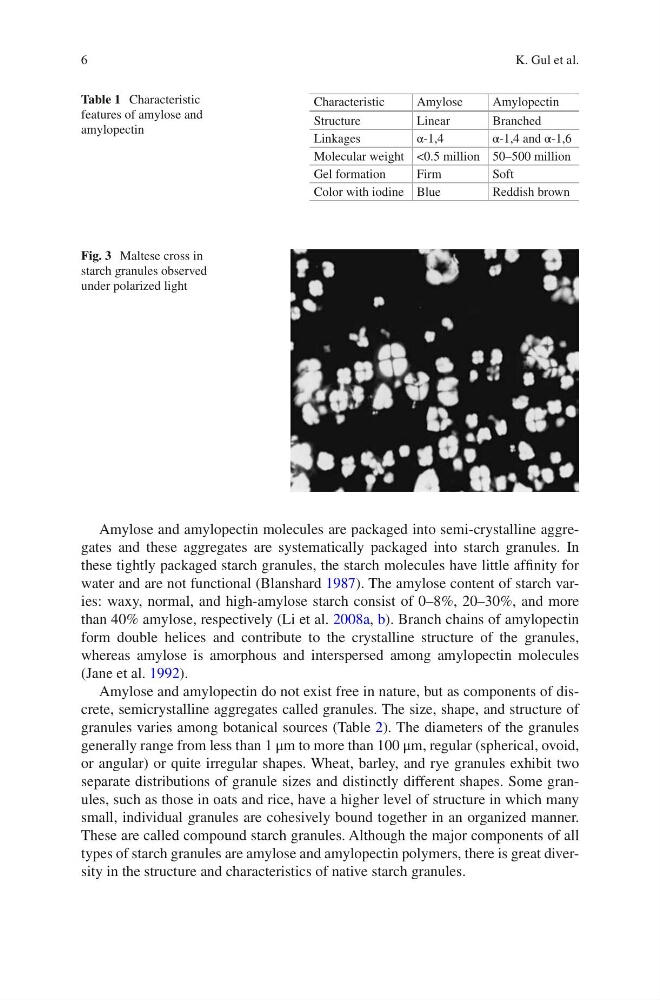
Fig. 3 Maltese cross in
starch granules observed
under polarized light
K. Gul et al.
Amylose and amylopectin molecules are packaged into semi-crystalline aggregates and these aggregates are systematically packaged into starch granules. In
these tightly packaged starch granules, the starch molecules have little affinity for
water and are not functional (Blanshard 1987). The amylose content of starch varies: waxy, normal, and high-amylose starch consist of 0–8%, 20–30%, and more
than 40% amylose, respectively (Li et al. 2008a, b). Branch chains of amylopectin
form double helices and contribute to the crystalline structure of the granules,
whereas amylose is amorphous and interspersed among amylopectin molecules
(Jane et al. 1992).
Amylose and amylopectin do not exist free in nature, but as components of discrete, semicrystalline aggregates called granules. The size, shape, and structure of
granules varies among botanical sources (Table 2). The diameters of the granules
generally range from less than 1 μm to more than 100 μm, regular (spherical, ovoid,
or angular) or quite irregular shapes. Wheat, barley, and rye granules exhibit two
separate distributions of granule sizes and distinctly different shapes. Some granules, such as those in oats and rice, have a higher level of structure in which many
small, individual granules are cohesively bound together in an organized manner.
These are called compound starch granules. Although the major components of all
types of starch granules are amylose and amylopectin polymers, there is great diversity in the structure and characteristics of native starch granules.
Table 1 Characteristic
features of amylose and
amylopectin
Characteristic
Amylose
Amylopectin
Structure
Linear
Branched
Linkages
α-1,4
α-1,4 and α-1,6
Molecular weight <0.5 million 50–500 million
Gel formation
Firm
Soft
Color with iodine Blue
Reddish brown
Fig. 3 Maltese cross in
starch granules observed
under polarized light
K. Gul et al.