

7
Physicochemical and Functional Characteristics of Starch
Starch when heated in excess of water results in the disruption of crystalline structure, due to breakage of hydrogen bonds, and water molecules form hydrogen bonds
to the exposed hydroxyl groups of amylose and amylopectin. This results in an
increase in granule swelling and solubility. Swelling power and solubility provide
evidence of the magnitude of interaction between starch chains within the amorphous and crystalline domains. The extent of this interaction is influenced by the
amylose/amylopectin ratio, and by the characteristics of amylose and amylopectin
in terms of molecular weight distribution, degree of branching, length of branches
and conformation of the molecules. Amylose-lipid complexes have been shown to
restrict swelling and solubilization (Hoover and Hadziyev 1981). Swelling power
provides an evidence of non-covalent bonding between starch molecules. Factors
that determine the degree of swelling and solubility include amylose-amylopectin
ratio, chain length and molecular weight distribution, degree/length of branching
and conformation.
Starch Gelatinization and Retrogradation
Gelatinization is an endothermic process resulting in the disruption of molecular
order of the starch granules. Double helical and crystalline structures are disrupted
in starches during gelatinization. The granules are disrupted with absorption of
water, losing their organized molecular structure, to facilitate swelling (GarcíaAlonso et al. 1999). Native starches are insoluble in cold water and gelatinization is
essential to facilitate water absorption and enhance their chemical and physical
properties, to suit food processing industries. An increase in temperature causes the
starch crystallites to break apart and undergo hydration. This results in several
changes such as granular swelling, native crystalline melting, loss of birefringence,
and starch solubilization (Atwell et al. 1988). Gelatinization is a two-step process,
first the starch granules swell due to breakage of hydrogen bonds in the amorphous
portions and in the next event, water acts as a plasticizer, resulting in hydration and
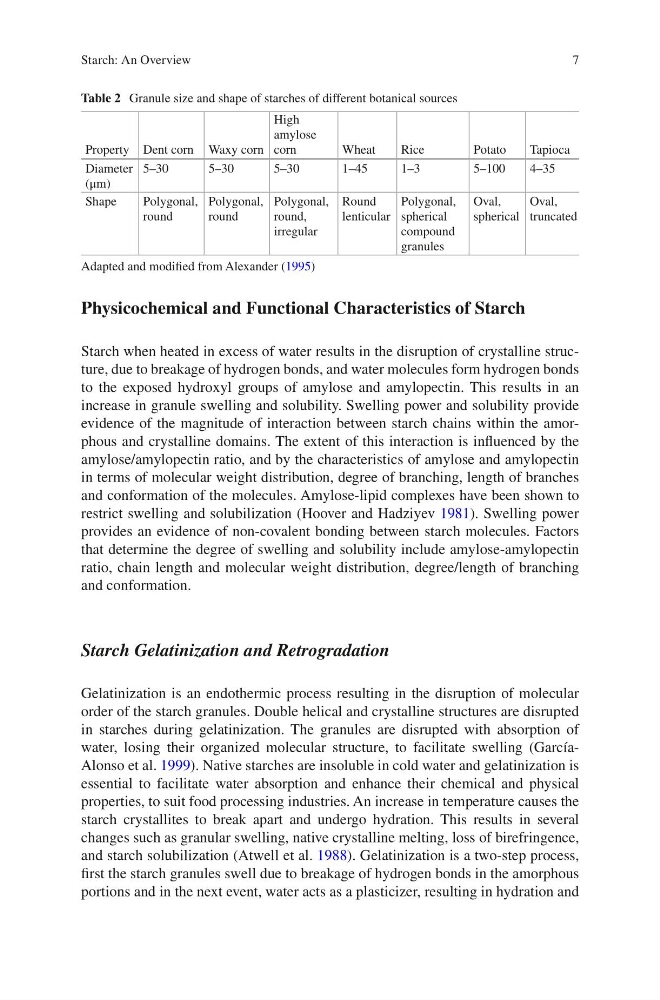
Table 2 Granule size and shape of starches of different botanical sources
Property Dent corn Waxy corn
High
amylose
corn
Wheat
Rice
Potato
Tapioca
Diameter
(μm)
5–30
5–30
5–30
1–45
1–3
5–100
4–35
Shape
Polygonal,
round
Polygonal,
round
Polygonal,
round,
irregular
Round
lenticular
Polygonal,
spherical
compound
granules
Oval,
spherical
Oval,
truncated
Adapted and modified from Alexander (1995)
Starch: An Overview
Physicochemical and Functional Characteristics of Starch
Starch when heated in excess of water results in the disruption of crystalline structure, due to breakage of hydrogen bonds, and water molecules form hydrogen bonds
to the exposed hydroxyl groups of amylose and amylopectin. This results in an
increase in granule swelling and solubility. Swelling power and solubility provide
evidence of the magnitude of interaction between starch chains within the amorphous and crystalline domains. The extent of this interaction is influenced by the
amylose/amylopectin ratio, and by the characteristics of amylose and amylopectin
in terms of molecular weight distribution, degree of branching, length of branches
and conformation of the molecules. Amylose-lipid complexes have been shown to
restrict swelling and solubilization (Hoover and Hadziyev 1981). Swelling power
provides an evidence of non-covalent bonding between starch molecules. Factors
that determine the degree of swelling and solubility include amylose-amylopectin
ratio, chain length and molecular weight distribution, degree/length of branching
and conformation.
Starch Gelatinization and Retrogradation
Gelatinization is an endothermic process resulting in the disruption of molecular
order of the starch granules. Double helical and crystalline structures are disrupted
in starches during gelatinization. The granules are disrupted with absorption of
water, losing their organized molecular structure, to facilitate swelling (GarcíaAlonso et al. 1999). Native starches are insoluble in cold water and gelatinization is
essential to facilitate water absorption and enhance their chemical and physical
properties, to suit food processing industries. An increase in temperature causes the
starch crystallites to break apart and undergo hydration. This results in several
changes such as granular swelling, native crystalline melting, loss of birefringence,
and starch solubilization (Atwell et al. 1988). Gelatinization is a two-step process,
first the starch granules swell due to breakage of hydrogen bonds in the amorphous
portions and in the next event, water acts as a plasticizer, resulting in hydration and
Table 2 Granule size and shape of starches of different botanical sources
Property Dent corn Waxy corn
High
amylose
corn
Wheat
Rice
Potato
Tapioca
Diameter
(μm)
5–30
5–30
5–30
1–45
1–3
5–100
4–35
Shape
Polygonal,
round
Polygonal,
round
Polygonal,
round,
irregular
Round
lenticular
Polygonal,
spherical
compound
granules
Oval,
spherical
Oval,
truncated
Adapted and modified from Alexander (1995)
Starch: An Overview