

5
on the botanical source. Differences in external granule morphology are generally
sufficient to provide unambiguous characterization of the botanical source, via optical microscopy.
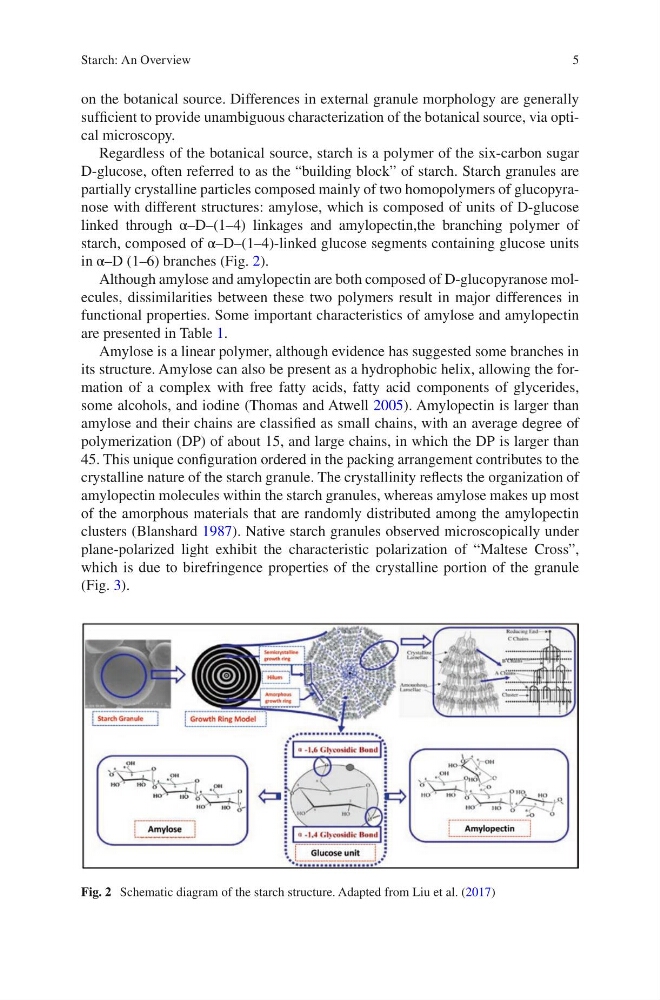
Regardless of the botanical source, starch is a polymer of the six-carbon sugar
D-glucose, often referred to as the “building block” of starch. Starch granules are
partially crystalline particles composed mainly of two homopolymers of glucopyranose with different structures: amylose, which is composed of units of D-glucose
linked through α–D–(1–4) linkages and amylopectin,the branching polymer of
starch, composed of α–D–(1–4)-linked glucose segments containing glucose units
in α–D (1–6) branches (Fig. 2).
Although amylose and amylopectin are both composed of D-glucopyranose molecules, dissimilarities between these two polymers result in major differences in
functional properties. Some important characteristics of amylose and amylopectin
are presented in Table 1.
Amylose is a linear polymer, although evidence has suggested some branches in
its structure. Amylose can also be present as a hydrophobic helix, allowing the formation of a complex with free fatty acids, fatty acid components of glycerides,
some alcohols, and iodine (Thomas and Atwell 2005). Amylopectin is larger than
amylose and their chains are classified as small chains, with an average degree of
polymerization (DP) of about 15, and large chains, in which the DP is larger than
45. This unique configuration ordered in the packing arrangement contributes to the
crystalline nature of the starch granule. The crystallinity reflects the organization of
amylopectin molecules within the starch granules, whereas amylose makes up most
of the amorphous materials that are randomly distributed among the amylopectin
clusters (Blanshard 1987). Native starch granules observed microscopically under
plane-polarized light exhibit the characteristic polarization of “Maltese Cross”,
which is due to birefringence properties of the crystalline portion of the granule
(Fig. 3).
Fig. 2 Schematic diagram of the starch structure. Adapted from Liu et al. (2017)
Starch: An Overview
on the botanical source. Differences in external granule morphology are generally
sufficient to provide unambiguous characterization of the botanical source, via optical microscopy.
Regardless of the botanical source, starch is a polymer of the six-carbon sugar
D-glucose, often referred to as the “building block” of starch. Starch granules are
partially crystalline particles composed mainly of two homopolymers of glucopyranose with different structures: amylose, which is composed of units of D-glucose
linked through α–D–(1–4) linkages and amylopectin,the branching polymer of
starch, composed of α–D–(1–4)-linked glucose segments containing glucose units
in α–D (1–6) branches (Fig. 2).
Although amylose and amylopectin are both composed of D-glucopyranose molecules, dissimilarities between these two polymers result in major differences in
functional properties. Some important characteristics of amylose and amylopectin
are presented in Table 1.
Amylose is a linear polymer, although evidence has suggested some branches in
its structure. Amylose can also be present as a hydrophobic helix, allowing the formation of a complex with free fatty acids, fatty acid components of glycerides,
some alcohols, and iodine (Thomas and Atwell 2005). Amylopectin is larger than
amylose and their chains are classified as small chains, with an average degree of
polymerization (DP) of about 15, and large chains, in which the DP is larger than
45. This unique configuration ordered in the packing arrangement contributes to the
crystalline nature of the starch granule. The crystallinity reflects the organization of
amylopectin molecules within the starch granules, whereas amylose makes up most
of the amorphous materials that are randomly distributed among the amylopectin
clusters (Blanshard 1987). Native starch granules observed microscopically under
plane-polarized light exhibit the characteristic polarization of “Maltese Cross”,
which is due to birefringence properties of the crystalline portion of the granule
(Fig. 3).
Fig. 2 Schematic diagram of the starch structure. Adapted from Liu et al. (2017)
Starch: An Overview