

4
native and modified form accounts for 99% of the world production. The importance of starch, both biologically and technologically, is well known, as is its central
role in the human diet. Starches have an enormous number of food uses, including
adhesive, binding, clouding, dusting, film forming, foam strengthening, anti-staling,
gelling, glazing, moisture retaining, stabilizing, texturizing, and thickening applications. The demand of starch has increased enormously in recent years as starch is
being widely used in production of ethanol and biodegradable plastics (Wani et al.
2012) apart from being used in food processing industries (Gul et al. 2014). Native
starches when cooked can easily retrograde and there is a gelling tendency of pastes
besides easily undergoing syneresis. Therefore, starches are modified primarily to
overcome the shortcomings of native starches and increase their usefulness for
industrial applications. To meet specific requirements or demands, different modification methods such as physical, chemical, and enzymatic have been used to
enhance or inhibit their inherent properties or to endow specific properties of starch.
Starch Chemistry
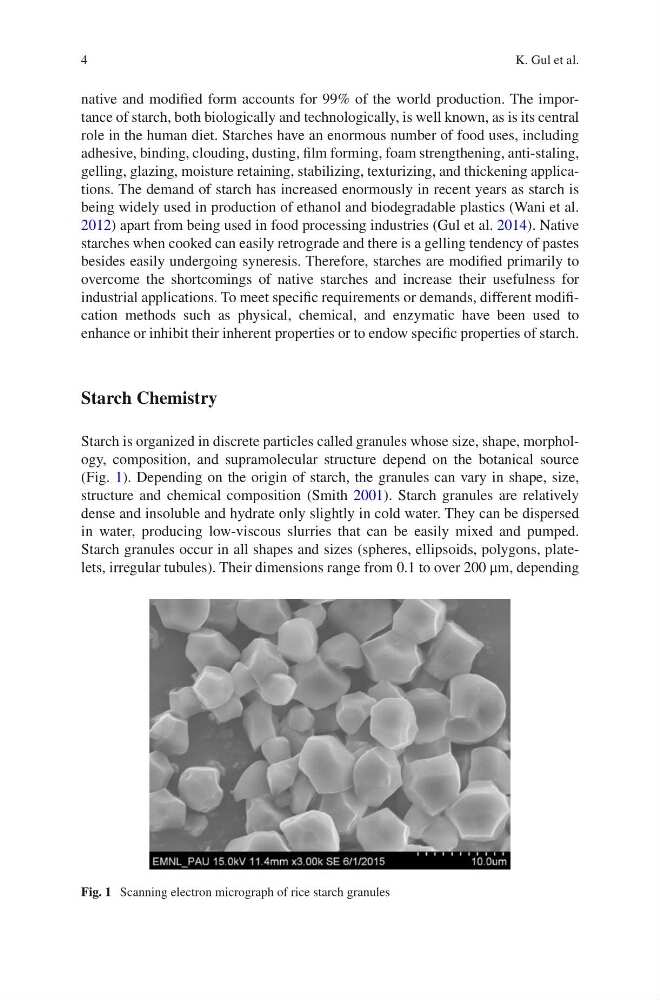
Starch is organized in discrete particles called granules whose size, shape, morphology, composition, and supramolecular structure depend on the botanical source
(Fig. 1). Depending on the origin of starch, the granules can vary in shape, size,
structure and chemical composition (Smith 2001). Starch granules are relatively
dense and insoluble and hydrate only slightly in cold water. They can be dispersed
in water, producing low-viscous slurries that can be easily mixed and pumped.
Starch granules occur in all shapes and sizes (spheres, ellipsoids, polygons, platelets, irregular tubules). Their dimensions range from 0.1 to over 200 μm, depending
Fig. 1 Scanning electron micrograph of rice starch granules
K. Gul et al.
native and modified form accounts for 99% of the world production. The importance of starch, both biologically and technologically, is well known, as is its central
role in the human diet. Starches have an enormous number of food uses, including
adhesive, binding, clouding, dusting, film forming, foam strengthening, anti-staling,
gelling, glazing, moisture retaining, stabilizing, texturizing, and thickening applications. The demand of starch has increased enormously in recent years as starch is
being widely used in production of ethanol and biodegradable plastics (Wani et al.
2012) apart from being used in food processing industries (Gul et al. 2014). Native
starches when cooked can easily retrograde and there is a gelling tendency of pastes
besides easily undergoing syneresis. Therefore, starches are modified primarily to
overcome the shortcomings of native starches and increase their usefulness for
industrial applications. To meet specific requirements or demands, different modification methods such as physical, chemical, and enzymatic have been used to
enhance or inhibit their inherent properties or to endow specific properties of starch.
Starch Chemistry
Starch is organized in discrete particles called granules whose size, shape, morphology, composition, and supramolecular structure depend on the botanical source
(Fig. 1). Depending on the origin of starch, the granules can vary in shape, size,
structure and chemical composition (Smith 2001). Starch granules are relatively
dense and insoluble and hydrate only slightly in cold water. They can be dispersed
in water, producing low-viscous slurries that can be easily mixed and pumped.
Starch granules occur in all shapes and sizes (spheres, ellipsoids, polygons, platelets, irregular tubules). Their dimensions range from 0.1 to over 200 μm, depending
Fig. 1 Scanning electron micrograph of rice starch granules
K. Gul et al.