

88
5 Flux Pinning Phenomena
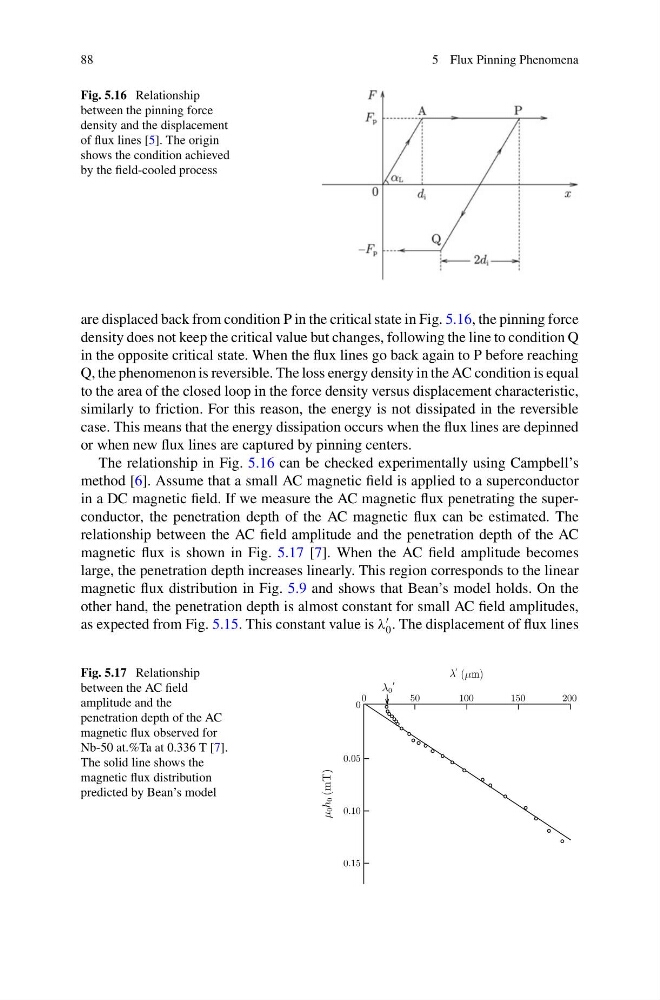
Fig. 5.16 Relationship
between the pinning force
density and the displacement
of flux lines [5]. The origin
shows the condition achieved
by the field-cooled process
are displaced back from condition P in the critical state in Fig. 5.16, the pinning force
density does not keep the critical value but changes, following the line to condition Q
in the opposite critical state. When the flux lines go back again to P before reaching
Q, the phenomenon is reversible. The loss energy density in the AC condition is equal
to the area of the closed loop in the force density versus displacement characteristic,
similarly to friction. For this reason, the energy is not dissipated in the reversible
case. This means that the energy dissipation occurs when the flux lines are depinned
or when new flux lines are captured by pinning centers.
The relationship in Fig. 5.16 can be checked experimentally using Campbell’s
method [6]. Assume that a small AC magnetic field is applied to a superconductor
in a DC magnetic field. If we measure the AC magnetic flux penetrating the superconductor, the penetration depth of the AC magnetic flux can be estimated. The
relationship between the AC field amplitude and the penetration depth of the AC
magnetic flux is shown in Fig. 5.17 [7]. When the AC field amplitude becomes
large, the penetration depth increases linearly. This region corresponds to the linear
magnetic flux distribution in Fig. 5.9 and shows that Bean’s model holds. On the
other hand, the penetration depth is almost constant for small AC field amplitudes,
as expected from Fig. 5.15. This constant value is λ
0 . The displacement of flux lines
Fig. 5.17 Relationship
between the AC field
amplitude and the
penetration depth of the AC
magnetic flux observed for
Nb-50 at.%Ta at 0.336 T [7].
The solid line shows the
magnetic flux distribution
predicted by Bean’s model
5 Flux Pinning Phenomena
Fig. 5.16 Relationship
between the pinning force
density and the displacement
of flux lines [5]. The origin
shows the condition achieved
by the field-cooled process
are displaced back from condition P in the critical state in Fig. 5.16, the pinning force
density does not keep the critical value but changes, following the line to condition Q
in the opposite critical state. When the flux lines go back again to P before reaching
Q, the phenomenon is reversible. The loss energy density in the AC condition is equal
to the area of the closed loop in the force density versus displacement characteristic,
similarly to friction. For this reason, the energy is not dissipated in the reversible
case. This means that the energy dissipation occurs when the flux lines are depinned
or when new flux lines are captured by pinning centers.
The relationship in Fig. 5.16 can be checked experimentally using Campbell’s
method [6]. Assume that a small AC magnetic field is applied to a superconductor
in a DC magnetic field. If we measure the AC magnetic flux penetrating the superconductor, the penetration depth of the AC magnetic flux can be estimated. The
relationship between the AC field amplitude and the penetration depth of the AC
magnetic flux is shown in Fig. 5.17 [7]. When the AC field amplitude becomes
large, the penetration depth increases linearly. This region corresponds to the linear
magnetic flux distribution in Fig. 5.9 and shows that Bean’s model holds. On the
other hand, the penetration depth is almost constant for small AC field amplitudes,
as expected from Fig. 5.15. This constant value is λ
0 . The displacement of flux lines
Fig. 5.17 Relationship
between the AC field
amplitude and the
penetration depth of the AC
magnetic flux observed for
Nb-50 at.%Ta at 0.336 T [7].
The solid line shows the
magnetic flux distribution
predicted by Bean’s model