

5.3 Reversible Flux Motion
87
b(x) = μ 0 h 0 exp
−
x
λ
0
,
(5.51)
where λ
0 is Campbell’s AC penetration depth [4], given by
λ
0 =
B
2
μ 0 α L
1/2
.
(5.52)
This length is the characteristic length of the above-mentioned spatial variation in
the current density from J c to −J c . If the pinning strength is increased, i.e., α L is
increased, λ
0 becomes shorter. The displacement of flux lines u also has a functional
form similar to (5.51).
Just after the change in the external magnetic field from the increasing process
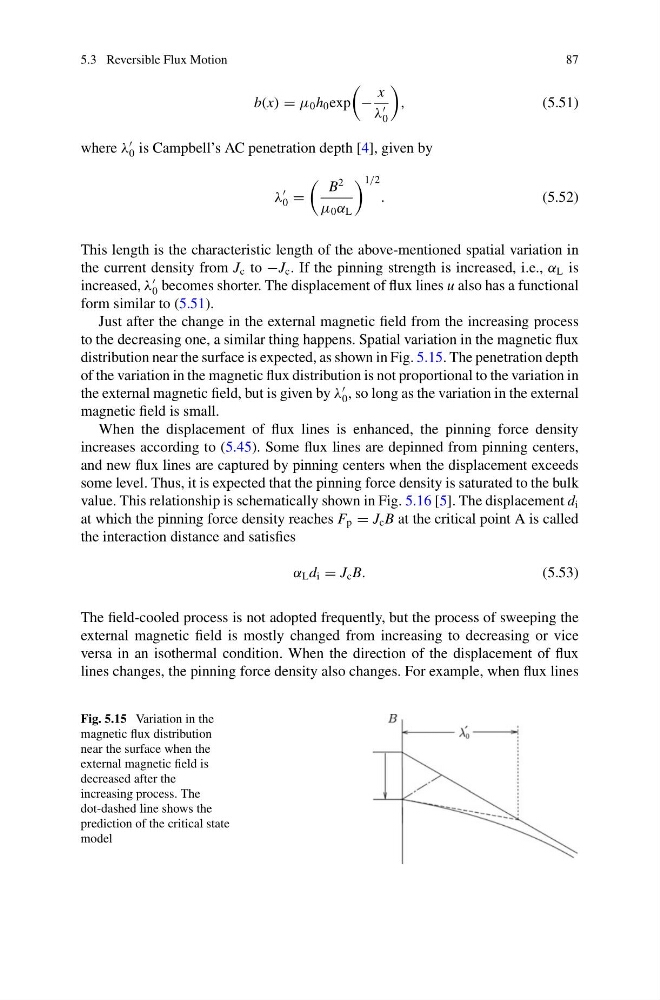
to the decreasing one, a similar thing happens. Spatial variation in the magnetic flux
distribution near the surface is expected, as shown in Fig. 5.15. The penetration depth
of the variation in the magnetic flux distribution is not proportional to the variation in
the external magnetic field, but is given by λ
0 , so long as the variation in the external
magnetic field is small.
When the displacement of flux lines is enhanced, the pinning force density
increases according to (5.45). Some flux lines are depinned from pinning centers,
and new flux lines are captured by pinning centers when the displacement exceeds
some level. Thus, it is expected that the pinning force density is saturated to the bulk
value. This relationship is schematically shown in Fig. 5.16 [5]. The displacement d i
at which the pinning force density reaches F p = J c B at the critical point A is called
the interaction distance and satisfies
α L d i = J c B.
(5.53)
The field-cooled process is not adopted frequently, but the process of sweeping the
external magnetic field is mostly changed from increasing to decreasing or vice
versa in an isothermal condition. When the direction of the displacement of flux
lines changes, the pinning force density also changes. For example, when flux lines
Fig. 5.15 Variation in the
magnetic flux distribution
near the surface when the
external magnetic field is
decreased after the
increasing process. The
dot-dashed line shows the
prediction of the critical state
model
87
b(x) = μ 0 h 0 exp
−
x
λ
0
,
(5.51)
where λ
0 is Campbell’s AC penetration depth [4], given by
λ
0 =
B
2
μ 0 α L
1/2
.
(5.52)
This length is the characteristic length of the above-mentioned spatial variation in
the current density from J c to −J c . If the pinning strength is increased, i.e., α L is
increased, λ
0 becomes shorter. The displacement of flux lines u also has a functional
form similar to (5.51).
Just after the change in the external magnetic field from the increasing process
to the decreasing one, a similar thing happens. Spatial variation in the magnetic flux
distribution near the surface is expected, as shown in Fig. 5.15. The penetration depth
of the variation in the magnetic flux distribution is not proportional to the variation in
the external magnetic field, but is given by λ
0 , so long as the variation in the external
magnetic field is small.
When the displacement of flux lines is enhanced, the pinning force density
increases according to (5.45). Some flux lines are depinned from pinning centers,
and new flux lines are captured by pinning centers when the displacement exceeds
some level. Thus, it is expected that the pinning force density is saturated to the bulk
value. This relationship is schematically shown in Fig. 5.16 [5]. The displacement d i
at which the pinning force density reaches F p = J c B at the critical point A is called
the interaction distance and satisfies
α L d i = J c B.
(5.53)
The field-cooled process is not adopted frequently, but the process of sweeping the
external magnetic field is mostly changed from increasing to decreasing or vice
versa in an isothermal condition. When the direction of the displacement of flux
lines changes, the pinning force density also changes. For example, when flux lines
Fig. 5.15 Variation in the
magnetic flux distribution
near the surface when the
external magnetic field is
decreased after the
increasing process. The
dot-dashed line shows the
prediction of the critical state
model