

5.1 Flux Pinning Mechanism
71
grain boundary
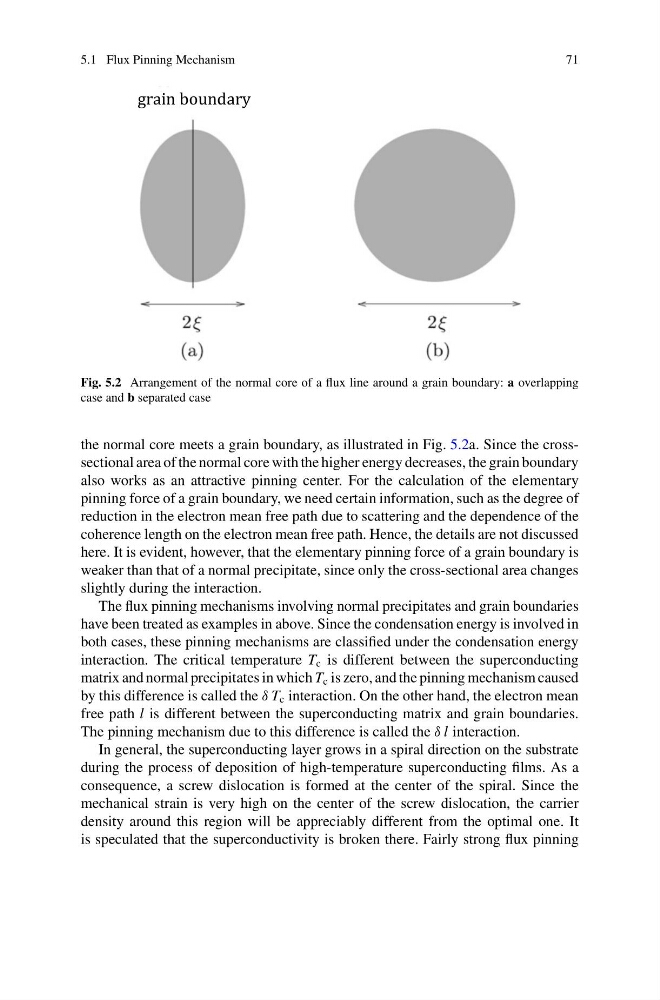
Fig. 5.2 Arrangement of the normal core of a flux line around a grain boundary: a overlapping
case and b separated case
the normal core meets a grain boundary, as illustrated in Fig. 5.2a. Since the crosssectional area of the normal core with the higher energy decreases, the grain boundary
also works as an attractive pinning center. For the calculation of the elementary
pinning force of a grain boundary, we need certain information, such as the degree of
reduction in the electron mean free path due to scattering and the dependence of the
coherence length on the electron mean free path. Hence, the details are not discussed
here. It is evident, however, that the elementary pinning force of a grain boundary is
weaker than that of a normal precipitate, since only the cross-sectional area changes
slightly during the interaction.
The flux pinning mechanisms involving normal precipitates and grain boundaries
have been treated as examples in above. Since the condensation energy is involved in
both cases, these pinning mechanisms are classified under the condensation energy
interaction. The critical temperature T c is different between the superconducting
matrix and normal precipitates in which T c is zero, and the pinning mechanism caused
by this difference is called the δ T c interaction. On the other hand, the electron mean
free path l is different between the superconducting matrix and grain boundaries.
The pinning mechanism due to this difference is called the δ l interaction.
In general, the superconducting layer grows in a spiral direction on the substrate
during the process of deposition of high-temperature superconducting films. As a
consequence, a screw dislocation is formed at the center of the spiral. Since the
mechanical strain is very high on the center of the screw dislocation, the carrier
density around this region will be appreciably different from the optimal one. It
is speculated that the superconductivity is broken there. Fairly strong flux pinning
71
grain boundary
Fig. 5.2 Arrangement of the normal core of a flux line around a grain boundary: a overlapping
case and b separated case
the normal core meets a grain boundary, as illustrated in Fig. 5.2a. Since the crosssectional area of the normal core with the higher energy decreases, the grain boundary
also works as an attractive pinning center. For the calculation of the elementary
pinning force of a grain boundary, we need certain information, such as the degree of
reduction in the electron mean free path due to scattering and the dependence of the
coherence length on the electron mean free path. Hence, the details are not discussed
here. It is evident, however, that the elementary pinning force of a grain boundary is
weaker than that of a normal precipitate, since only the cross-sectional area changes
slightly during the interaction.
The flux pinning mechanisms involving normal precipitates and grain boundaries
have been treated as examples in above. Since the condensation energy is involved in
both cases, these pinning mechanisms are classified under the condensation energy
interaction. The critical temperature T c is different between the superconducting
matrix and normal precipitates in which T c is zero, and the pinning mechanism caused
by this difference is called the δ T c interaction. On the other hand, the electron mean
free path l is different between the superconducting matrix and grain boundaries.
The pinning mechanism due to this difference is called the δ l interaction.
In general, the superconducting layer grows in a spiral direction on the substrate
during the process of deposition of high-temperature superconducting films. As a
consequence, a screw dislocation is formed at the center of the spiral. Since the
mechanical strain is very high on the center of the screw dislocation, the carrier
density around this region will be appreciably different from the optimal one. It
is speculated that the superconductivity is broken there. Fairly strong flux pinning