

70
5 Flux Pinning Phenomena
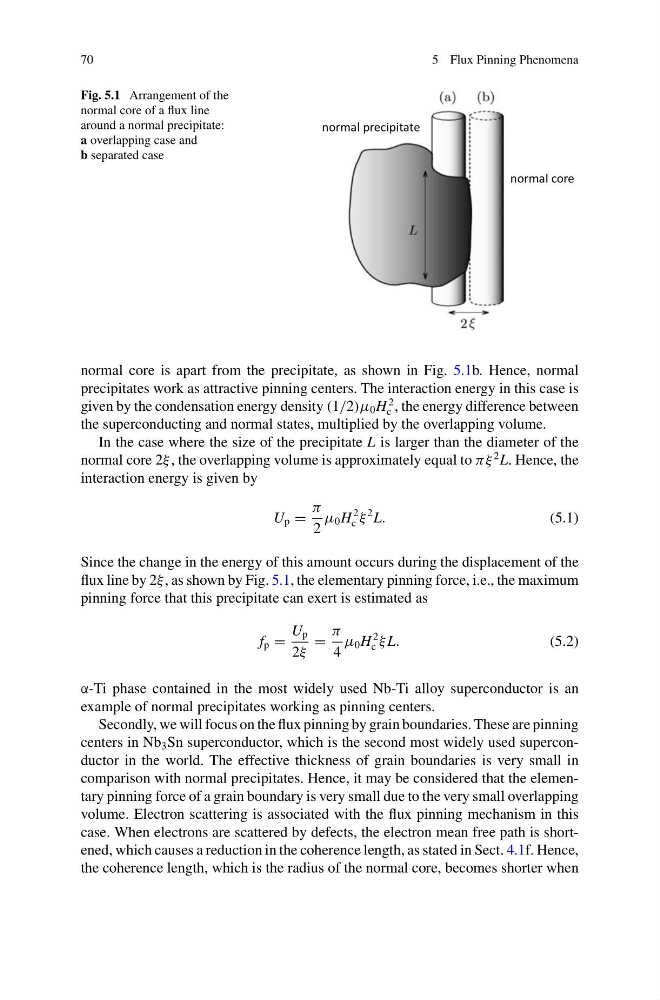
Fig. 5.1 Arrangement of the
normal core of a flux line
around a normal precipitate:
a overlapping case and
b separated case
normal precipitate
normal core
normal core is apart from the precipitate, as shown in Fig. 5.1b. Hence, normal
precipitates work as attractive pinning centers. The interaction energy in this case is
given by the condensation energy density (1/2)μ 0 H
2
c , the energy difference between
the superconducting and normal states, multiplied by the overlapping volume.
In the case where the size of the precipitate L is larger than the diameter of the
normal core 2ξ , the overlapping volume is approximately equal to πξ
2 L. Hence, the
interaction energy is given by
U p =
π
2
μ 0 H
2
c ξ
2 L.
(5.1)
Since the change in the energy of this amount occurs during the displacement of the
flux line by 2ξ , as shown by Fig. 5.1, the elementary pinning force, i.e., the maximum
pinning force that this precipitate can exert is estimated as
f p =
U p
2ξ
=
π
4
μ 0 H
2
c ξ L.
(5.2)
α-Ti phase contained in the most widely used Nb-Ti alloy superconductor is an
example of normal precipitates working as pinning centers.
Secondly, we will focus on the flux pinning by grain boundaries. These are pinning
centers in Nb 3 Sn superconductor, which is the second most widely used superconductor in the world. The effective thickness of grain boundaries is very small in
comparison with normal precipitates. Hence, it may be considered that the elementary pinning force of a grain boundary is very small due to the very small overlapping
volume. Electron scattering is associated with the flux pinning mechanism in this
case. When electrons are scattered by defects, the electron mean free path is shortened, which causes a reduction in the coherence length, as stated in Sect. 4.1f. Hence,
the coherence length, which is the radius of the normal core, becomes shorter when
5 Flux Pinning Phenomena
Fig. 5.1 Arrangement of the
normal core of a flux line
around a normal precipitate:
a overlapping case and
b separated case
normal precipitate
normal core
normal core is apart from the precipitate, as shown in Fig. 5.1b. Hence, normal
precipitates work as attractive pinning centers. The interaction energy in this case is
given by the condensation energy density (1/2)μ 0 H
2
c , the energy difference between
the superconducting and normal states, multiplied by the overlapping volume.
In the case where the size of the precipitate L is larger than the diameter of the
normal core 2ξ , the overlapping volume is approximately equal to πξ
2 L. Hence, the
interaction energy is given by
U p =
π
2
μ 0 H
2
c ξ
2 L.
(5.1)
Since the change in the energy of this amount occurs during the displacement of the
flux line by 2ξ , as shown by Fig. 5.1, the elementary pinning force, i.e., the maximum
pinning force that this precipitate can exert is estimated as
f p =
U p
2ξ
=
π
4
μ 0 H
2
c ξ L.
(5.2)
α-Ti phase contained in the most widely used Nb-Ti alloy superconductor is an
example of normal precipitates working as pinning centers.
Secondly, we will focus on the flux pinning by grain boundaries. These are pinning
centers in Nb 3 Sn superconductor, which is the second most widely used superconductor in the world. The effective thickness of grain boundaries is very small in
comparison with normal precipitates. Hence, it may be considered that the elementary pinning force of a grain boundary is very small due to the very small overlapping
volume. Electron scattering is associated with the flux pinning mechanism in this
case. When electrons are scattered by defects, the electron mean free path is shortened, which causes a reduction in the coherence length, as stated in Sect. 4.1f. Hence,
the coherence length, which is the radius of the normal core, becomes shorter when