

72
5 Flux Pinning Phenomena
by screw dislocations in high-temperature superconductors is also explained by the
condensation energy interaction.
Niobium was introduced into Nb-Ti as a material for pinning centers. Since Nb
itself is a superconductor with almost the same T c as the superconducting matrix, the
condensation energy is not involved in the pinning mechanism. On the other hand,
the upper critical field and hence, the coherence length of Nb is significantly different
from those of the matrix. For this reason, the free energy associated with the flux
pinning is the kinetic energy given by the second term in the brackets of (4.32).
The elementary pinning mechanism is explained for various cases above. The
pinning force density observed in practice is given by the sum of individual pinning
forces contained in a macroscopic scale volume. Assume a superconductor that
contains pinning centers with the number density N p and the elementary pinning
force f p . The mathematical problem of estimating the pinning force density F p as a
function of N p and f p is called the summation problem. Most simply, we can assume
the relationship
F p = N p f p .
(5.3)
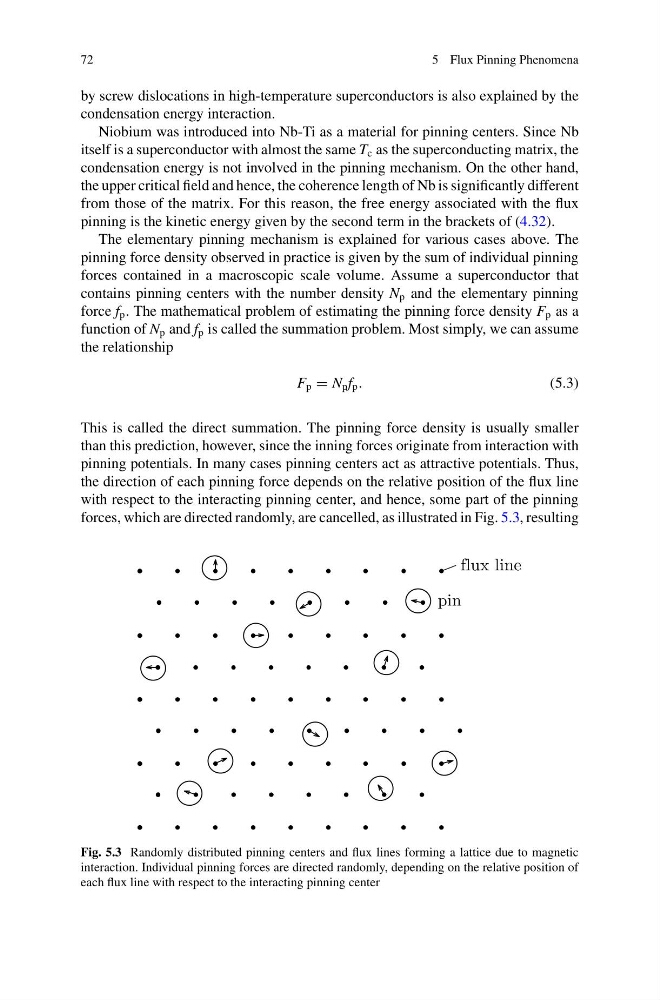
This is called the direct summation. The pinning force density is usually smaller
than this prediction, however, since the inning forces originate from interaction with
pinning potentials. In many cases pinning centers act as attractive potentials. Thus,
the direction of each pinning force depends on the relative position of the flux line
with respect to the interacting pinning center, and hence, some part of the pinning
forces, which are directed randomly, are cancelled, as illustrated in Fig. 5.3, resulting
Fig. 5.3 Randomly distributed pinning centers and flux lines forming a lattice due to magnetic
interaction. Individual pinning forces are directed randomly, depending on the relative position of
each flux line with respect to the interacting pinning center
5 Flux Pinning Phenomena
by screw dislocations in high-temperature superconductors is also explained by the
condensation energy interaction.
Niobium was introduced into Nb-Ti as a material for pinning centers. Since Nb
itself is a superconductor with almost the same T c as the superconducting matrix, the
condensation energy is not involved in the pinning mechanism. On the other hand,
the upper critical field and hence, the coherence length of Nb is significantly different
from those of the matrix. For this reason, the free energy associated with the flux
pinning is the kinetic energy given by the second term in the brackets of (4.32).
The elementary pinning mechanism is explained for various cases above. The
pinning force density observed in practice is given by the sum of individual pinning
forces contained in a macroscopic scale volume. Assume a superconductor that
contains pinning centers with the number density N p and the elementary pinning
force f p . The mathematical problem of estimating the pinning force density F p as a
function of N p and f p is called the summation problem. Most simply, we can assume
the relationship
F p = N p f p .
(5.3)
This is called the direct summation. The pinning force density is usually smaller
than this prediction, however, since the inning forces originate from interaction with
pinning potentials. In many cases pinning centers act as attractive potentials. Thus,
the direction of each pinning force depends on the relative position of the flux line
with respect to the interacting pinning center, and hence, some part of the pinning
forces, which are directed randomly, are cancelled, as illustrated in Fig. 5.3, resulting
Fig. 5.3 Randomly distributed pinning centers and flux lines forming a lattice due to magnetic
interaction. Individual pinning forces are directed randomly, depending on the relative position of
each flux line with respect to the interacting pinning center