

34
3 Effects of the Introduction of Superconductivity into Electromagnetism
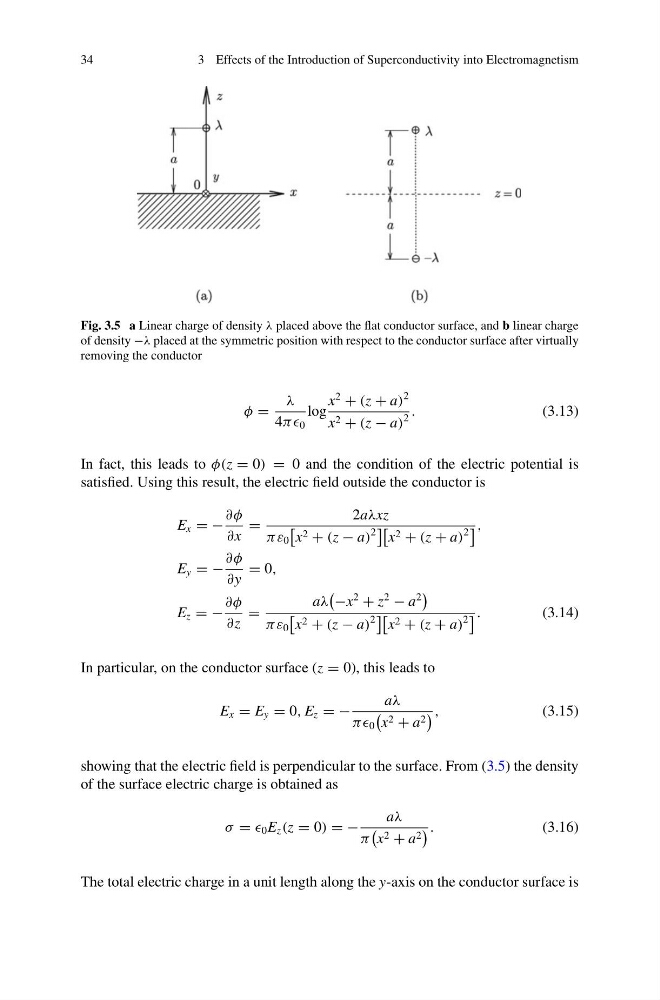
Fig. 3.5 a Linear charge of density λ placed above the flat conductor surface, and b linear charge
of density −λ placed at the symmetric position with respect to the conductor surface after virtually
removing the conductor
φ =
λ
4ππ 0
log
x
2
+ (z + a)
2
x 2 + (z − a)
2
.
(3.13)
In fact, this leads to φ(z = 0) = 0 and the condition of the electric potential is
satisfied. Using this result, the electric field outside the conductor is
E x = −
∂φ
∂x
=
2aλxz
πε 0
x 2 + (z − a)
2
x 2 + (z + a)
2
,
E y = −
∂φ
∂y
= 0,
E z = −
∂φ
∂z
=
aλ
−x
2
+ z
2
− a
2
πε 0
x 2 + (z − a)
2
x 2 + (z + a)
2
.
(3.14)
In particular, on the conductor surface (z = 0), this leads to
E x = E y = 0, E z = −
aλ
ππ 0
x 2 + a 2
,
(3.15)
showing that the electric field is perpendicular to the surface. From (3.5) the density
of the surface electric charge is obtained as
σ = 0 E z (z = 0) = −
aλ
π
x 2 + a 2
.
(3.16)
The total electric charge in a unit length along the y-axis on the conductor surface is
3 Effects of the Introduction of Superconductivity into Electromagnetism
Fig. 3.5 a Linear charge of density λ placed above the flat conductor surface, and b linear charge
of density −λ placed at the symmetric position with respect to the conductor surface after virtually
removing the conductor
φ =
λ
4ππ 0
log
x
2
+ (z + a)
2
x 2 + (z − a)
2
.
(3.13)
In fact, this leads to φ(z = 0) = 0 and the condition of the electric potential is
satisfied. Using this result, the electric field outside the conductor is
E x = −
∂φ
∂x
=
2aλxz
πε 0
x 2 + (z − a)
2
x 2 + (z + a)
2
,
E y = −
∂φ
∂y
= 0,
E z = −
∂φ
∂z
=
aλ
−x
2
+ z
2
− a
2
πε 0
x 2 + (z − a)
2
x 2 + (z + a)
2
.
(3.14)
In particular, on the conductor surface (z = 0), this leads to
E x = E y = 0, E z = −
aλ
ππ 0
x 2 + a 2
,
(3.15)
showing that the electric field is perpendicular to the surface. From (3.5) the density
of the surface electric charge is obtained as
σ = 0 E z (z = 0) = −
aλ
π
x 2 + a 2
.
(3.16)
The total electric charge in a unit length along the y-axis on the conductor surface is