

32
3 Effects of the Introduction of Superconductivity into Electromagnetism
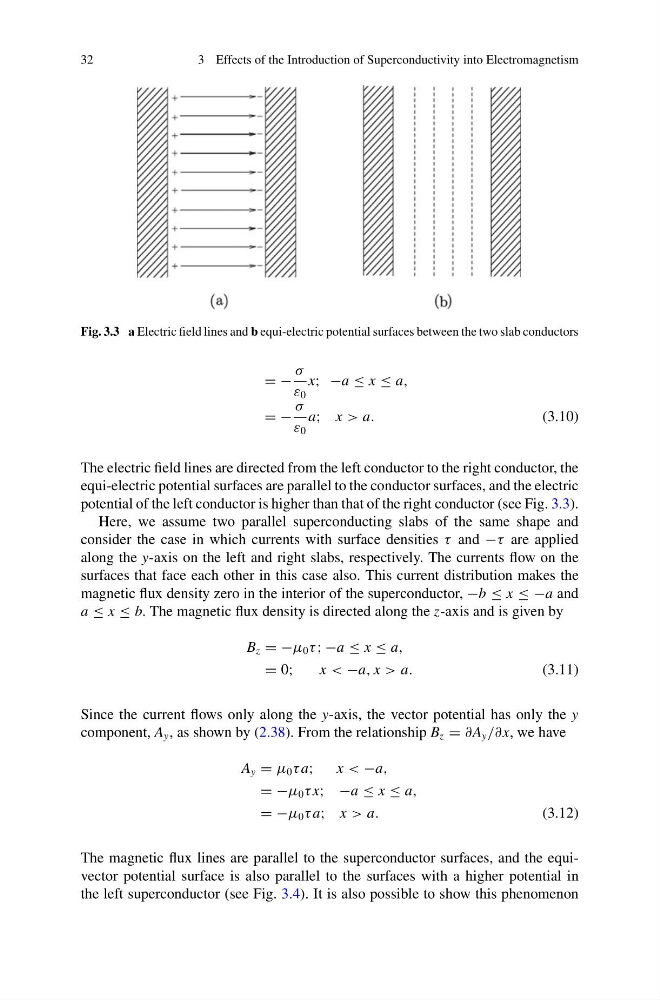
Fig. 3.3 a Electric field lines and b equi-electric potential surfaces between the two slab conductors
= −
σ
ε 0
x; −a ≤ x ≤ a,
= −
σ
ε 0
a; x > a.
(3.10)
The electric field lines are directed from the left conductor to the right conductor, the
equi-electric potential surfaces are parallel to the conductor surfaces, and the electric
potential of the left conductor is higher than that of the right conductor (see Fig. 3.3).
Here, we assume two parallel superconducting slabs of the same shape and
consider the case in which currents with surface densities τ and −τ are applied
along the y-axis on the left and right slabs, respectively. The currents flow on the
surfaces that face each other in this case also. This current distribution makes the
magnetic flux density zero in the interior of the superconductor, −b ≤ x ≤ −a and
a ≤ x ≤ b. The magnetic flux density is directed along the z-axis and is given by
B z = −μ 0 τ ; −a ≤ x ≤ a,
= 0;
x < −a, x > a.
(3.11)
Since the current flows only along the y-axis, the vector potential has only the y
component, A y , as shown by (2.38). From the relationship B z = ∂A y /∂x, we have
A y = μ 0 τ a;
x < −a,
= −μ 0 τ x; −a ≤ x ≤ a,
= −μ 0 τ a; x > a.
(3.12)
The magnetic flux lines are parallel to the superconductor surfaces, and the equivector potential surface is also parallel to the surfaces with a higher potential in
the left superconductor (see Fig. 3.4). It is also possible to show this phenomenon
3 Effects of the Introduction of Superconductivity into Electromagnetism
Fig. 3.3 a Electric field lines and b equi-electric potential surfaces between the two slab conductors
= −
σ
ε 0
x; −a ≤ x ≤ a,
= −
σ
ε 0
a; x > a.
(3.10)
The electric field lines are directed from the left conductor to the right conductor, the
equi-electric potential surfaces are parallel to the conductor surfaces, and the electric
potential of the left conductor is higher than that of the right conductor (see Fig. 3.3).
Here, we assume two parallel superconducting slabs of the same shape and
consider the case in which currents with surface densities τ and −τ are applied
along the y-axis on the left and right slabs, respectively. The currents flow on the
surfaces that face each other in this case also. This current distribution makes the
magnetic flux density zero in the interior of the superconductor, −b ≤ x ≤ −a and
a ≤ x ≤ b. The magnetic flux density is directed along the z-axis and is given by
B z = −μ 0 τ ; −a ≤ x ≤ a,
= 0;
x < −a, x > a.
(3.11)
Since the current flows only along the y-axis, the vector potential has only the y
component, A y , as shown by (2.38). From the relationship B z = ∂A y /∂x, we have
A y = μ 0 τ a;
x < −a,
= −μ 0 τ x; −a ≤ x ≤ a,
= −μ 0 τ a; x > a.
(3.12)
The magnetic flux lines are parallel to the superconductor surfaces, and the equivector potential surface is also parallel to the surfaces with a higher potential in
the left superconductor (see Fig. 3.4). It is also possible to show this phenomenon