

3.1 Electricity in a Conductor and Magnetism in a Superconductor
31
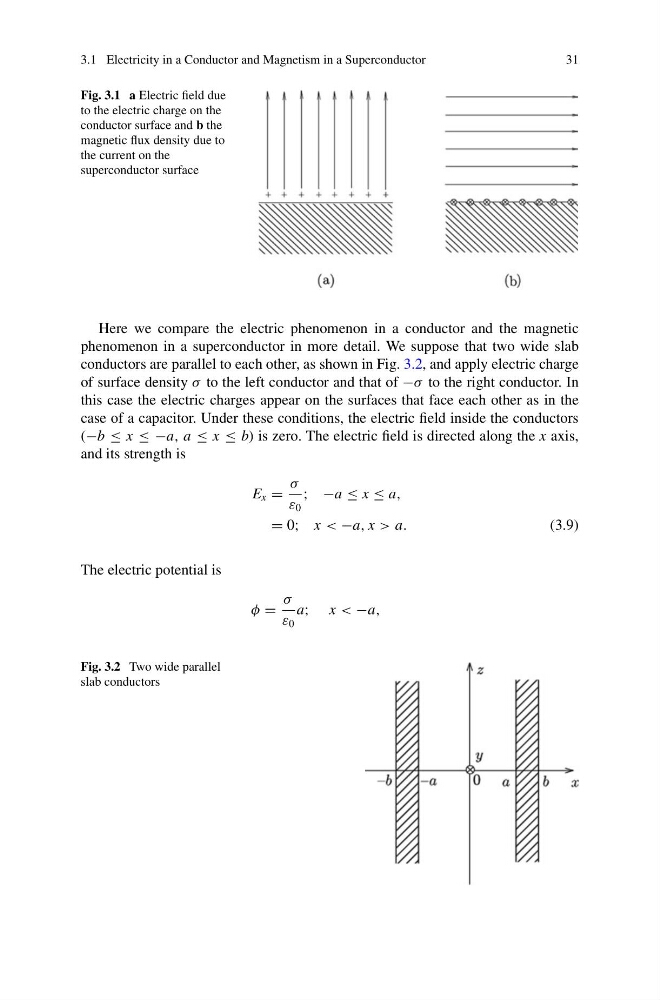
Fig. 3.1 a Electric field due
to the electric charge on the
conductor surface and b the
magnetic flux density due to
the current on the
superconductor surface
Here we compare the electric phenomenon in a conductor and the magnetic
phenomenon in a superconductor in more detail. We suppose that two wide slab
conductors are parallel to each other, as shown in Fig. 3.2, and apply electric charge
of surface density σ to the left conductor and that of −σ to the right conductor. In
this case the electric charges appear on the surfaces that face each other as in the
case of a capacitor. Under these conditions, the electric field inside the conductors
(−b ≤ x ≤ −a, a ≤ x ≤ b) is zero. The electric field is directed along the x axis,
and its strength is
E x =
σ
ε 0
; −a ≤ x ≤ a,
= 0; x < −a, x > a.
(3.9)
The electric potential is
φ =
σ
ε 0
a; x < −a,
Fig. 3.2 Two wide parallel
slab conductors
31
Fig. 3.1 a Electric field due
to the electric charge on the
conductor surface and b the
magnetic flux density due to
the current on the
superconductor surface
Here we compare the electric phenomenon in a conductor and the magnetic
phenomenon in a superconductor in more detail. We suppose that two wide slab
conductors are parallel to each other, as shown in Fig. 3.2, and apply electric charge
of surface density σ to the left conductor and that of −σ to the right conductor. In
this case the electric charges appear on the surfaces that face each other as in the
case of a capacitor. Under these conditions, the electric field inside the conductors
(−b ≤ x ≤ −a, a ≤ x ≤ b) is zero. The electric field is directed along the x axis,
and its strength is
E x =
σ
ε 0
; −a ≤ x ≤ a,
= 0; x < −a, x > a.
(3.9)
The electric potential is
φ =
σ
ε 0
a; x < −a,
Fig. 3.2 Two wide parallel
slab conductors