

20
2 Basic Electromagnetism
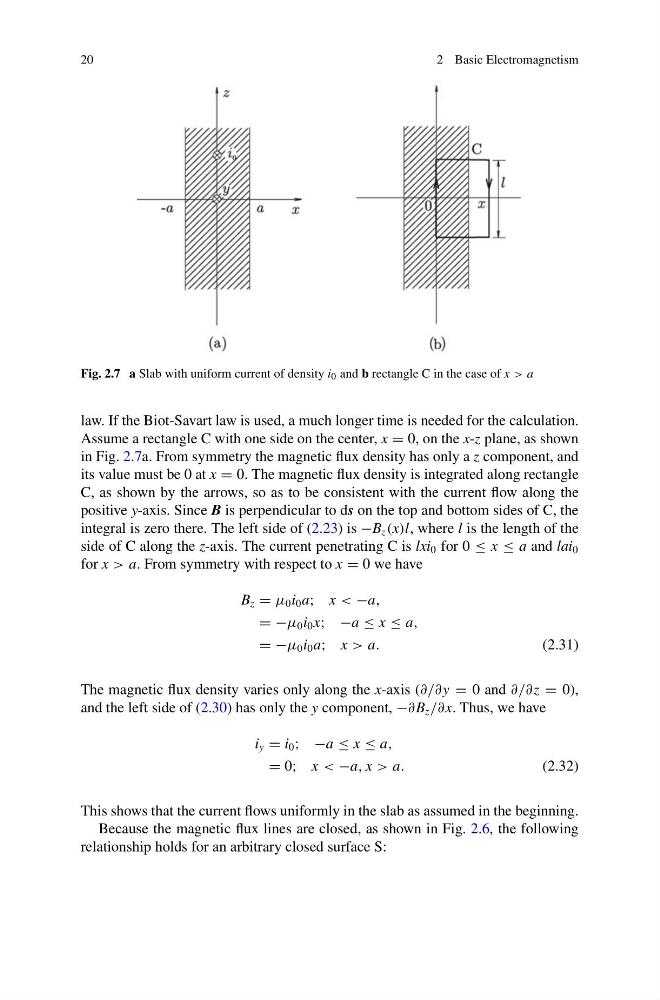
Fig. 2.7 a Slab with uniform current of density i 0 and b rectangle C in the case of x > a
law. If the Biot-Savart law is used, a much longer time is needed for the calculation.
Assume a rectangle C with one side on the center, x = 0, on the x-z plane, as shown
in Fig. 2.7a. From symmetry the magnetic flux density has only a z component, and
its value must be 0 at x = 0. The magnetic flux density is integrated along rectangle
C, as shown by the arrows, so as to be consistent with the current flow along the
positive y-axis. Since B is perpendicular to ds on the top and bottom sides of C, the
integral is zero there. The left side of (2.23) is −B z (x)l, where l is the length of the
side of C along the z-axis. The current penetrating C is lxi 0 for 0 ≤ x ≤ a and lai 0
for x > a. From symmetry with respect to x = 0 we have
B z = μ 0 i 0 a; x < −a,
= −μ 0 i 0 x; −a ≤ x ≤ a,
= −μ 0 i 0 a; x > a.
(2.31)
The magnetic flux density varies only along the x-axis (∂/∂y = 0 and ∂/∂z = 0),
and the left side of (2.30) has only the y component, −∂B z /∂x. Thus, we have
i y = i 0 ; −a ≤ x ≤ a,
= 0; x < −a, x > a.
(2.32)
This shows that the current flows uniformly in the slab as assumed in the beginning.
Because the magnetic flux lines are closed, as shown in Fig. 2.6, the following
relationship holds for an arbitrary closed surface S:
2 Basic Electromagnetism
Fig. 2.7 a Slab with uniform current of density i 0 and b rectangle C in the case of x > a
law. If the Biot-Savart law is used, a much longer time is needed for the calculation.
Assume a rectangle C with one side on the center, x = 0, on the x-z plane, as shown
in Fig. 2.7a. From symmetry the magnetic flux density has only a z component, and
its value must be 0 at x = 0. The magnetic flux density is integrated along rectangle
C, as shown by the arrows, so as to be consistent with the current flow along the
positive y-axis. Since B is perpendicular to ds on the top and bottom sides of C, the
integral is zero there. The left side of (2.23) is −B z (x)l, where l is the length of the
side of C along the z-axis. The current penetrating C is lxi 0 for 0 ≤ x ≤ a and lai 0
for x > a. From symmetry with respect to x = 0 we have
B z = μ 0 i 0 a; x < −a,
= −μ 0 i 0 x; −a ≤ x ≤ a,
= −μ 0 i 0 a; x > a.
(2.31)
The magnetic flux density varies only along the x-axis (∂/∂y = 0 and ∂/∂z = 0),
and the left side of (2.30) has only the y component, −∂B z /∂x. Thus, we have
i y = i 0 ; −a ≤ x ≤ a,
= 0; x < −a, x > a.
(2.32)
This shows that the current flows uniformly in the slab as assumed in the beginning.
Because the magnetic flux lines are closed, as shown in Fig. 2.6, the following
relationship holds for an arbitrary closed surface S: