

2.2 Static Magnetic Phenomena
21
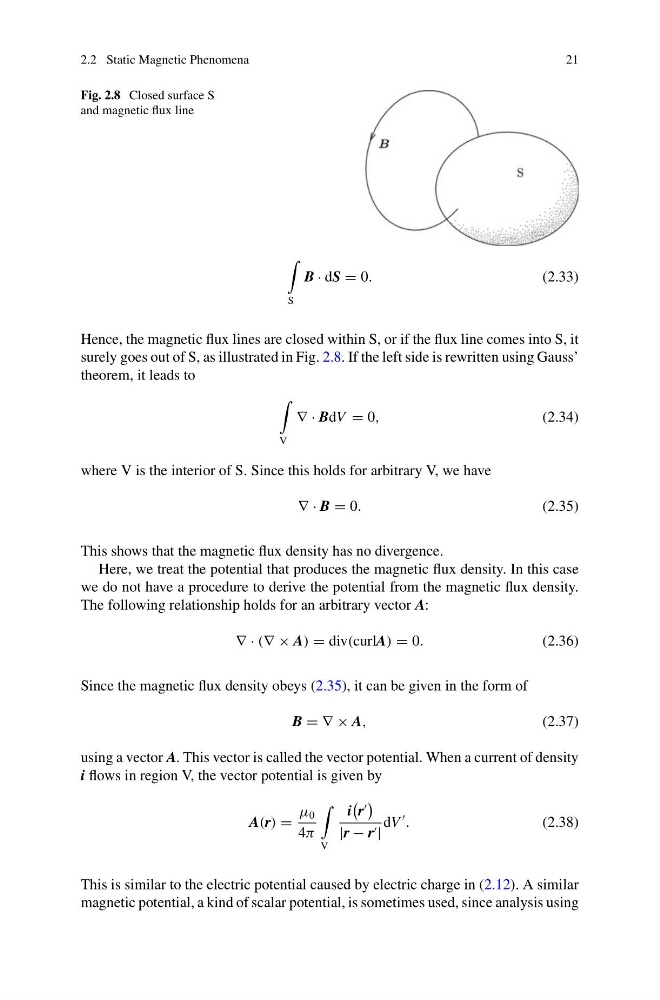
Fig. 2.8 Closed surface S
and magnetic flux line
S
B · dS = 0.
(2.33)
Hence, the magnetic flux lines are closed within S, or if the flux line comes into S, it
surely goes out of S, as illustrated in Fig. 2.8. If the left side is rewritten using Gauss’
theorem, it leads to
V
∇ · BdV = 0,
(2.34)
where V is the interior of S. Since this holds for arbitrary V, we have
∇ · B = 0.
(2.35)
This shows that the magnetic flux density has no divergence.
Here, we treat the potential that produces the magnetic flux density. In this case
we do not have a procedure to derive the potential from the magnetic flux density.
The following relationship holds for an arbitrary vector A:
∇ · (∇ × A) = div(curlA) = 0.
(2.36)
Since the magnetic flux density obeys (2.35), it can be given in the form of
B = ∇ × A,
(2.37)
using a vector A. This vector is called the vector potential. When a current of density
i flows in region V, the vector potential is given by
A(r) =
μ 0
4π
V
i
r
|r − r |
dV
.
(2.38)
This is similar to the electric potential caused by electric charge in (2.12). A similar
magnetic potential, a kind of scalar potential, is sometimes used, since analysis using
21
Fig. 2.8 Closed surface S
and magnetic flux line
S
B · dS = 0.
(2.33)
Hence, the magnetic flux lines are closed within S, or if the flux line comes into S, it
surely goes out of S, as illustrated in Fig. 2.8. If the left side is rewritten using Gauss’
theorem, it leads to
V
∇ · BdV = 0,
(2.34)
where V is the interior of S. Since this holds for arbitrary V, we have
∇ · B = 0.
(2.35)
This shows that the magnetic flux density has no divergence.
Here, we treat the potential that produces the magnetic flux density. In this case
we do not have a procedure to derive the potential from the magnetic flux density.
The following relationship holds for an arbitrary vector A:
∇ · (∇ × A) = div(curlA) = 0.
(2.36)
Since the magnetic flux density obeys (2.35), it can be given in the form of
B = ∇ × A,
(2.37)
using a vector A. This vector is called the vector potential. When a current of density
i flows in region V, the vector potential is given by
A(r) =
μ 0
4π
V
i
r
|r − r |
dV
.
(2.38)
This is similar to the electric potential caused by electric charge in (2.12). A similar
magnetic potential, a kind of scalar potential, is sometimes used, since analysis using