

Appendix
193
> c
= c
= c+0
> 0
= 0
a
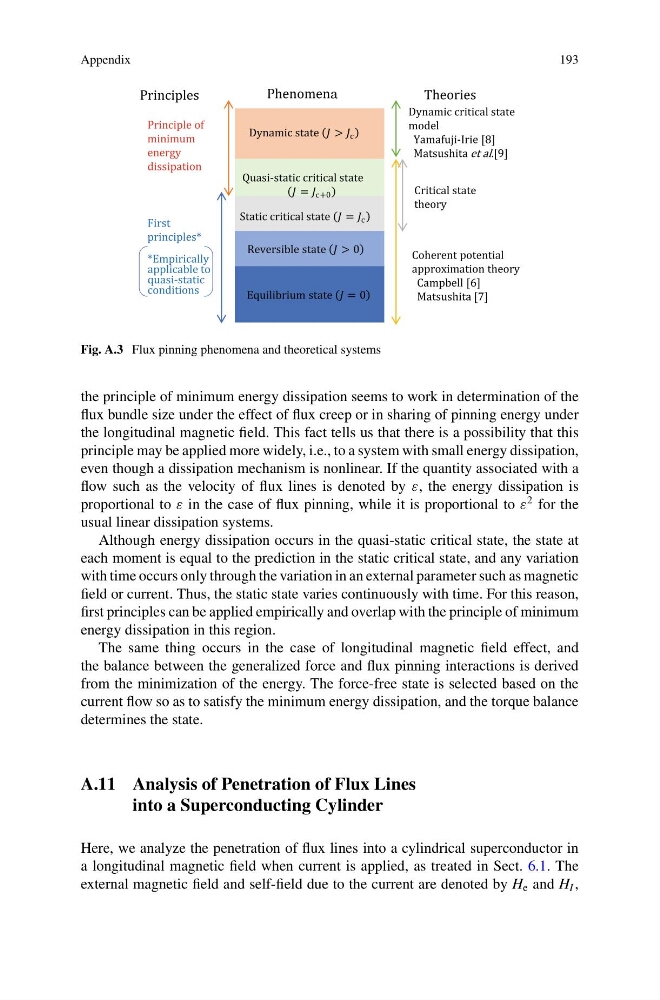
Fig. A.3 Flux pinning phenomena and theoretical systems
the principle of minimum energy dissipation seems to work in determination of the
flux bundle size under the effect of flux creep or in sharing of pinning energy under
the longitudinal magnetic field. This fact tells us that there is a possibility that this
principle may be applied more widely, i.e., to a system with small energy dissipation,
even though a dissipation mechanism is nonlinear. If the quantity associated with a
flow such as the velocity of flux lines is denoted by ε, the energy dissipation is
proportional to ε in the case of flux pinning, while it is proportional to ε
2 for the
usual linear dissipation systems.
Although energy dissipation occurs in the quasi-static critical state, the state at
each moment is equal to the prediction in the static critical state, and any variation
with time occurs only through the variation in an external parameter such as magnetic
field or current. Thus, the static state varies continuously with time. For this reason,
first principles can be applied empirically and overlap with the principle of minimum
energy dissipation in this region.
The same thing occurs in the case of longitudinal magnetic field effect, and
the balance between the generalized force and flux pinning interactions is derived
from the minimization of the energy. The force-free state is selected based on the
current flow so as to satisfy the minimum energy dissipation, and the torque balance
determines the state.
A.11 Analysis of Penetration of Flux Lines
into a Superconducting Cylinder
Here, we analyze the penetration of flux lines into a cylindrical superconductor in
a longitudinal magnetic field when current is applied, as treated in Sect. 6.1. The
external magnetic field and self-field due to the current are denoted by H e and H I ,
193
> c
= c
= c+0
> 0
= 0
a
Fig. A.3 Flux pinning phenomena and theoretical systems
the principle of minimum energy dissipation seems to work in determination of the
flux bundle size under the effect of flux creep or in sharing of pinning energy under
the longitudinal magnetic field. This fact tells us that there is a possibility that this
principle may be applied more widely, i.e., to a system with small energy dissipation,
even though a dissipation mechanism is nonlinear. If the quantity associated with a
flow such as the velocity of flux lines is denoted by ε, the energy dissipation is
proportional to ε in the case of flux pinning, while it is proportional to ε
2 for the
usual linear dissipation systems.
Although energy dissipation occurs in the quasi-static critical state, the state at
each moment is equal to the prediction in the static critical state, and any variation
with time occurs only through the variation in an external parameter such as magnetic
field or current. Thus, the static state varies continuously with time. For this reason,
first principles can be applied empirically and overlap with the principle of minimum
energy dissipation in this region.
The same thing occurs in the case of longitudinal magnetic field effect, and
the balance between the generalized force and flux pinning interactions is derived
from the minimization of the energy. The force-free state is selected based on the
current flow so as to satisfy the minimum energy dissipation, and the torque balance
determines the state.
A.11 Analysis of Penetration of Flux Lines
into a Superconducting Cylinder
Here, we analyze the penetration of flux lines into a cylindrical superconductor in
a longitudinal magnetic field when current is applied, as treated in Sect. 6.1. The
external magnetic field and self-field due to the current are denoted by H e and H I ,