

194
Appendix
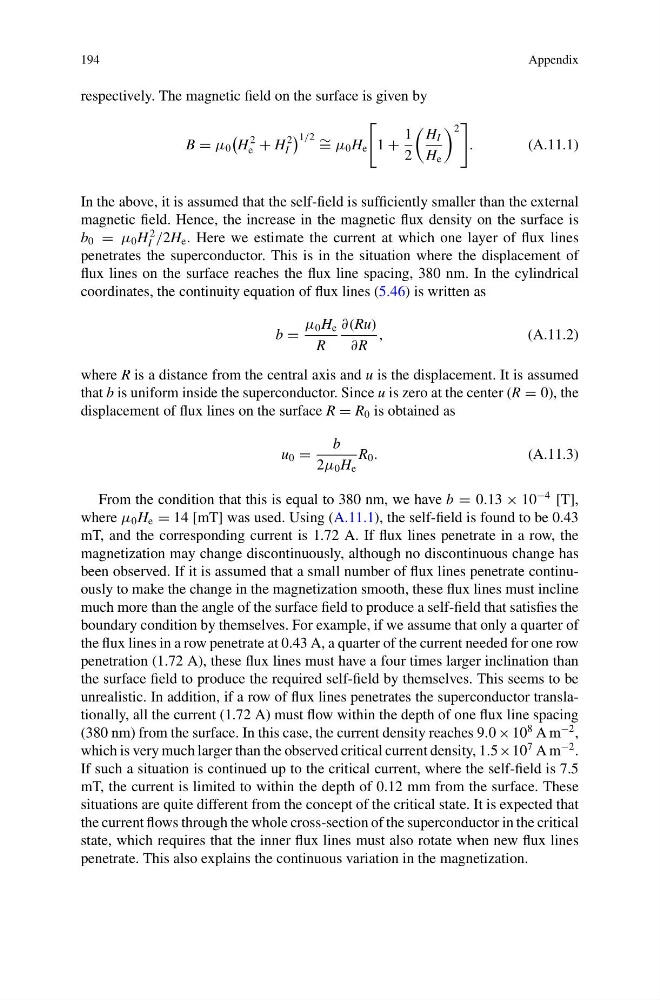
respectively. The magnetic field on the surface is given by
B = μ 0
H
2
e + H
2
I
1/2 ∼ = μ 0 H e
1 +
1
2
H I
H e
2
.
(A.11.1)
In the above, it is assumed that the self-field is sufficiently smaller than the external
magnetic field. Hence, the increase in the magnetic flux density on the surface is
b 0 = μ 0 H
2
I /2H e . Here we estimate the current at which one layer of flux lines
penetrates the superconductor. This is in the situation where the displacement of
flux lines on the surface reaches the flux line spacing, 380 nm. In the cylindrical
coordinates, the continuity equation of flux lines (5.46) is written as
b =
μ 0 H e
R
∂(Ru)
∂R
,
(A.11.2)
where R is a distance from the central axis and u is the displacement. It is assumed
that b is uniform inside the superconductor. Since u is zero at the center (R = 0), the
displacement of flux lines on the surface R = R 0 is obtained as
u 0 =
b
2μ 0 H e
R 0 .
(A.11.3)
From the condition that this is equal to 380 nm, we have b = 0.13 × 10
−4 [T],
where μ 0 H e = 14 [mT] was used. Using (A.11.1), the self-field is found to be 0.43
mT, and the corresponding current is 1.72 A. If flux lines penetrate in a row, the
magnetization may change discontinuously, although no discontinuous change has
been observed. If it is assumed that a small number of flux lines penetrate continuously to make the change in the magnetization smooth, these flux lines must incline
much more than the angle of the surface field to produce a self-field that satisfies the
boundary condition by themselves. For example, if we assume that only a quarter of
the flux lines in a row penetrate at 0.43 A, a quarter of the current needed for one row
penetration (1.72 A), these flux lines must have a four times larger inclination than
the surface field to produce the required self-field by themselves. This seems to be
unrealistic. In addition, if a row of flux lines penetrates the superconductor translationally, all the current (1.72 A) must flow within the depth of one flux line spacing
(380 nm) from the surface. In this case, the current density reaches 9.0 × 10
8 A m
−2 ,
which is very much larger than the observed critical current density, 1.5×10
7 A m
−2 .
If such a situation is continued up to the critical current, where the self-field is 7.5
mT, the current is limited to within the depth of 0.12 mm from the surface. These
situations are quite different from the concept of the critical state. It is expected that
the current flows through the whole cross-section of the superconductor in the critical
state, which requires that the inner flux lines must also rotate when new flux lines
penetrate. This also explains the continuous variation in the magnetization.
Appendix
respectively. The magnetic field on the surface is given by
B = μ 0
H
2
e + H
2
I
1/2 ∼ = μ 0 H e
1 +
1
2
H I
H e
2
.
(A.11.1)
In the above, it is assumed that the self-field is sufficiently smaller than the external
magnetic field. Hence, the increase in the magnetic flux density on the surface is
b 0 = μ 0 H
2
I /2H e . Here we estimate the current at which one layer of flux lines
penetrates the superconductor. This is in the situation where the displacement of
flux lines on the surface reaches the flux line spacing, 380 nm. In the cylindrical
coordinates, the continuity equation of flux lines (5.46) is written as
b =
μ 0 H e
R
∂(Ru)
∂R
,
(A.11.2)
where R is a distance from the central axis and u is the displacement. It is assumed
that b is uniform inside the superconductor. Since u is zero at the center (R = 0), the
displacement of flux lines on the surface R = R 0 is obtained as
u 0 =
b
2μ 0 H e
R 0 .
(A.11.3)
From the condition that this is equal to 380 nm, we have b = 0.13 × 10
−4 [T],
where μ 0 H e = 14 [mT] was used. Using (A.11.1), the self-field is found to be 0.43
mT, and the corresponding current is 1.72 A. If flux lines penetrate in a row, the
magnetization may change discontinuously, although no discontinuous change has
been observed. If it is assumed that a small number of flux lines penetrate continuously to make the change in the magnetization smooth, these flux lines must incline
much more than the angle of the surface field to produce a self-field that satisfies the
boundary condition by themselves. For example, if we assume that only a quarter of
the flux lines in a row penetrate at 0.43 A, a quarter of the current needed for one row
penetration (1.72 A), these flux lines must have a four times larger inclination than
the surface field to produce the required self-field by themselves. This seems to be
unrealistic. In addition, if a row of flux lines penetrates the superconductor translationally, all the current (1.72 A) must flow within the depth of one flux line spacing
(380 nm) from the surface. In this case, the current density reaches 9.0 × 10
8 A m
−2 ,
which is very much larger than the observed critical current density, 1.5×10
7 A m
−2 .
If such a situation is continued up to the critical current, where the self-field is 7.5
mT, the current is limited to within the depth of 0.12 mm from the surface. These
situations are quite different from the concept of the critical state. It is expected that
the current flows through the whole cross-section of the superconductor in the critical
state, which requires that the inner flux lines must also rotate when new flux lines
penetrate. This also explains the continuous variation in the magnetization.