

192
Appendix
Table A.1 Comparison of
different kinds of
irreversibility
Viscous loss
Pinning loss
Time reversal symmetry
No
Yes
Static stable state
No
Yes
Dissipation in steady state
Yes
No
Type of loss under variation
Copper loss
Iron loss
A.9 Two Kinds of Irreversibility
Here, we discuss two kinds of irreversibility. One of them is a general irreversibility
arising from the breaking of time reversal symmetry, and the other is caused by
different biased distributions of flux lines in the potential well due to the instability
in flux motion accompanied by a hysteresis, as shown in Chap. 5. In the latter case,
a reversible behavior is included, in which the time reversal symmetry is satisfied
and the irreversibility is independent of the breaking of time reversal symmetry. If
short, therefore, the irreversibility and energy dissipation are not identical in physics.
This is because it is possible to change over from an irreversible state to a lossless
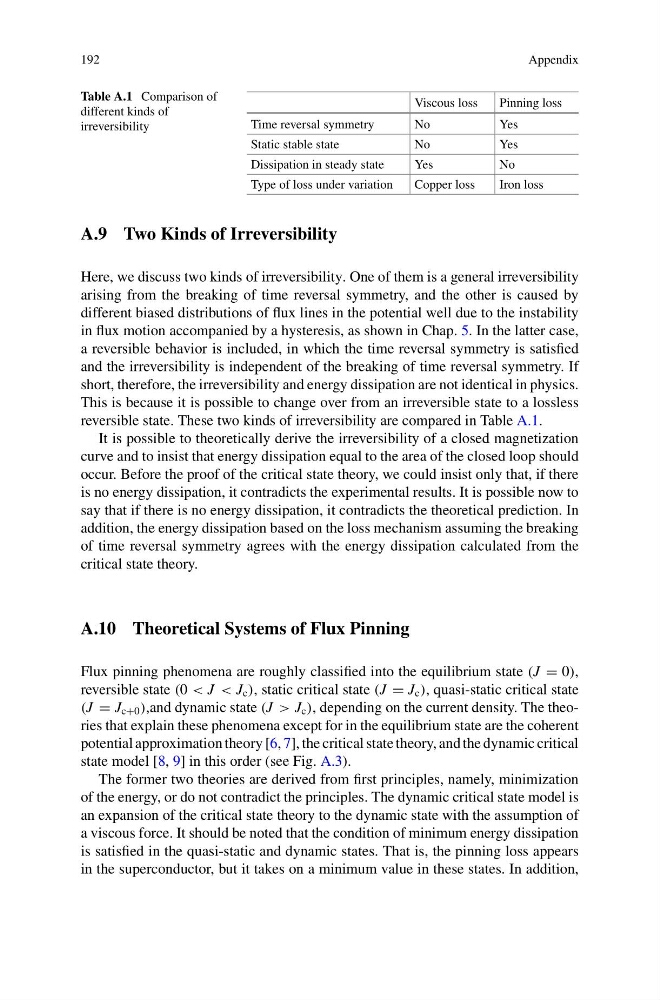
reversible state. These two kinds of irreversibility are compared in Table A.1.
It is possible to theoretically derive the irreversibility of a closed magnetization
curve and to insist that energy dissipation equal to the area of the closed loop should
occur. Before the proof of the critical state theory, we could insist only that, if there
is no energy dissipation, it contradicts the experimental results. It is possible now to
say that if there is no energy dissipation, it contradicts the theoretical prediction. In
addition, the energy dissipation based on the loss mechanism assuming the breaking
of time reversal symmetry agrees with the energy dissipation calculated from the
critical state theory.
A.10 Theoretical Systems of Flux Pinning
Flux pinning phenomena are roughly classified into the equilibrium state (J = 0),
reversible state (0 < J < J c ), static critical state (J = J c ), quasi-static critical state
(J = J c+0 ),and dynamic state (J > J c ), depending on the current density. The theories that explain these phenomena except for in the equilibrium state are the coherent
potential approximation theory [6, 7], the critical state theory, and the dynamic critical
state model [8, 9] in this order (see Fig. A.3).
The former two theories are derived from first principles, namely, minimization
of the energy, or do not contradict the principles. The dynamic critical state model is
an expansion of the critical state theory to the dynamic state with the assumption of
a viscous force. It should be noted that the condition of minimum energy dissipation
is satisfied in the quasi-static and dynamic states. That is, the pinning loss appears
in the superconductor, but it takes on a minimum value in these states. In addition,
Appendix
Table A.1 Comparison of
different kinds of
irreversibility
Viscous loss
Pinning loss
Time reversal symmetry
No
Yes
Static stable state
No
Yes
Dissipation in steady state
Yes
No
Type of loss under variation
Copper loss
Iron loss
A.9 Two Kinds of Irreversibility
Here, we discuss two kinds of irreversibility. One of them is a general irreversibility
arising from the breaking of time reversal symmetry, and the other is caused by
different biased distributions of flux lines in the potential well due to the instability
in flux motion accompanied by a hysteresis, as shown in Chap. 5. In the latter case,
a reversible behavior is included, in which the time reversal symmetry is satisfied
and the irreversibility is independent of the breaking of time reversal symmetry. If
short, therefore, the irreversibility and energy dissipation are not identical in physics.
This is because it is possible to change over from an irreversible state to a lossless
reversible state. These two kinds of irreversibility are compared in Table A.1.
It is possible to theoretically derive the irreversibility of a closed magnetization
curve and to insist that energy dissipation equal to the area of the closed loop should
occur. Before the proof of the critical state theory, we could insist only that, if there
is no energy dissipation, it contradicts the experimental results. It is possible now to
say that if there is no energy dissipation, it contradicts the theoretical prediction. In
addition, the energy dissipation based on the loss mechanism assuming the breaking
of time reversal symmetry agrees with the energy dissipation calculated from the
critical state theory.
A.10 Theoretical Systems of Flux Pinning
Flux pinning phenomena are roughly classified into the equilibrium state (J = 0),
reversible state (0 < J < J c ), static critical state (J = J c ), quasi-static critical state
(J = J c+0 ),and dynamic state (J > J c ), depending on the current density. The theories that explain these phenomena except for in the equilibrium state are the coherent
potential approximation theory [6, 7], the critical state theory, and the dynamic critical
state model [8, 9] in this order (see Fig. A.3).
The former two theories are derived from first principles, namely, minimization
of the energy, or do not contradict the principles. The dynamic critical state model is
an expansion of the critical state theory to the dynamic state with the assumption of
a viscous force. It should be noted that the condition of minimum energy dissipation
is satisfied in the quasi-static and dynamic states. That is, the pinning loss appears
in the superconductor, but it takes on a minimum value in these states. In addition,