

Appendix
191
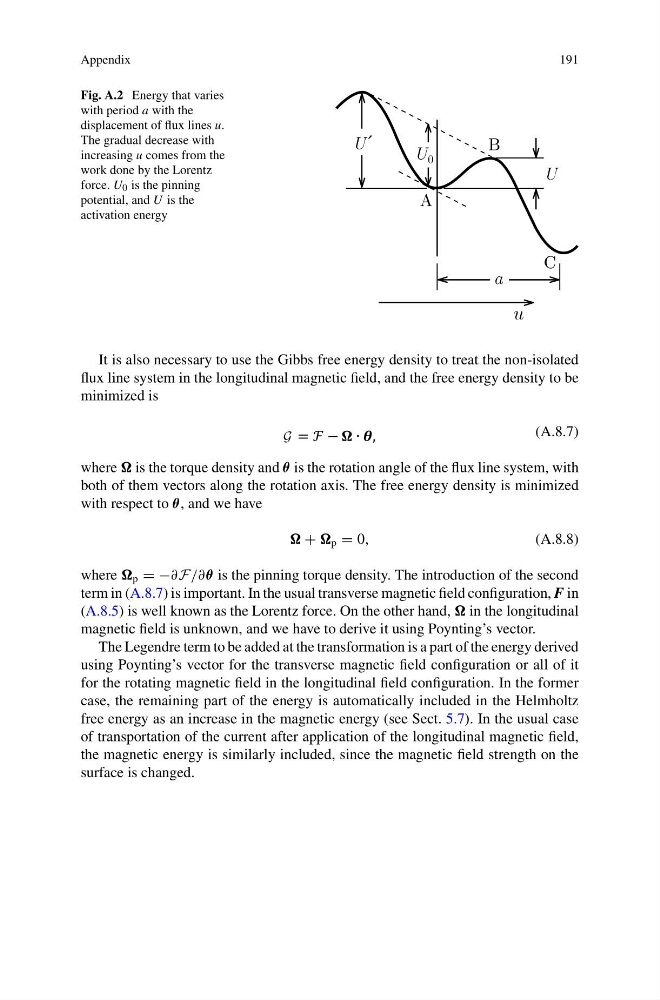
Fig. A.2 Energy that varies
with period a with the
displacement of flux lines u.
The gradual decrease with
increasing u comes from the
work done by the Lorentz
force. U 0 is the pinning
potential, and U is the
activation energy
It is also necessary to use the Gibbs free energy density to treat the non-isolated
flux line system in the longitudinal magnetic field, and the free energy density to be
minimized is
(A.8.7)
where is the torque density and θ is the rotation angle of the flux line system, with
both of them vectors along the rotation axis. The free energy density is minimized
with respect to θ , and we have
+ p = 0,
(A.8.8)
where p = −∂F/∂θ is the pinning torque density. The introduction of the second
term in (A.8.7) is important. In the usual transverse magnetic field configuration, F in
(A.8.5) is well known as the Lorentz force. On the other hand, in the longitudinal
magnetic field is unknown, and we have to derive it using Poynting’s vector.
The Legendre term to be added at the transformation is a part of the energy derived
using Poynting’s vector for the transverse magnetic field configuration or all of it
for the rotating magnetic field in the longitudinal field configuration. In the former
case, the remaining part of the energy is automatically included in the Helmholtz
free energy as an increase in the magnetic energy (see Sect. 5.7). In the usual case
of transportation of the current after application of the longitudinal magnetic field,
the magnetic energy is similarly included, since the magnetic field strength on the
surface is changed.
191
Fig. A.2 Energy that varies
with period a with the
displacement of flux lines u.
The gradual decrease with
increasing u comes from the
work done by the Lorentz
force. U 0 is the pinning
potential, and U is the
activation energy
It is also necessary to use the Gibbs free energy density to treat the non-isolated
flux line system in the longitudinal magnetic field, and the free energy density to be
minimized is
(A.8.7)
where is the torque density and θ is the rotation angle of the flux line system, with
both of them vectors along the rotation axis. The free energy density is minimized
with respect to θ , and we have
+ p = 0,
(A.8.8)
where p = −∂F/∂θ is the pinning torque density. The introduction of the second
term in (A.8.7) is important. In the usual transverse magnetic field configuration, F in
(A.8.5) is well known as the Lorentz force. On the other hand, in the longitudinal
magnetic field is unknown, and we have to derive it using Poynting’s vector.
The Legendre term to be added at the transformation is a part of the energy derived
using Poynting’s vector for the transverse magnetic field configuration or all of it
for the rotating magnetic field in the longitudinal field configuration. In the former
case, the remaining part of the energy is automatically included in the Helmholtz
free energy as an increase in the magnetic energy (see Sect. 5.7). In the usual case
of transportation of the current after application of the longitudinal magnetic field,
the magnetic energy is similarly included, since the magnetic field strength on the
surface is changed.