

188
Appendix
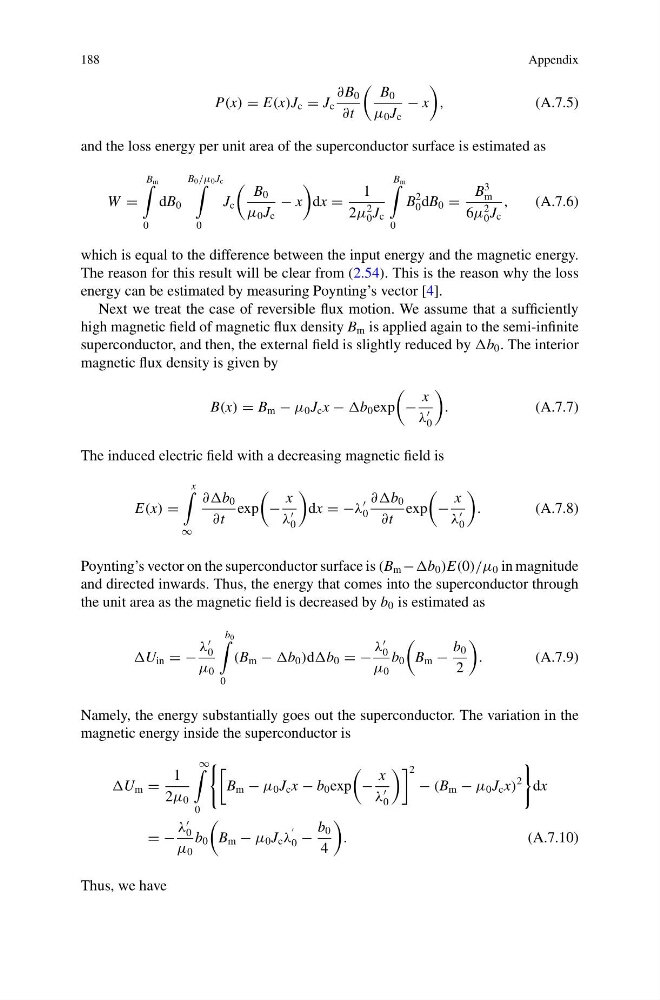
P(x) = E(x)J c = J c
∂B 0
∂t
B 0
μ 0 J c
− x
,
(A.7.5)
and the loss energy per unit area of the superconductor surface is estimated as
W =
B m
0
dB 0
B 0 /μ 0 J c
0
J c
B 0
μ 0 J c
− x
dx =
1
2μ
2
0 J c
B m
0
B
2
0 dB 0 =
B
3
m
6μ
2
0 J c
,
(A.7.6)
which is equal to the difference between the input energy and the magnetic energy.
The reason for this result will be clear from (2.54). This is the reason why the loss
energy can be estimated by measuring Poynting’s vector [4].
Next we treat the case of reversible flux motion. We assume that a sufficiently
high magnetic field of magnetic flux density B m is applied again to the semi-infinite
superconductor, and then, the external field is slightly reduced by b 0 . The interior
magnetic flux density is given by
B(x) = B m − μ 0 J c x − b 0 exp
−
x
λ
0
.
(A.7.7)
The induced electric field with a decreasing magnetic field is
E(x) =
x
∞
∂∂b 0
∂t
exp
−
x
λ
0
dx = −λ
0
∂∂b 0
∂t
exp
−
x
λ
0
.
(A.7.8)
Poynting’s vector on the superconductor surface is (B m −b 0 )E(0)/μ 0 in magnitude
and directed inwards. Thus, the energy that comes into the superconductor through
the unit area as the magnetic field is decreased by b 0 is estimated as
U in = −
λ
0
μ 0
b 0
0
(B m − b 0 )db 0 = −
λ
0
μ 0
b 0
B m −
b 0
2
.
(A.7.9)
Namely, the energy substantially goes out the superconductor. The variation in the
magnetic energy inside the superconductor is
U m =
1
2μ 0
∞
0
B m − μ 0 J c x − b 0 exp
−
x
λ
0
2
− (B m − μ 0 J c x)
2
dx
= −
λ
0
μ 0
b 0
B m − μ 0 J c λ
0 −
b 0
4
.
(A.7.10)
Thus, we have
Appendix
P(x) = E(x)J c = J c
∂B 0
∂t
B 0
μ 0 J c
− x
,
(A.7.5)
and the loss energy per unit area of the superconductor surface is estimated as
W =
B m
0
dB 0
B 0 /μ 0 J c
0
J c
B 0
μ 0 J c
− x
dx =
1
2μ
2
0 J c
B m
0
B
2
0 dB 0 =
B
3
m
6μ
2
0 J c
,
(A.7.6)
which is equal to the difference between the input energy and the magnetic energy.
The reason for this result will be clear from (2.54). This is the reason why the loss
energy can be estimated by measuring Poynting’s vector [4].
Next we treat the case of reversible flux motion. We assume that a sufficiently
high magnetic field of magnetic flux density B m is applied again to the semi-infinite
superconductor, and then, the external field is slightly reduced by b 0 . The interior
magnetic flux density is given by
B(x) = B m − μ 0 J c x − b 0 exp
−
x
λ
0
.
(A.7.7)
The induced electric field with a decreasing magnetic field is
E(x) =
x
∞
∂∂b 0
∂t
exp
−
x
λ
0
dx = −λ
0
∂∂b 0
∂t
exp
−
x
λ
0
.
(A.7.8)
Poynting’s vector on the superconductor surface is (B m −b 0 )E(0)/μ 0 in magnitude
and directed inwards. Thus, the energy that comes into the superconductor through
the unit area as the magnetic field is decreased by b 0 is estimated as
U in = −
λ
0
μ 0
b 0
0
(B m − b 0 )db 0 = −
λ
0
μ 0
b 0
B m −
b 0
2
.
(A.7.9)
Namely, the energy substantially goes out the superconductor. The variation in the
magnetic energy inside the superconductor is
U m =
1
2μ 0
∞
0
B m − μ 0 J c x − b 0 exp
−
x
λ
0
2
− (B m − μ 0 J c x)
2
dx
= −
λ
0
μ 0
b 0
B m − μ 0 J c λ
0 −
b 0
4
.
(A.7.10)
Thus, we have