

Appendix
189
U in − m = −
λ
0
μ 0
b 0
μ 0 J c λ
0 −
b 0
4
.
(A.7.11)
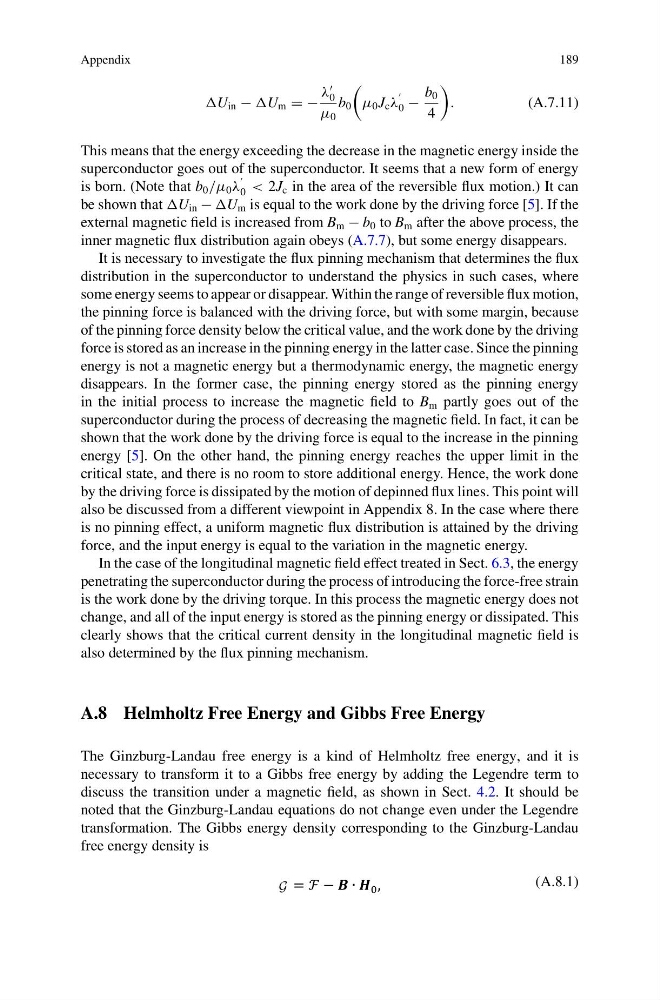
This means that the energy exceeding the decrease in the magnetic energy inside the
superconductor goes out of the superconductor. It seems that a new form of energy
is born. (Note that b 0 /μ 0 λ
0 < 2J c in the area of the reversible flux motion.) It can
be shown that in − m is equal to the work done by the driving force [5]. If the
external magnetic field is increased from B m − b 0 to B m after the above process, the
inner magnetic flux distribution again obeys (A.7.7), but some energy disappears.
It is necessary to investigate the flux pinning mechanism that determines the flux
distribution in the superconductor to understand the physics in such cases, where
some energy seems to appear or disappear. Within the range of reversible flux motion,
the pinning force is balanced with the driving force, but with some margin, because
of the pinning force density below the critical value, and the work done by the driving
force is stored as an increase in the pinning energy in the latter case. Since the pinning
energy is not a magnetic energy but a thermodynamic energy, the magnetic energy
disappears. In the former case, the pinning energy stored as the pinning energy
in the initial process to increase the magnetic field to B m partly goes out of the
superconductor during the process of decreasing the magnetic field. In fact, it can be
shown that the work done by the driving force is equal to the increase in the pinning
energy [5]. On the other hand, the pinning energy reaches the upper limit in the
critical state, and there is no room to store additional energy. Hence, the work done
by the driving force is dissipated by the motion of depinned flux lines. This point will
also be discussed from a different viewpoint in Appendix 8. In the case where there
is no pinning effect, a uniform magnetic flux distribution is attained by the driving
force, and the input energy is equal to the variation in the magnetic energy.
In the case of the longitudinal magnetic field effect treated in Sect. 6.3, the energy
penetrating the superconductor during the process of introducing the force-free strain
is the work done by the driving torque. In this process the magnetic energy does not
change, and all of the input energy is stored as the pinning energy or dissipated. This
clearly shows that the critical current density in the longitudinal magnetic field is
also determined by the flux pinning mechanism.
A.8 Helmholtz Free Energy and Gibbs Free Energy
The Ginzburg-Landau free energy is a kind of Helmholtz free energy, and it is
necessary to transform it to a Gibbs free energy by adding the Legendre term to
discuss the transition under a magnetic field, as shown in Sect. 4.2. It should be
noted that the Ginzburg-Landau equations do not change even under the Legendre
transformation. The Gibbs energy density corresponding to the Ginzburg-Landau
free energy density is
(A.8.1)
189
U in − m = −
λ
0
μ 0
b 0
μ 0 J c λ
0 −
b 0
4
.
(A.7.11)
This means that the energy exceeding the decrease in the magnetic energy inside the
superconductor goes out of the superconductor. It seems that a new form of energy
is born. (Note that b 0 /μ 0 λ
0 < 2J c in the area of the reversible flux motion.) It can
be shown that in − m is equal to the work done by the driving force [5]. If the
external magnetic field is increased from B m − b 0 to B m after the above process, the
inner magnetic flux distribution again obeys (A.7.7), but some energy disappears.
It is necessary to investigate the flux pinning mechanism that determines the flux
distribution in the superconductor to understand the physics in such cases, where
some energy seems to appear or disappear. Within the range of reversible flux motion,
the pinning force is balanced with the driving force, but with some margin, because
of the pinning force density below the critical value, and the work done by the driving
force is stored as an increase in the pinning energy in the latter case. Since the pinning
energy is not a magnetic energy but a thermodynamic energy, the magnetic energy
disappears. In the former case, the pinning energy stored as the pinning energy
in the initial process to increase the magnetic field to B m partly goes out of the
superconductor during the process of decreasing the magnetic field. In fact, it can be
shown that the work done by the driving force is equal to the increase in the pinning
energy [5]. On the other hand, the pinning energy reaches the upper limit in the
critical state, and there is no room to store additional energy. Hence, the work done
by the driving force is dissipated by the motion of depinned flux lines. This point will
also be discussed from a different viewpoint in Appendix 8. In the case where there
is no pinning effect, a uniform magnetic flux distribution is attained by the driving
force, and the input energy is equal to the variation in the magnetic energy.
In the case of the longitudinal magnetic field effect treated in Sect. 6.3, the energy
penetrating the superconductor during the process of introducing the force-free strain
is the work done by the driving torque. In this process the magnetic energy does not
change, and all of the input energy is stored as the pinning energy or dissipated. This
clearly shows that the critical current density in the longitudinal magnetic field is
also determined by the flux pinning mechanism.
A.8 Helmholtz Free Energy and Gibbs Free Energy
The Ginzburg-Landau free energy is a kind of Helmholtz free energy, and it is
necessary to transform it to a Gibbs free energy by adding the Legendre term to
discuss the transition under a magnetic field, as shown in Sect. 4.2. It should be
noted that the Ginzburg-Landau equations do not change even under the Legendre
transformation. The Gibbs energy density corresponding to the Ginzburg-Landau
free energy density is
(A.8.1)