

Appendix
187
A.7 Input Energy and Increase in Magnetic Energy
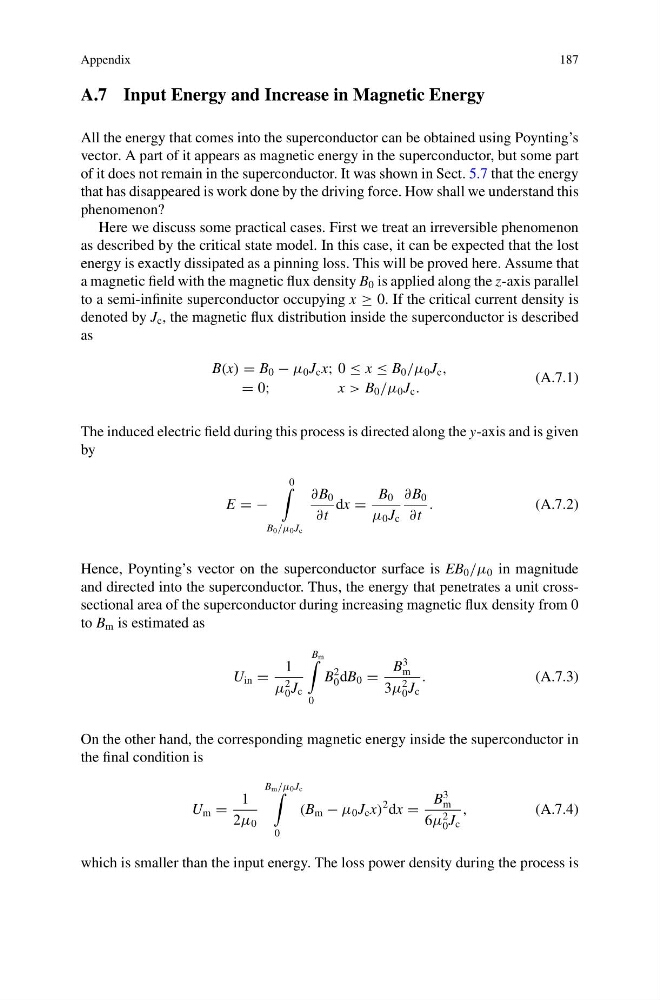
All the energy that comes into the superconductor can be obtained using Poynting’s
vector. A part of it appears as magnetic energy in the superconductor, but some part
of it does not remain in the superconductor. It was shown in Sect. 5.7 that the energy
that has disappeared is work done by the driving force. How shall we understand this
phenomenon?
Here we discuss some practical cases. First we treat an irreversible phenomenon
as described by the critical state model. In this case, it can be expected that the lost
energy is exactly dissipated as a pinning loss. This will be proved here. Assume that
a magnetic field with the magnetic flux density B 0 is applied along the z-axis parallel
to a semi-infinite superconductor occupying x ≥ 0. If the critical current density is
denoted by J c , the magnetic flux distribution inside the superconductor is described
as
B(x) = B 0 − μ 0 J c x; 0 ≤ x ≤ B 0 /μ 0 J c ,
= 0;
x > B 0 /μ 0 J c .
(A.7.1)
The induced electric field during this process is directed along the y-axis and is given
by
E = −
0
B 0 /μ 0 J c
∂B 0
∂t
dx =
B 0
μ 0 J c
∂B 0
∂t
.
(A.7.2)
Hence, Poynting’s vector on the superconductor surface is EB 0 /μ 0 in magnitude
and directed into the superconductor. Thus, the energy that penetrates a unit crosssectional area of the superconductor during increasing magnetic flux density from 0
to B m is estimated as
U in =
1
μ
2
0 J c
B m
0
B
2
0 dB 0 =
B
3
m
3μ
2
0 J c
.
(A.7.3)
On the other hand, the corresponding magnetic energy inside the superconductor in
the final condition is
U m =
1
2μ 0
B m /μ 0 J c
0
(B m − μ 0 J c x)
2 dx =
B
3
m
6μ
2
0 J c
,
(A.7.4)
which is smaller than the input energy. The loss power density during the process is
187
A.7 Input Energy and Increase in Magnetic Energy
All the energy that comes into the superconductor can be obtained using Poynting’s
vector. A part of it appears as magnetic energy in the superconductor, but some part
of it does not remain in the superconductor. It was shown in Sect. 5.7 that the energy
that has disappeared is work done by the driving force. How shall we understand this
phenomenon?
Here we discuss some practical cases. First we treat an irreversible phenomenon
as described by the critical state model. In this case, it can be expected that the lost
energy is exactly dissipated as a pinning loss. This will be proved here. Assume that
a magnetic field with the magnetic flux density B 0 is applied along the z-axis parallel
to a semi-infinite superconductor occupying x ≥ 0. If the critical current density is
denoted by J c , the magnetic flux distribution inside the superconductor is described
as
B(x) = B 0 − μ 0 J c x; 0 ≤ x ≤ B 0 /μ 0 J c ,
= 0;
x > B 0 /μ 0 J c .
(A.7.1)
The induced electric field during this process is directed along the y-axis and is given
by
E = −
0
B 0 /μ 0 J c
∂B 0
∂t
dx =
B 0
μ 0 J c
∂B 0
∂t
.
(A.7.2)
Hence, Poynting’s vector on the superconductor surface is EB 0 /μ 0 in magnitude
and directed into the superconductor. Thus, the energy that penetrates a unit crosssectional area of the superconductor during increasing magnetic flux density from 0
to B m is estimated as
U in =
1
μ
2
0 J c
B m
0
B
2
0 dB 0 =
B
3
m
3μ
2
0 J c
.
(A.7.3)
On the other hand, the corresponding magnetic energy inside the superconductor in
the final condition is
U m =
1
2μ 0
B m /μ 0 J c
0
(B m − μ 0 J c x)
2 dx =
B
3
m
6μ
2
0 J c
,
(A.7.4)
which is smaller than the input energy. The loss power density during the process is