

186
Appendix
u
=
∂u
∂ζ
i ζ +
∂u
∂ξ
i ξ .
(A.6.3)
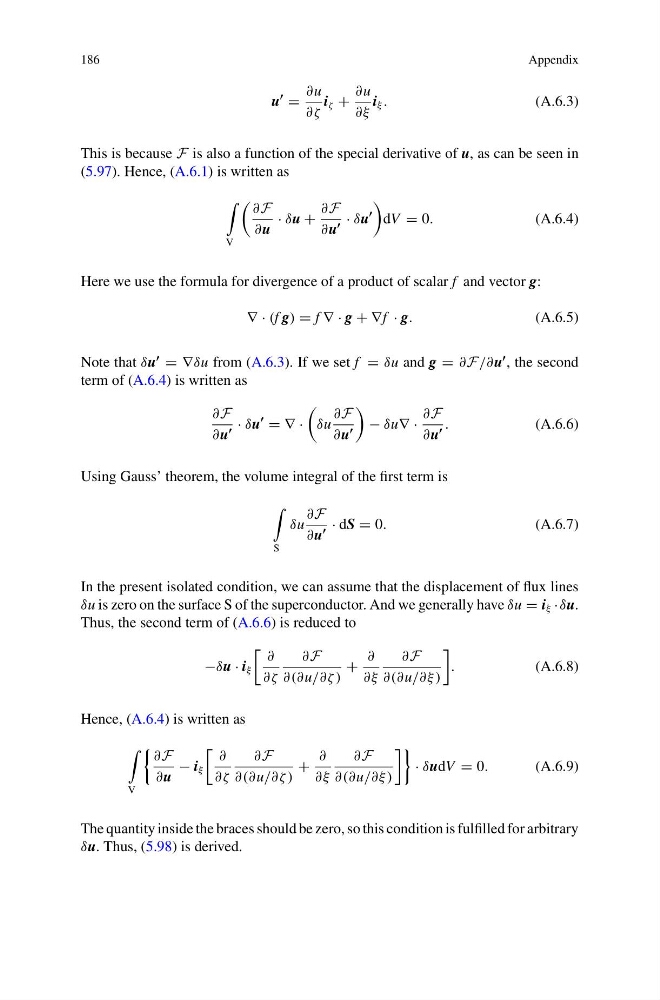
This is because F is also a function of the special derivative of u, as can be seen in
(5.97). Hence, (A.6.1) is written as
V
∂F
∂u
· δu +
∂F
∂u
· δu
dV = 0.
(A.6.4)
Here we use the formula for divergence of a product of scalar f and vector g:
∇ · (f g) = f ∇ · g + ∇f · g.
(A.6.5)
Note that δu
= ∇δu from (A.6.3). If we set f = δu and g = ∂F/∂u
, the second
term of (A.6.4) is written as
∂F
∂u
· δu
= ∇ ·
δu
∂F
∂u
− δu∇ ·
∂F
∂u
.
(A.6.6)
Using Gauss’ theorem, the volume integral of the first term is
S
δu
∂F
∂u
· dS = 0.
(A.6.7)
In the present isolated condition, we can assume that the displacement of flux lines
δu is zero on the surface S of the superconductor. And we generally have δu = i ξ ·δu.
Thus, the second term of (A.6.6) is reduced to
−δu · i ξ
∂
∂ζ
∂F
∂(∂u/∂ζ )
+
∂
∂ξ
∂F
∂(∂u/∂ξ )
.
(A.6.8)
Hence, (A.6.4) is written as
V
∂F
∂u
− i ξ
∂
∂ζ
∂F
∂(∂u/∂ζ )
+
∂
∂ξ
∂F
∂(∂u/∂ξ )
· δudV = 0.
(A.6.9)
The quantity inside the braces should be zero, so this condition is fulfilled for arbitrary
δu. Thus, (5.98) is derived.
Appendix
u
=
∂u
∂ζ
i ζ +
∂u
∂ξ
i ξ .
(A.6.3)
This is because F is also a function of the special derivative of u, as can be seen in
(5.97). Hence, (A.6.1) is written as
V
∂F
∂u
· δu +
∂F
∂u
· δu
dV = 0.
(A.6.4)
Here we use the formula for divergence of a product of scalar f and vector g:
∇ · (f g) = f ∇ · g + ∇f · g.
(A.6.5)
Note that δu
= ∇δu from (A.6.3). If we set f = δu and g = ∂F/∂u
, the second
term of (A.6.4) is written as
∂F
∂u
· δu
= ∇ ·
δu
∂F
∂u
− δu∇ ·
∂F
∂u
.
(A.6.6)
Using Gauss’ theorem, the volume integral of the first term is
S
δu
∂F
∂u
· dS = 0.
(A.6.7)
In the present isolated condition, we can assume that the displacement of flux lines
δu is zero on the surface S of the superconductor. And we generally have δu = i ξ ·δu.
Thus, the second term of (A.6.6) is reduced to
−δu · i ξ
∂
∂ζ
∂F
∂(∂u/∂ζ )
+
∂
∂ξ
∂F
∂(∂u/∂ξ )
.
(A.6.8)
Hence, (A.6.4) is written as
V
∂F
∂u
− i ξ
∂
∂ζ
∂F
∂(∂u/∂ζ )
+
∂
∂ξ
∂F
∂(∂u/∂ξ )
· δudV = 0.
(A.6.9)
The quantity inside the braces should be zero, so this condition is fulfilled for arbitrary
δu. Thus, (5.98) is derived.