

178
Appendix
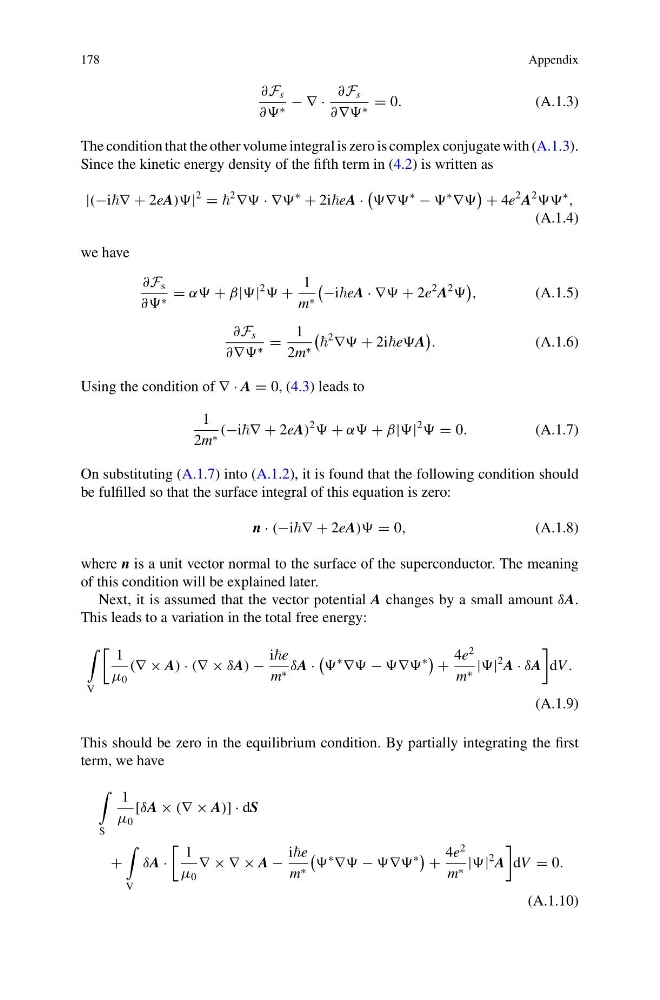
∂F s
∂∂ ∗ − ∇ ·
∂F s
∂∇ ∗ = 0.
(A.1.3)
The condition that the other volume integral is zero is complex conjugate with (A.1.3).
Since the kinetic energy density of the fifth term in (4.2) is written as
|(−i∇ + 2eA)|
2
=
2
∇ · ∇
∗
+ 2ieA ·
∇
∗
−
∗
∇
+ 4e
2 A
2
∗
,
(A.1.4)
we have
∂F s
∂∂ ∗ = αα + β||
2
+
1
m ∗
−ieA · ∇ + 2e
2 A
2
,
(A.1.5)
∂F s
∂∇ ∗ =
1
2m ∗
2
∇ + 2ieA
.
(A.1.6)
Using the condition of ∇ · A = 0, (4.3) leads to
1
2m ∗ (−i∇ + 2eA)
2
+ αα + β||
2
= 0.
(A.1.7)
On substituting (A.1.7) into (A.1.2), it is found that the following condition should
be fulfilled so that the surface integral of this equation is zero:
n · (−i∇ + 2eA) = 0,
(A.1.8)
where n is a unit vector normal to the surface of the superconductor. The meaning
of this condition will be explained later.
Next, it is assumed that the vector potential A changes by a small amount δA.
This leads to a variation in the total free energy:
V
1
μ 0
(∇ × A) · (∇ × δA) −
ie
m ∗ δA ·
∗
∇ − ∇
∗
+
4e
2
m ∗ ||
2 A · δA
dV .
(A.1.9)
This should be zero in the equilibrium condition. By partially integrating the first
term, we have
S
1
μ 0
[δA × (∇ × A)] · dS
+
V
δA ·
1
μ 0
∇ × ∇ × A −
ie
m ∗
∗
∇ − ∇
∗
+
4e
2
m ∗ ||
2 A
dV = 0.
(A.1.10)
Appendix
∂F s
∂∂ ∗ − ∇ ·
∂F s
∂∇ ∗ = 0.
(A.1.3)
The condition that the other volume integral is zero is complex conjugate with (A.1.3).
Since the kinetic energy density of the fifth term in (4.2) is written as
|(−i∇ + 2eA)|
2
=
2
∇ · ∇
∗
+ 2ieA ·
∇
∗
−
∗
∇
+ 4e
2 A
2
∗
,
(A.1.4)
we have
∂F s
∂∂ ∗ = αα + β||
2
+
1
m ∗
−ieA · ∇ + 2e
2 A
2
,
(A.1.5)
∂F s
∂∇ ∗ =
1
2m ∗
2
∇ + 2ieA
.
(A.1.6)
Using the condition of ∇ · A = 0, (4.3) leads to
1
2m ∗ (−i∇ + 2eA)
2
+ αα + β||
2
= 0.
(A.1.7)
On substituting (A.1.7) into (A.1.2), it is found that the following condition should
be fulfilled so that the surface integral of this equation is zero:
n · (−i∇ + 2eA) = 0,
(A.1.8)
where n is a unit vector normal to the surface of the superconductor. The meaning
of this condition will be explained later.
Next, it is assumed that the vector potential A changes by a small amount δA.
This leads to a variation in the total free energy:
V
1
μ 0
(∇ × A) · (∇ × δA) −
ie
m ∗ δA ·
∗
∇ − ∇
∗
+
4e
2
m ∗ ||
2 A · δA
dV .
(A.1.9)
This should be zero in the equilibrium condition. By partially integrating the first
term, we have
S
1
μ 0
[δA × (∇ × A)] · dS
+
V
δA ·
1
μ 0
∇ × ∇ × A −
ie
m ∗
∗
∇ − ∇
∗
+
4e
2
m ∗ ||
2 A
dV = 0.
(A.1.10)