

Appendix
179
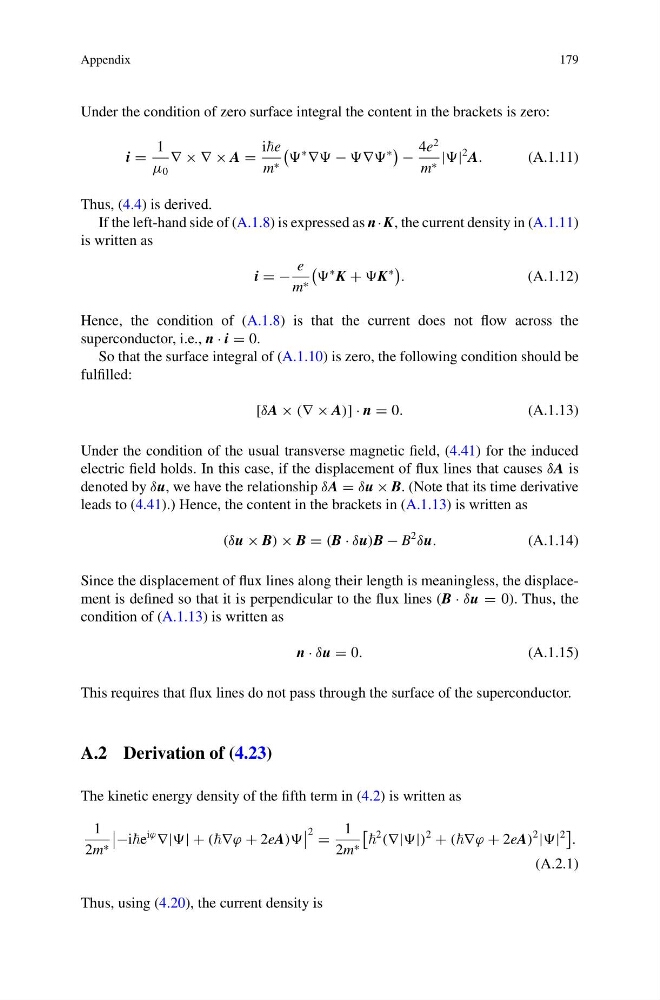
Under the condition of zero surface integral the content in the brackets is zero:
i =
1
μ 0
∇ × ∇ × A =
ie
m ∗
∗
∇ − ∇
∗
−
4e
2
m ∗ ||
2 A.
(A.1.11)
Thus, (4.4) is derived.
If the left-hand side of (A.1.8) is expressed as n · K, the current density in (A.1.11)
is written as
i = −
e
m ∗
∗ K + K
∗
.
(A.1.12)
Hence, the condition of (A.1.8) is that the current does not flow across the
superconductor, i.e., n · i = 0.
So that the surface integral of (A.1.10) is zero, the following condition should be
fulfilled:
[δA × (∇ × A)] · n = 0.
(A.1.13)
Under the condition of the usual transverse magnetic field, (4.41) for the induced
electric field holds. In this case, if the displacement of flux lines that causes δA is
denoted by δu, we have the relationship δA = δu × B. (Note that its time derivative
leads to (4.41).) Hence, the content in the brackets in (A.1.13) is written as
(δu × B) × B = (B · δu)B − B
2
δu.
(A.1.14)
Since the displacement of flux lines along their length is meaningless, the displacement is defined so that it is perpendicular to the flux lines (B · δu = 0). Thus, the
condition of (A.1.13) is written as
n · δu = 0.
(A.1.15)
This requires that flux lines do not pass through the surface of the superconductor.
A.2 Derivation of (4.23)
The kinetic energy density of the fifth term in (4.2) is written as
1
2m ∗
−ie
iϕ
∇|| + (∇ϕ + 2eA)
2 =
1
2m ∗
2
(∇||)
2
+ (∇ϕ + 2eA)
2
||
2
.
(A.2.1)
Thus, using (4.20), the current density is
179
Under the condition of zero surface integral the content in the brackets is zero:
i =
1
μ 0
∇ × ∇ × A =
ie
m ∗
∗
∇ − ∇
∗
−
4e
2
m ∗ ||
2 A.
(A.1.11)
Thus, (4.4) is derived.
If the left-hand side of (A.1.8) is expressed as n · K, the current density in (A.1.11)
is written as
i = −
e
m ∗
∗ K + K
∗
.
(A.1.12)
Hence, the condition of (A.1.8) is that the current does not flow across the
superconductor, i.e., n · i = 0.
So that the surface integral of (A.1.10) is zero, the following condition should be
fulfilled:
[δA × (∇ × A)] · n = 0.
(A.1.13)
Under the condition of the usual transverse magnetic field, (4.41) for the induced
electric field holds. In this case, if the displacement of flux lines that causes δA is
denoted by δu, we have the relationship δA = δu × B. (Note that its time derivative
leads to (4.41).) Hence, the content in the brackets in (A.1.13) is written as
(δu × B) × B = (B · δu)B − B
2
δu.
(A.1.14)
Since the displacement of flux lines along their length is meaningless, the displacement is defined so that it is perpendicular to the flux lines (B · δu = 0). Thus, the
condition of (A.1.13) is written as
n · δu = 0.
(A.1.15)
This requires that flux lines do not pass through the surface of the superconductor.
A.2 Derivation of (4.23)
The kinetic energy density of the fifth term in (4.2) is written as
1
2m ∗
−ie
iϕ
∇|| + (∇ϕ + 2eA)
2 =
1
2m ∗
2
(∇||)
2
+ (∇ϕ + 2eA)
2
||
2
.
(A.2.1)
Thus, using (4.20), the current density is