

Appendix
A.1 Derivation of Ginzburg-Landau Equations
The equilibrium state in a superconductor is given by the condition in which the
volume integral of the free energy density F s in (4.2) takes on a minimum value with
respect to the order parameter and the vector potential A.
It is assumed that changes by a small amount δδ. (
∗ also changes by δδ
∗ .)
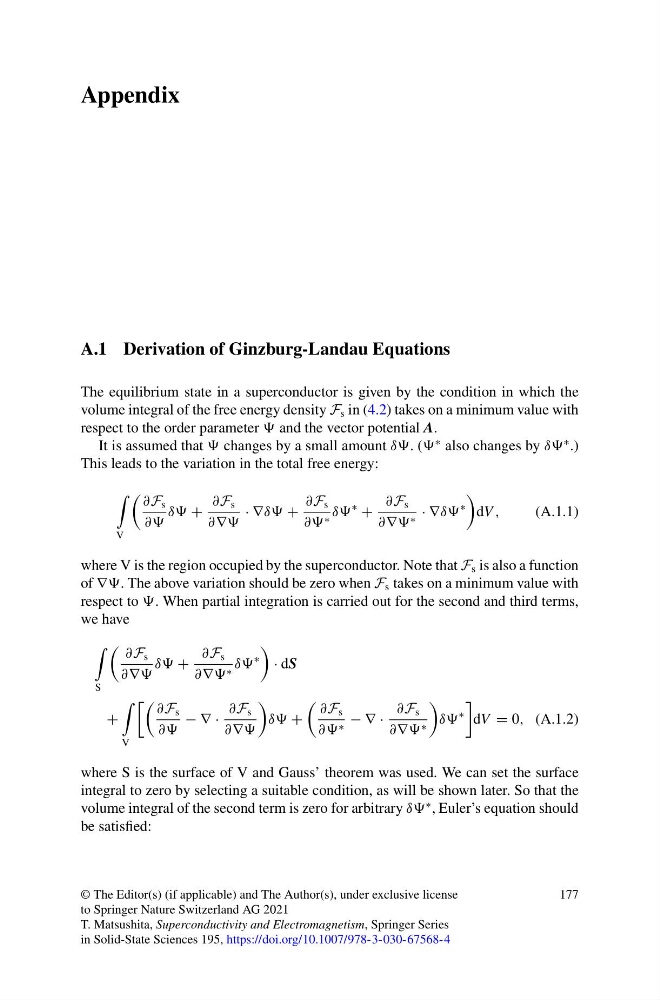
This leads to the variation in the total free energy:
V
∂F s
∂∂
δδ +
∂F s
∂∇
· ∇δδ +
∂F s
∂∂ ∗ δδ
∗
+
∂F s
∂∇ ∗ · ∇δδ
∗
dV ,
(A.1.1)
where V is the region occupied by the superconductor. Note that F s is also a function
of ∇. The above variation should be zero when F s takes on a minimum value with
respect to . When partial integration is carried out for the second and third terms,
we have
S
∂F s
∂∇
δδ +
∂F s
∂∇ ∗ δδ
∗
· dS
+
V
∂F s
∂∂
− ∇ ·
∂F s
∂∇
δδ +
∂F s
∂∂ ∗ − ∇ ·
∂F s
∂∇ ∗
δδ
∗
dV = 0, (A.1.2)
where S is the surface of V and Gauss’ theorem was used. We can set the surface
integral to zero by selecting a suitable condition, as will be shown later. So that the
volume integral of the second term is zero for arbitrary δδ
∗ , Euler’s equation should
be satisfied:
© The Editor(s) (if applicable) and The Author(s), under exclusive license
to Springer Nature Switzerland AG 2021
T. Matsushita, Superconductivity and Electromagnetism, Springer Series
in Solid-State Sciences 195, https://doi.org/10.1007/978-3-030-67568-4
177
A.1 Derivation of Ginzburg-Landau Equations
The equilibrium state in a superconductor is given by the condition in which the
volume integral of the free energy density F s in (4.2) takes on a minimum value with
respect to the order parameter and the vector potential A.
It is assumed that changes by a small amount δδ. (
∗ also changes by δδ
∗ .)
This leads to the variation in the total free energy:
V
∂F s
∂∂
δδ +
∂F s
∂∇
· ∇δδ +
∂F s
∂∂ ∗ δδ
∗
+
∂F s
∂∇ ∗ · ∇δδ
∗
dV ,
(A.1.1)
where V is the region occupied by the superconductor. Note that F s is also a function
of ∇. The above variation should be zero when F s takes on a minimum value with
respect to . When partial integration is carried out for the second and third terms,
we have
S
∂F s
∂∇
δδ +
∂F s
∂∇ ∗ δδ
∗
· dS
+
V
∂F s
∂∂
− ∇ ·
∂F s
∂∇
δδ +
∂F s
∂∂ ∗ − ∇ ·
∂F s
∂∇ ∗
δδ
∗
dV = 0, (A.1.2)
where S is the surface of V and Gauss’ theorem was used. We can set the surface
integral to zero by selecting a suitable condition, as will be shown later. So that the
volume integral of the second term is zero for arbitrary δδ
∗ , Euler’s equation should
be satisfied:
© The Editor(s) (if applicable) and The Author(s), under exclusive license
to Springer Nature Switzerland AG 2021
T. Matsushita, Superconductivity and Electromagnetism, Springer Series
in Solid-State Sciences 195, https://doi.org/10.1007/978-3-030-67568-4
177