

144
6 Longitudinal Magnetic Field Effect
where J c⊥ and J c are the critical current densities along the normal and parallel
directions of flux lines, δ ⊥ and δ are the sign factors of the directions of the corresponding currents, respectively, and f and g are the sharing factors of the pinning
energy that satisfy [22]
f
2
+ g
2
= 1.
(6.66)
In the case of a superconductor, the dissipated energy in irreversible processes is
much smaller than the total energy, i.e., mostly the magnetic energy. From various
examples, the pinning energy is expected to be shared under the principle of minimum
energy dissipation. The critical state model that explains electromagnetic phenomena
in the transverse magnetic field is based on the assumption that the pinning interaction
works to minimize the variation in the magnetic flux distribution. As a result, the
AC loss energy density given by (5.39) takes on its minimum value by maximizing
the critical current density, and the critical state model follows this principle. The
critical current density in the longitudinal magnetic field, J c , is much larger than
that in the transverse magnetic field, J c⊥ , and hence, it is convenient to distribute the
pinning energy not to the force-balance but to the torque-balance to reduce the energy
dissipation. In fact, the loss energy density due to alternating current is appreciably
reduced in the transverse magnetic field (see Fig. 6.4). Thus, we have
f ∼ = 0, g ∼ = 1.
(6.67)
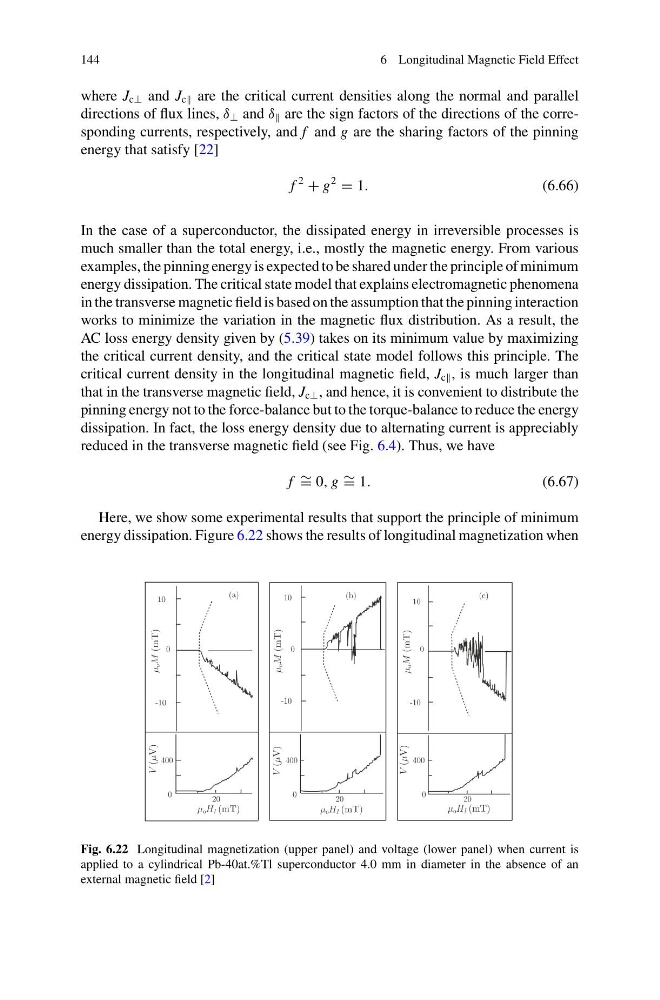
Here, we show some experimental results that support the principle of minimum
energy dissipation. Figure 6.22 shows the results of longitudinal magnetization when
Fig. 6.22 Longitudinal magnetization (upper panel) and voltage (lower panel) when current is
applied to a cylindrical Pb-40at.%Tl superconductor 4.0 mm in diameter in the absence of an
external magnetic field [2]
6 Longitudinal Magnetic Field Effect
where J c⊥ and J c are the critical current densities along the normal and parallel
directions of flux lines, δ ⊥ and δ are the sign factors of the directions of the corresponding currents, respectively, and f and g are the sharing factors of the pinning
energy that satisfy [22]
f
2
+ g
2
= 1.
(6.66)
In the case of a superconductor, the dissipated energy in irreversible processes is
much smaller than the total energy, i.e., mostly the magnetic energy. From various
examples, the pinning energy is expected to be shared under the principle of minimum
energy dissipation. The critical state model that explains electromagnetic phenomena
in the transverse magnetic field is based on the assumption that the pinning interaction
works to minimize the variation in the magnetic flux distribution. As a result, the
AC loss energy density given by (5.39) takes on its minimum value by maximizing
the critical current density, and the critical state model follows this principle. The
critical current density in the longitudinal magnetic field, J c , is much larger than
that in the transverse magnetic field, J c⊥ , and hence, it is convenient to distribute the
pinning energy not to the force-balance but to the torque-balance to reduce the energy
dissipation. In fact, the loss energy density due to alternating current is appreciably
reduced in the transverse magnetic field (see Fig. 6.4). Thus, we have
f ∼ = 0, g ∼ = 1.
(6.67)
Here, we show some experimental results that support the principle of minimum
energy dissipation. Figure 6.22 shows the results of longitudinal magnetization when
Fig. 6.22 Longitudinal magnetization (upper panel) and voltage (lower panel) when current is
applied to a cylindrical Pb-40at.%Tl superconductor 4.0 mm in diameter in the absence of an
external magnetic field [2]