

6.5 Completion of Theory
143
a problem. Equation (4.41) is derived from its variation with respect to time. It is
proved, however, both experimentally and theoretically that (4.41) does not hold.
Here, we examine the phenomenon in the force-free state treated in Sect. 6.4.
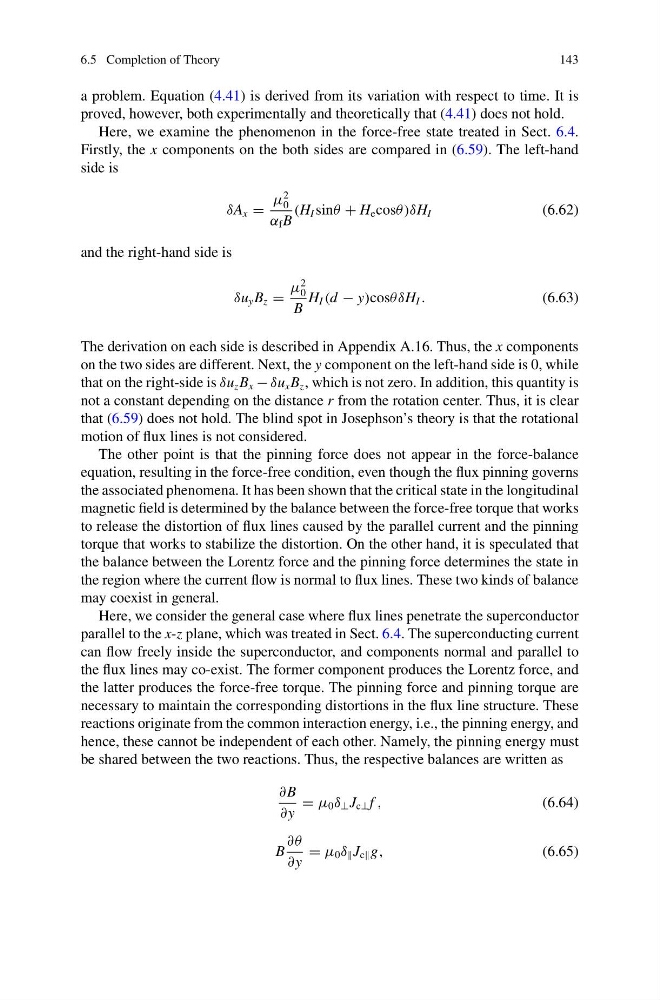
Firstly, the x components on the both sides are compared in (6.59). The left-hand
side is
δA x =
μ
2
0
α f B
(H I sinθ + H e cosθ )δH I
(6.62)
and the right-hand side is
δu y B z =
μ
2
0
B
H I (d − y)cosθδH I .
(6.63)
The derivation on each side is described in Appendix A.16. Thus, the x components
on the two sides are different. Next, the y component on the left-hand side is 0, while
that on the right-side is δu z B x − δu x B z , which is not zero. In addition, this quantity is
not a constant depending on the distance r from the rotation center. Thus, it is clear
that (6.59) does not hold. The blind spot in Josephson’s theory is that the rotational
motion of flux lines is not considered.
The other point is that the pinning force does not appear in the force-balance
equation, resulting in the force-free condition, even though the flux pinning governs
the associated phenomena. It has been shown that the critical state in the longitudinal
magnetic field is determined by the balance between the force-free torque that works
to release the distortion of flux lines caused by the parallel current and the pinning
torque that works to stabilize the distortion. On the other hand, it is speculated that
the balance between the Lorentz force and the pinning force determines the state in
the region where the current flow is normal to flux lines. These two kinds of balance
may coexist in general.
Here, we consider the general case where flux lines penetrate the superconductor
parallel to the x-z plane, which was treated in Sect. 6.4. The superconducting current
can flow freely inside the superconductor, and components normal and parallel to
the flux lines may co-exist. The former component produces the Lorentz force, and
the latter produces the force-free torque. The pinning force and pinning torque are
necessary to maintain the corresponding distortions in the flux line structure. These
reactions originate from the common interaction energy, i.e., the pinning energy, and
hence, these cannot be independent of each other. Namely, the pinning energy must
be shared between the two reactions. Thus, the respective balances are written as
∂B
∂y
= μ 0 δ ⊥ J c⊥ f ,
(6.64)
B
∂θ
∂y
= μ 0 δ J c g,
(6.65)
143
a problem. Equation (4.41) is derived from its variation with respect to time. It is
proved, however, both experimentally and theoretically that (4.41) does not hold.
Here, we examine the phenomenon in the force-free state treated in Sect. 6.4.
Firstly, the x components on the both sides are compared in (6.59). The left-hand
side is
δA x =
μ
2
0
α f B
(H I sinθ + H e cosθ )δH I
(6.62)
and the right-hand side is
δu y B z =
μ
2
0
B
H I (d − y)cosθδH I .
(6.63)
The derivation on each side is described in Appendix A.16. Thus, the x components
on the two sides are different. Next, the y component on the left-hand side is 0, while
that on the right-side is δu z B x − δu x B z , which is not zero. In addition, this quantity is
not a constant depending on the distance r from the rotation center. Thus, it is clear
that (6.59) does not hold. The blind spot in Josephson’s theory is that the rotational
motion of flux lines is not considered.
The other point is that the pinning force does not appear in the force-balance
equation, resulting in the force-free condition, even though the flux pinning governs
the associated phenomena. It has been shown that the critical state in the longitudinal
magnetic field is determined by the balance between the force-free torque that works
to release the distortion of flux lines caused by the parallel current and the pinning
torque that works to stabilize the distortion. On the other hand, it is speculated that
the balance between the Lorentz force and the pinning force determines the state in
the region where the current flow is normal to flux lines. These two kinds of balance
may coexist in general.
Here, we consider the general case where flux lines penetrate the superconductor
parallel to the x-z plane, which was treated in Sect. 6.4. The superconducting current
can flow freely inside the superconductor, and components normal and parallel to
the flux lines may co-exist. The former component produces the Lorentz force, and
the latter produces the force-free torque. The pinning force and pinning torque are
necessary to maintain the corresponding distortions in the flux line structure. These
reactions originate from the common interaction energy, i.e., the pinning energy, and
hence, these cannot be independent of each other. Namely, the pinning energy must
be shared between the two reactions. Thus, the respective balances are written as
∂B
∂y
= μ 0 δ ⊥ J c⊥ f ,
(6.64)
B
∂θ
∂y
= μ 0 δ J c g,
(6.65)