

6.5 Completion of Theory
145
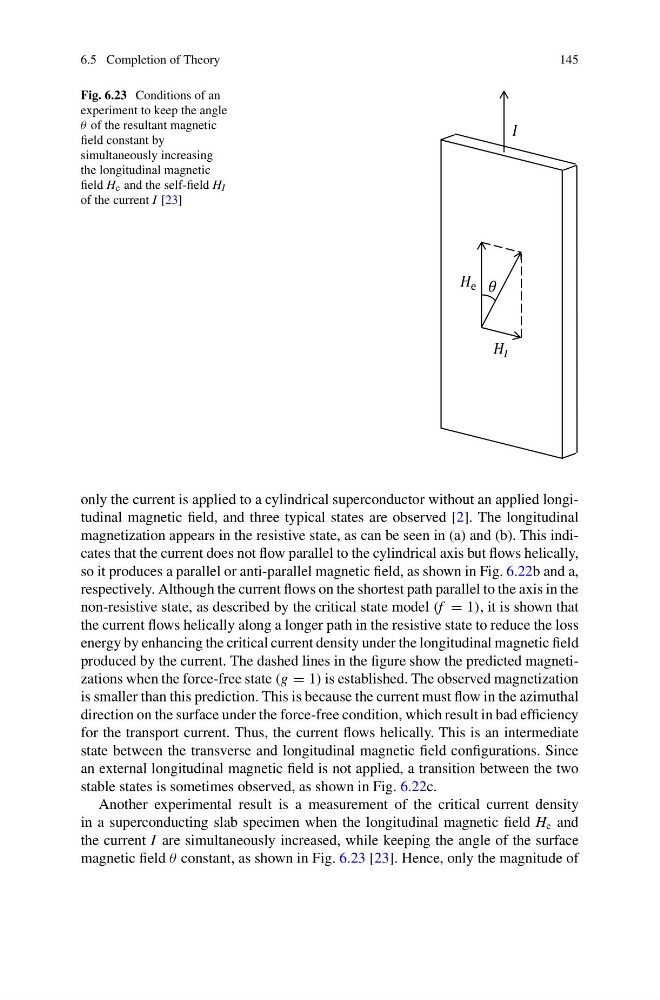
Fig. 6.23 Conditions of an
experiment to keep the angle
θ of the resultant magnetic
field constant by
simultaneously increasing
the longitudinal magnetic
field H e and the self-field H I
of the current I [23]
only the current is applied to a cylindrical superconductor without an applied longitudinal magnetic field, and three typical states are observed [2]. The longitudinal
magnetization appears in the resistive state, as can be seen in (a) and (b). This indicates that the current does not flow parallel to the cylindrical axis but flows helically,
so it produces a parallel or anti-parallel magnetic field, as shown in Fig. 6.22b and a,
respectively. Although the current flows on the shortest path parallel to the axis in the
non-resistive state, as described by the critical state model (f = 1), it is shown that
the current flows helically along a longer path in the resistive state to reduce the loss
energy by enhancing the critical current density under the longitudinal magnetic field
produced by the current. The dashed lines in the figure show the predicted magnetizations when the force-free state (g = 1) is established. The observed magnetization
is smaller than this prediction. This is because the current must flow in the azimuthal
direction on the surface under the force-free condition, which result in bad efficiency
for the transport current. Thus, the current flows helically. This is an intermediate
state between the transverse and longitudinal magnetic field configurations. Since
an external longitudinal magnetic field is not applied, a transition between the two
stable states is sometimes observed, as shown in Fig. 6.22c.
Another experimental result is a measurement of the critical current density
in a superconducting slab specimen when the longitudinal magnetic field H e and
the current I are simultaneously increased, while keeping the angle of the surface
magnetic field θ constant, as shown in Fig. 6.23 [23]. Hence, only the magnitude of
145
Fig. 6.23 Conditions of an
experiment to keep the angle
θ of the resultant magnetic
field constant by
simultaneously increasing
the longitudinal magnetic
field H e and the self-field H I
of the current I [23]
only the current is applied to a cylindrical superconductor without an applied longitudinal magnetic field, and three typical states are observed [2]. The longitudinal
magnetization appears in the resistive state, as can be seen in (a) and (b). This indicates that the current does not flow parallel to the cylindrical axis but flows helically,
so it produces a parallel or anti-parallel magnetic field, as shown in Fig. 6.22b and a,
respectively. Although the current flows on the shortest path parallel to the axis in the
non-resistive state, as described by the critical state model (f = 1), it is shown that
the current flows helically along a longer path in the resistive state to reduce the loss
energy by enhancing the critical current density under the longitudinal magnetic field
produced by the current. The dashed lines in the figure show the predicted magnetizations when the force-free state (g = 1) is established. The observed magnetization
is smaller than this prediction. This is because the current must flow in the azimuthal
direction on the surface under the force-free condition, which result in bad efficiency
for the transport current. Thus, the current flows helically. This is an intermediate
state between the transverse and longitudinal magnetic field configurations. Since
an external longitudinal magnetic field is not applied, a transition between the two
stable states is sometimes observed, as shown in Fig. 6.22c.
Another experimental result is a measurement of the critical current density
in a superconducting slab specimen when the longitudinal magnetic field H e and
the current I are simultaneously increased, while keeping the angle of the surface
magnetic field θ constant, as shown in Fig. 6.23 [23]. Hence, only the magnitude of