

6.4 Electromagnetic Phenomena Caused by Rotation of Flux Lines
137
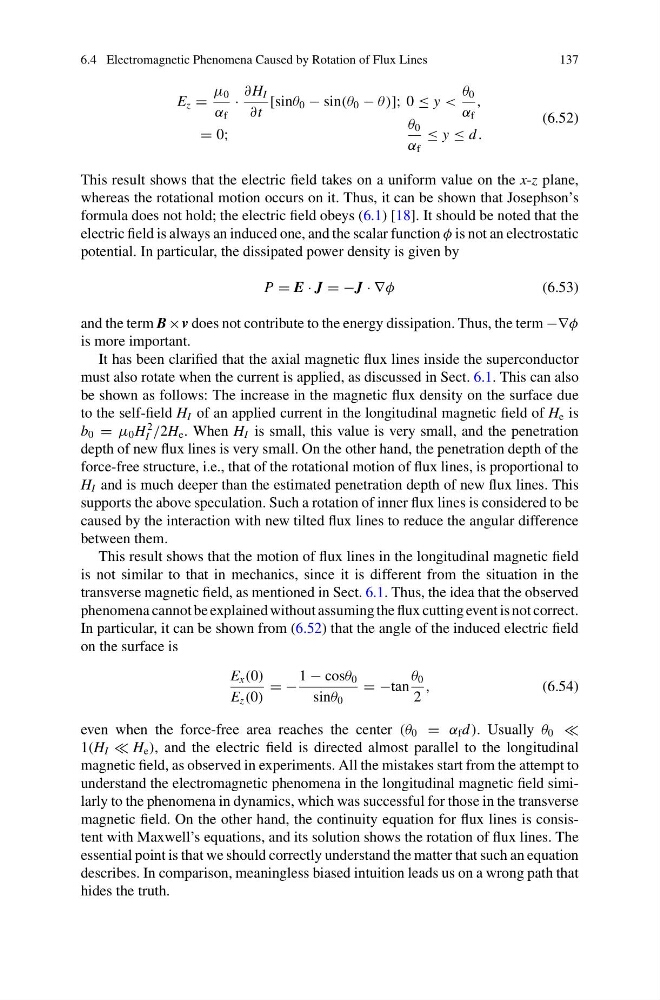
E z =
μ 0
α f
·
∂H I
∂t
[sinθ 0 − sin(θ 0 − θ)]; 0 ≤ y <
θ 0
α f
,
= 0;
θ 0
α f
≤ y ≤ d .
(6.52)
This result shows that the electric field takes on a uniform value on the x-z plane,
whereas the rotational motion occurs on it. Thus, it can be shown that Josephson’s
formula does not hold; the electric field obeys (6.1) [18]. It should be noted that the
electric field is always an induced one, and the scalar function φ is not an electrostatic
potential. In particular, the dissipated power density is given by
P = E · J = −J · ∇φ
(6.53)
and the term B × v does not contribute to the energy dissipation. Thus, the term −∇φ
is more important.
It has been clarified that the axial magnetic flux lines inside the superconductor
must also rotate when the current is applied, as discussed in Sect. 6.1. This can also
be shown as follows: The increase in the magnetic flux density on the surface due
to the self-field H I of an applied current in the longitudinal magnetic field of H e is
b 0 = μ 0 H
2
I /2H e . When H I is small, this value is very small, and the penetration
depth of new flux lines is very small. On the other hand, the penetration depth of the
force-free structure, i.e., that of the rotational motion of flux lines, is proportional to
H I and is much deeper than the estimated penetration depth of new flux lines. This
supports the above speculation. Such a rotation of inner flux lines is considered to be
caused by the interaction with new tilted flux lines to reduce the angular difference
between them.
This result shows that the motion of flux lines in the longitudinal magnetic field
is not similar to that in mechanics, since it is different from the situation in the
transverse magnetic field, as mentioned in Sect. 6.1. Thus, the idea that the observed
phenomena cannot be explained without assuming the flux cutting event is not correct.
In particular, it can be shown from (6.52) that the angle of the induced electric field
on the surface is
E x (0)
E z (0)
= −
1 − cosθ 0
sinθ 0
= −tan
θ 0
2
,
(6.54)
even when the force-free area reaches the center (θ 0 = α f d ). Usually θ 0
1(H I H e ), and the electric field is directed almost parallel to the longitudinal
magnetic field, as observed in experiments. All the mistakes start from the attempt to
understand the electromagnetic phenomena in the longitudinal magnetic field similarly to the phenomena in dynamics, which was successful for those in the transverse
magnetic field. On the other hand, the continuity equation for flux lines is consistent with Maxwell’s equations, and its solution shows the rotation of flux lines. The
essential point is that we should correctly understand the matter that such an equation
describes. In comparison, meaningless biased intuition leads us on a wrong path that
hides the truth.
137
E z =
μ 0
α f
·
∂H I
∂t
[sinθ 0 − sin(θ 0 − θ)]; 0 ≤ y <
θ 0
α f
,
= 0;
θ 0
α f
≤ y ≤ d .
(6.52)
This result shows that the electric field takes on a uniform value on the x-z plane,
whereas the rotational motion occurs on it. Thus, it can be shown that Josephson’s
formula does not hold; the electric field obeys (6.1) [18]. It should be noted that the
electric field is always an induced one, and the scalar function φ is not an electrostatic
potential. In particular, the dissipated power density is given by
P = E · J = −J · ∇φ
(6.53)
and the term B × v does not contribute to the energy dissipation. Thus, the term −∇φ
is more important.
It has been clarified that the axial magnetic flux lines inside the superconductor
must also rotate when the current is applied, as discussed in Sect. 6.1. This can also
be shown as follows: The increase in the magnetic flux density on the surface due
to the self-field H I of an applied current in the longitudinal magnetic field of H e is
b 0 = μ 0 H
2
I /2H e . When H I is small, this value is very small, and the penetration
depth of new flux lines is very small. On the other hand, the penetration depth of the
force-free structure, i.e., that of the rotational motion of flux lines, is proportional to
H I and is much deeper than the estimated penetration depth of new flux lines. This
supports the above speculation. Such a rotation of inner flux lines is considered to be
caused by the interaction with new tilted flux lines to reduce the angular difference
between them.
This result shows that the motion of flux lines in the longitudinal magnetic field
is not similar to that in mechanics, since it is different from the situation in the
transverse magnetic field, as mentioned in Sect. 6.1. Thus, the idea that the observed
phenomena cannot be explained without assuming the flux cutting event is not correct.
In particular, it can be shown from (6.52) that the angle of the induced electric field
on the surface is
E x (0)
E z (0)
= −
1 − cosθ 0
sinθ 0
= −tan
θ 0
2
,
(6.54)
even when the force-free area reaches the center (θ 0 = α f d ). Usually θ 0
1(H I H e ), and the electric field is directed almost parallel to the longitudinal
magnetic field, as observed in experiments. All the mistakes start from the attempt to
understand the electromagnetic phenomena in the longitudinal magnetic field similarly to the phenomena in dynamics, which was successful for those in the transverse
magnetic field. On the other hand, the continuity equation for flux lines is consistent with Maxwell’s equations, and its solution shows the rotation of flux lines. The
essential point is that we should correctly understand the matter that such an equation
describes. In comparison, meaningless biased intuition leads us on a wrong path that
hides the truth.