

6.2 Clue to the Solution
129
longitudinal field effect is realized only in superconductors. The magnetic helicity
is discussed in Appendix A.13.
Here, we show that the paramagnetic effect can be obtained in the force-free state.
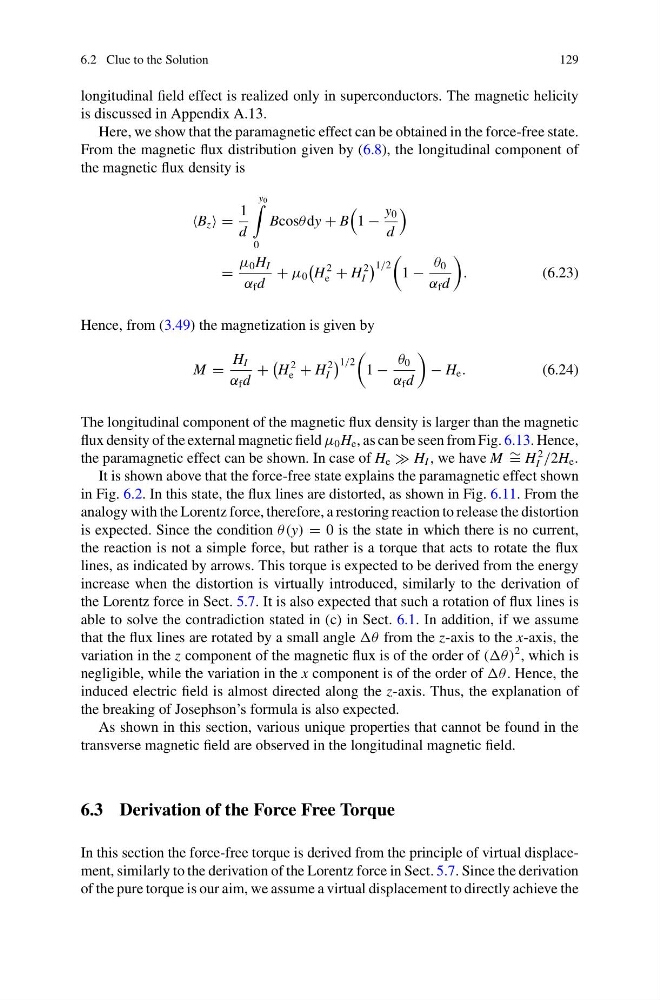
From the magnetic flux distribution given by (6.8), the longitudinal component of
the magnetic flux density is
B z =
1
d
y 0
0
Bcosθ dy + B
1 −
y 0
d
=
μ 0 H I
α f d
+ μ 0
H
2
e + H
2
I
1/2
1 −
θ 0
α f d
.
(6.23)
Hence, from (3.49) the magnetization is given by
M =
H I
α f d
+
H
2
e + H
2
I
1/2
1 −
θ 0
α f d
− H e .
(6.24)
The longitudinal component of the magnetic flux density is larger than the magnetic
flux density of the external magnetic field μ 0 H e , as can be seen from Fig. 6.13. Hence,
the paramagnetic effect can be shown. In case of H e H I , we have M ∼ = H
2
I /2H e .
It is shown above that the force-free state explains the paramagnetic effect shown
in Fig. 6.2. In this state, the flux lines are distorted, as shown in Fig. 6.11. From the
analogy with the Lorentz force, therefore, a restoring reaction to release the distortion
is expected. Since the condition θ (y) = 0 is the state in which there is no current,
the reaction is not a simple force, but rather is a torque that acts to rotate the flux
lines, as indicated by arrows. This torque is expected to be derived from the energy
increase when the distortion is virtually introduced, similarly to the derivation of
the Lorentz force in Sect. 5.7. It is also expected that such a rotation of flux lines is
able to solve the contradiction stated in (c) in Sect. 6.1. In addition, if we assume
that the flux lines are rotated by a small angle θ from the z-axis to the x-axis, the
variation in the z component of the magnetic flux is of the order of (θ)
2 , which is
negligible, while the variation in the x component is of the order of θ . Hence, the
induced electric field is almost directed along the z-axis. Thus, the explanation of
the breaking of Josephson’s formula is also expected.
As shown in this section, various unique properties that cannot be found in the
transverse magnetic field are observed in the longitudinal magnetic field.
6.3 Derivation of the Force Free Torque
In this section the force-free torque is derived from the principle of virtual displacement, similarly to the derivation of the Lorentz force in Sect. 5.7. Since the derivation
of the pure torque is our aim, we assume a virtual displacement to directly achieve the
129
longitudinal field effect is realized only in superconductors. The magnetic helicity
is discussed in Appendix A.13.
Here, we show that the paramagnetic effect can be obtained in the force-free state.
From the magnetic flux distribution given by (6.8), the longitudinal component of
the magnetic flux density is
B z =
1
d
y 0
0
Bcosθ dy + B
1 −
y 0
d
=
μ 0 H I
α f d
+ μ 0
H
2
e + H
2
I
1/2
1 −
θ 0
α f d
.
(6.23)
Hence, from (3.49) the magnetization is given by
M =
H I
α f d
+
H
2
e + H
2
I
1/2
1 −
θ 0
α f d
− H e .
(6.24)
The longitudinal component of the magnetic flux density is larger than the magnetic
flux density of the external magnetic field μ 0 H e , as can be seen from Fig. 6.13. Hence,
the paramagnetic effect can be shown. In case of H e H I , we have M ∼ = H
2
I /2H e .
It is shown above that the force-free state explains the paramagnetic effect shown
in Fig. 6.2. In this state, the flux lines are distorted, as shown in Fig. 6.11. From the
analogy with the Lorentz force, therefore, a restoring reaction to release the distortion
is expected. Since the condition θ (y) = 0 is the state in which there is no current,
the reaction is not a simple force, but rather is a torque that acts to rotate the flux
lines, as indicated by arrows. This torque is expected to be derived from the energy
increase when the distortion is virtually introduced, similarly to the derivation of
the Lorentz force in Sect. 5.7. It is also expected that such a rotation of flux lines is
able to solve the contradiction stated in (c) in Sect. 6.1. In addition, if we assume
that the flux lines are rotated by a small angle θ from the z-axis to the x-axis, the
variation in the z component of the magnetic flux is of the order of (θ)
2 , which is
negligible, while the variation in the x component is of the order of θ . Hence, the
induced electric field is almost directed along the z-axis. Thus, the explanation of
the breaking of Josephson’s formula is also expected.
As shown in this section, various unique properties that cannot be found in the
transverse magnetic field are observed in the longitudinal magnetic field.
6.3 Derivation of the Force Free Torque
In this section the force-free torque is derived from the principle of virtual displacement, similarly to the derivation of the Lorentz force in Sect. 5.7. Since the derivation
of the pure torque is our aim, we assume a virtual displacement to directly achieve the