

128
6 Longitudinal Magnetic Field Effect
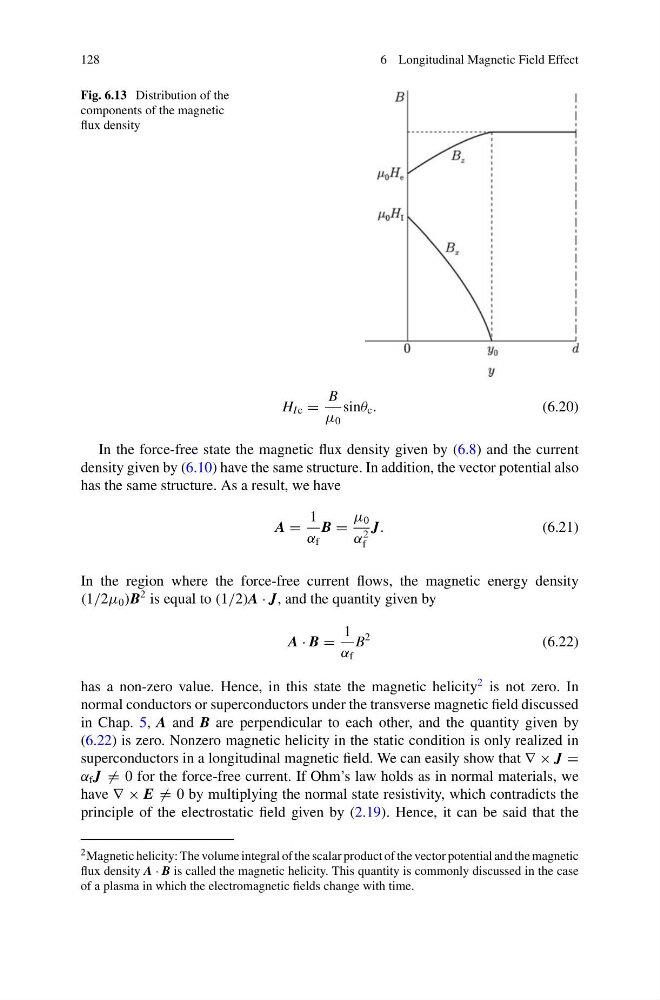
Fig. 6.13 Distribution of the
components of the magnetic
flux density
H I c =
B
μ 0
sinθ c .
(6.20)
In the force-free state the magnetic flux density given by (6.8) and the current
density given by (6.10) have the same structure. In addition, the vector potential also
has the same structure. As a result, we have
A =
1
α f
B =
μ 0
α
2
f
J.
(6.21)
In the region where the force-free current flows, the magnetic energy density
(1/2μ 0 )B
2 is equal to (1/2)A · J, and the quantity given by
A · B =
1
α f
B
2
(6.22)
has a non-zero value. Hence, in this state the magnetic helicity
2 is not zero. In
normal conductors or superconductors under the transverse magnetic field discussed
in Chap. 5, A and B are perpendicular to each other, and the quantity given by
(6.22) is zero. Nonzero magnetic helicity in the static condition is only realized in
superconductors in a longitudinal magnetic field. We can easily show that ∇ × J =
α f J = 0 for the force-free current. If Ohm’s law holds as in normal materials, we
have ∇ × E = 0 by multiplying the normal state resistivity, which contradicts the
principle of the electrostatic field given by (2.19). Hence, it can be said that the
2 Magnetic helicity: The volume integral of the scalar product of the vector potential and the magnetic
flux density A · B is called the magnetic helicity. This quantity is commonly discussed in the case
of a plasma in which the electromagnetic fields change with time.
6 Longitudinal Magnetic Field Effect
Fig. 6.13 Distribution of the
components of the magnetic
flux density
H I c =
B
μ 0
sinθ c .
(6.20)
In the force-free state the magnetic flux density given by (6.8) and the current
density given by (6.10) have the same structure. In addition, the vector potential also
has the same structure. As a result, we have
A =
1
α f
B =
μ 0
α
2
f
J.
(6.21)
In the region where the force-free current flows, the magnetic energy density
(1/2μ 0 )B
2 is equal to (1/2)A · J, and the quantity given by
A · B =
1
α f
B
2
(6.22)
has a non-zero value. Hence, in this state the magnetic helicity
2 is not zero. In
normal conductors or superconductors under the transverse magnetic field discussed
in Chap. 5, A and B are perpendicular to each other, and the quantity given by
(6.22) is zero. Nonzero magnetic helicity in the static condition is only realized in
superconductors in a longitudinal magnetic field. We can easily show that ∇ × J =
α f J = 0 for the force-free current. If Ohm’s law holds as in normal materials, we
have ∇ × E = 0 by multiplying the normal state resistivity, which contradicts the
principle of the electrostatic field given by (2.19). Hence, it can be said that the
2 Magnetic helicity: The volume integral of the scalar product of the vector potential and the magnetic
flux density A · B is called the magnetic helicity. This quantity is commonly discussed in the case
of a plasma in which the electromagnetic fields change with time.