

124
6 Longitudinal Magnetic Field Effect
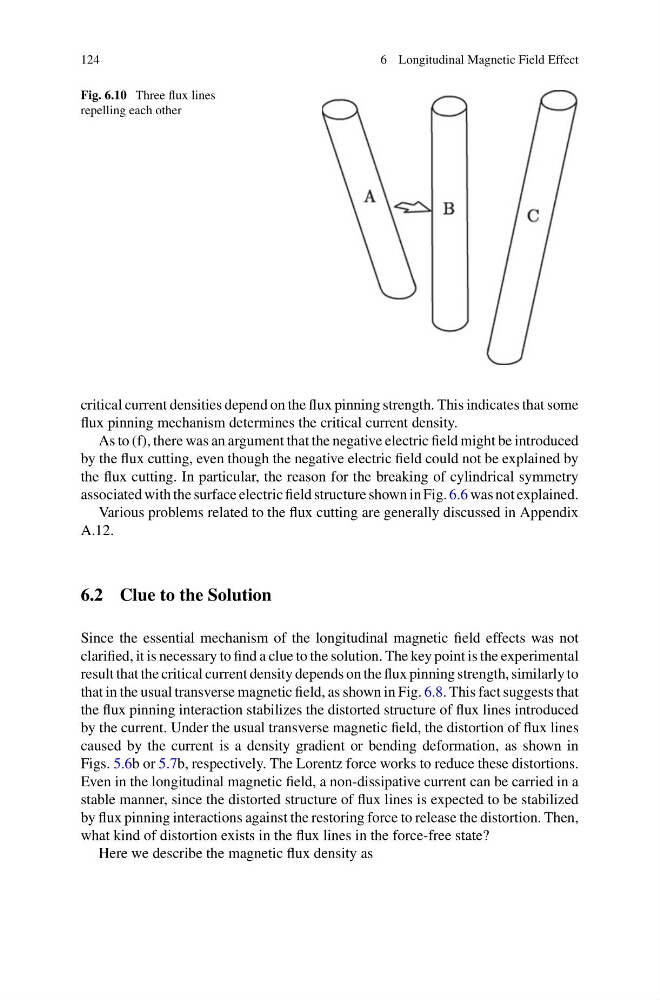
Fig. 6.10 Three flux lines
repelling each other
critical current densities depend on the flux pinning strength. This indicates that some
flux pinning mechanism determines the critical current density.
As to (f), there was an argument that the negative electric field might be introduced
by the flux cutting, even though the negative electric field could not be explained by
the flux cutting. In particular, the reason for the breaking of cylindrical symmetry
associated with the surface electric field structure shown in Fig. 6.6 was not explained.
Various problems related to the flux cutting are generally discussed in Appendix
A.12.
6.2 Clue to the Solution
Since the essential mechanism of the longitudinal magnetic field effects was not
clarified, it is necessary to find a clue to the solution. The key point is the experimental
result that the critical current density depends on the flux pinning strength, similarly to
that in the usual transverse magnetic field, as shown in Fig. 6.8. This fact suggests that
the flux pinning interaction stabilizes the distorted structure of flux lines introduced
by the current. Under the usual transverse magnetic field, the distortion of flux lines
caused by the current is a density gradient or bending deformation, as shown in
Figs. 5.6b or 5.7b, respectively. The Lorentz force works to reduce these distortions.
Even in the longitudinal magnetic field, a non-dissipative current can be carried in a
stable manner, since the distorted structure of flux lines is expected to be stabilized
by flux pinning interactions against the restoring force to release the distortion. Then,
what kind of distortion exists in the flux lines in the force-free state?
Here we describe the magnetic flux density as
6 Longitudinal Magnetic Field Effect
Fig. 6.10 Three flux lines
repelling each other
critical current densities depend on the flux pinning strength. This indicates that some
flux pinning mechanism determines the critical current density.
As to (f), there was an argument that the negative electric field might be introduced
by the flux cutting, even though the negative electric field could not be explained by
the flux cutting. In particular, the reason for the breaking of cylindrical symmetry
associated with the surface electric field structure shown in Fig. 6.6 was not explained.
Various problems related to the flux cutting are generally discussed in Appendix
A.12.
6.2 Clue to the Solution
Since the essential mechanism of the longitudinal magnetic field effects was not
clarified, it is necessary to find a clue to the solution. The key point is the experimental
result that the critical current density depends on the flux pinning strength, similarly to
that in the usual transverse magnetic field, as shown in Fig. 6.8. This fact suggests that
the flux pinning interaction stabilizes the distorted structure of flux lines introduced
by the current. Under the usual transverse magnetic field, the distortion of flux lines
caused by the current is a density gradient or bending deformation, as shown in
Figs. 5.6b or 5.7b, respectively. The Lorentz force works to reduce these distortions.
Even in the longitudinal magnetic field, a non-dissipative current can be carried in a
stable manner, since the distorted structure of flux lines is expected to be stabilized
by flux pinning interactions against the restoring force to release the distortion. Then,
what kind of distortion exists in the flux lines in the force-free state?
Here we describe the magnetic flux density as