

6.1 Experimental Results
123
If the flux cutting event occurs as assumed in (d), the flux lines that cut each
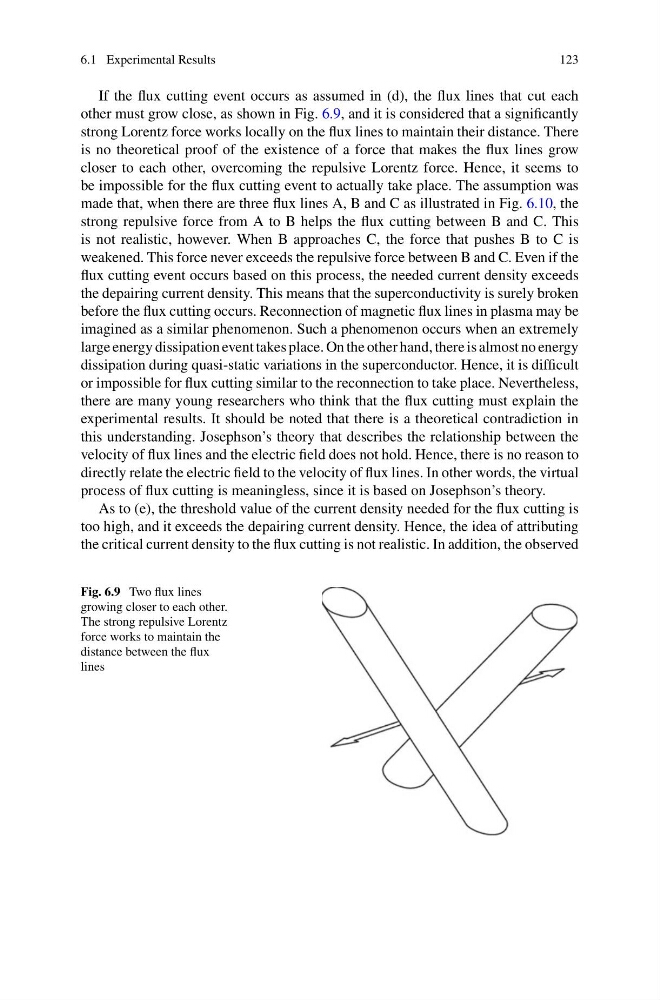
other must grow close, as shown in Fig. 6.9, and it is considered that a significantly
strong Lorentz force works locally on the flux lines to maintain their distance. There
is no theoretical proof of the existence of a force that makes the flux lines grow
closer to each other, overcoming the repulsive Lorentz force. Hence, it seems to
be impossible for the flux cutting event to actually take place. The assumption was
made that, when there are three flux lines A, B and C as illustrated in Fig. 6.10, the
strong repulsive force from A to B helps the flux cutting between B and C. This
is not realistic, however. When B approaches C, the force that pushes B to C is
weakened. This force never exceeds the repulsive force between B and C. Even if the
flux cutting event occurs based on this process, the needed current density exceeds
the depairing current density. This means that the superconductivity is surely broken
before the flux cutting occurs. Reconnection of magnetic flux lines in plasma may be
imagined as a similar phenomenon. Such a phenomenon occurs when an extremely
large energy dissipation event takes place. On the other hand, there is almost no energy
dissipation during quasi-static variations in the superconductor. Hence, it is difficult
or impossible for flux cutting similar to the reconnection to take place. Nevertheless,
there are many young researchers who think that the flux cutting must explain the
experimental results. It should be noted that there is a theoretical contradiction in
this understanding. Josephson’s theory that describes the relationship between the
velocity of flux lines and the electric field does not hold. Hence, there is no reason to
directly relate the electric field to the velocity of flux lines. In other words, the virtual
process of flux cutting is meaningless, since it is based on Josephson’s theory.
As to (e), the threshold value of the current density needed for the flux cutting is
too high, and it exceeds the depairing current density. Hence, the idea of attributing
the critical current density to the flux cutting is not realistic. In addition, the observed
Fig. 6.9 Two flux lines
growing closer to each other.
The strong repulsive Lorentz
force works to maintain the
distance between the flux
lines
123
If the flux cutting event occurs as assumed in (d), the flux lines that cut each
other must grow close, as shown in Fig. 6.9, and it is considered that a significantly
strong Lorentz force works locally on the flux lines to maintain their distance. There
is no theoretical proof of the existence of a force that makes the flux lines grow
closer to each other, overcoming the repulsive Lorentz force. Hence, it seems to
be impossible for the flux cutting event to actually take place. The assumption was
made that, when there are three flux lines A, B and C as illustrated in Fig. 6.10, the
strong repulsive force from A to B helps the flux cutting between B and C. This
is not realistic, however. When B approaches C, the force that pushes B to C is
weakened. This force never exceeds the repulsive force between B and C. Even if the
flux cutting event occurs based on this process, the needed current density exceeds
the depairing current density. This means that the superconductivity is surely broken
before the flux cutting occurs. Reconnection of magnetic flux lines in plasma may be
imagined as a similar phenomenon. Such a phenomenon occurs when an extremely
large energy dissipation event takes place. On the other hand, there is almost no energy
dissipation during quasi-static variations in the superconductor. Hence, it is difficult
or impossible for flux cutting similar to the reconnection to take place. Nevertheless,
there are many young researchers who think that the flux cutting must explain the
experimental results. It should be noted that there is a theoretical contradiction in
this understanding. Josephson’s theory that describes the relationship between the
velocity of flux lines and the electric field does not hold. Hence, there is no reason to
directly relate the electric field to the velocity of flux lines. In other words, the virtual
process of flux cutting is meaningless, since it is based on Josephson’s theory.
As to (e), the threshold value of the current density needed for the flux cutting is
too high, and it exceeds the depairing current density. Hence, the idea of attributing
the critical current density to the flux cutting is not realistic. In addition, the observed
Fig. 6.9 Two flux lines
growing closer to each other.
The strong repulsive Lorentz
force works to maintain the
distance between the flux
lines