

122
6 Longitudinal Magnetic Field Effect
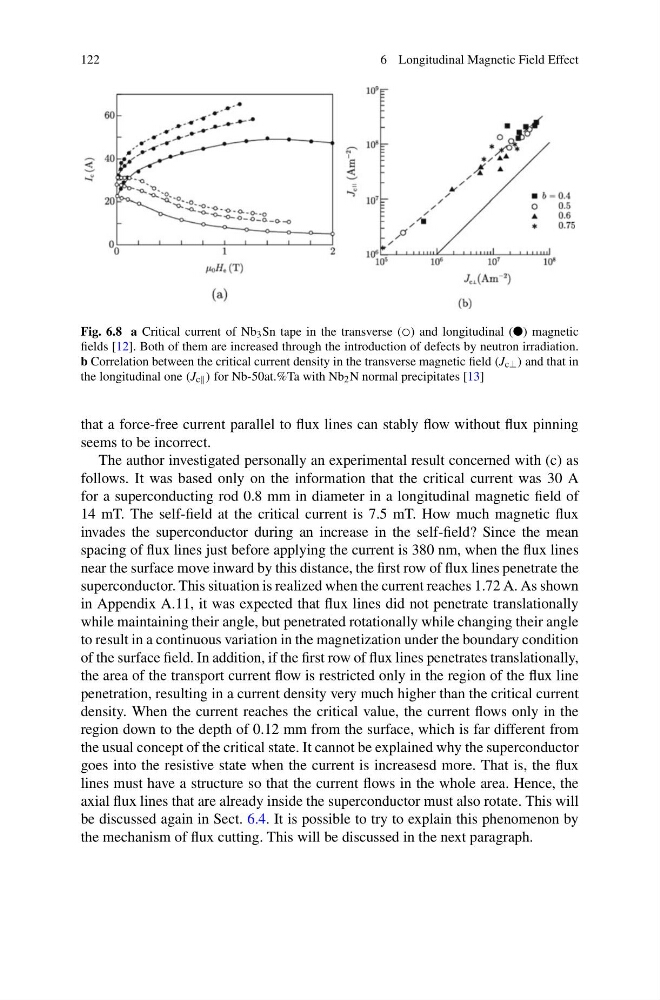
Fig. 6.8 a Critical current of Nb 3 Sn tape in the transverse (◯) and longitudinal (●) magnetic
fields [12]. Both of them are increased through the introduction of defects by neutron irradiation.
b Correlation between the critical current density in the transverse magnetic field (J c⊥ ) and that in
the longitudinal one (J c ) for Nb-50at.%Ta with Nb 2 N normal precipitates [13]
that a force-free current parallel to flux lines can stably flow without flux pinning
seems to be incorrect.
The author investigated personally an experimental result concerned with (c) as
follows. It was based only on the information that the critical current was 30 A
for a superconducting rod 0.8 mm in diameter in a longitudinal magnetic field of
14 mT. The self-field at the critical current is 7.5 mT. How much magnetic flux
invades the superconductor during an increase in the self-field? Since the mean
spacing of flux lines just before applying the current is 380 nm, when the flux lines
near the surface move inward by this distance, the first row of flux lines penetrate the
superconductor. This situation is realized when the current reaches 1.72 A. As shown
in Appendix A.11, it was expected that flux lines did not penetrate translationally
while maintaining their angle, but penetrated rotationally while changing their angle
to result in a continuous variation in the magnetization under the boundary condition
of the surface field. In addition, if the first row of flux lines penetrates translationally,
the area of the transport current flow is restricted only in the region of the flux line
penetration, resulting in a current density very much higher than the critical current
density. When the current reaches the critical value, the current flows only in the
region down to the depth of 0.12 mm from the surface, which is far different from
the usual concept of the critical state. It cannot be explained why the superconductor
goes into the resistive state when the current is increasesd more. That is, the flux
lines must have a structure so that the current flows in the whole area. Hence, the
axial flux lines that are already inside the superconductor must also rotate. This will
be discussed again in Sect. 6.4. It is possible to try to explain this phenomenon by
the mechanism of flux cutting. This will be discussed in the next paragraph.
6 Longitudinal Magnetic Field Effect
Fig. 6.8 a Critical current of Nb 3 Sn tape in the transverse (◯) and longitudinal (●) magnetic
fields [12]. Both of them are increased through the introduction of defects by neutron irradiation.
b Correlation between the critical current density in the transverse magnetic field (J c⊥ ) and that in
the longitudinal one (J c ) for Nb-50at.%Ta with Nb 2 N normal precipitates [13]
that a force-free current parallel to flux lines can stably flow without flux pinning
seems to be incorrect.
The author investigated personally an experimental result concerned with (c) as
follows. It was based only on the information that the critical current was 30 A
for a superconducting rod 0.8 mm in diameter in a longitudinal magnetic field of
14 mT. The self-field at the critical current is 7.5 mT. How much magnetic flux
invades the superconductor during an increase in the self-field? Since the mean
spacing of flux lines just before applying the current is 380 nm, when the flux lines
near the surface move inward by this distance, the first row of flux lines penetrate the
superconductor. This situation is realized when the current reaches 1.72 A. As shown
in Appendix A.11, it was expected that flux lines did not penetrate translationally
while maintaining their angle, but penetrated rotationally while changing their angle
to result in a continuous variation in the magnetization under the boundary condition
of the surface field. In addition, if the first row of flux lines penetrates translationally,
the area of the transport current flow is restricted only in the region of the flux line
penetration, resulting in a current density very much higher than the critical current
density. When the current reaches the critical value, the current flows only in the
region down to the depth of 0.12 mm from the surface, which is far different from
the usual concept of the critical state. It cannot be explained why the superconductor
goes into the resistive state when the current is increasesd more. That is, the flux
lines must have a structure so that the current flows in the whole area. Hence, the
axial flux lines that are already inside the superconductor must also rotate. This will
be discussed again in Sect. 6.4. It is possible to try to explain this phenomenon by
the mechanism of flux cutting. This will be discussed in the next paragraph.