

6.1 Experimental Results
121
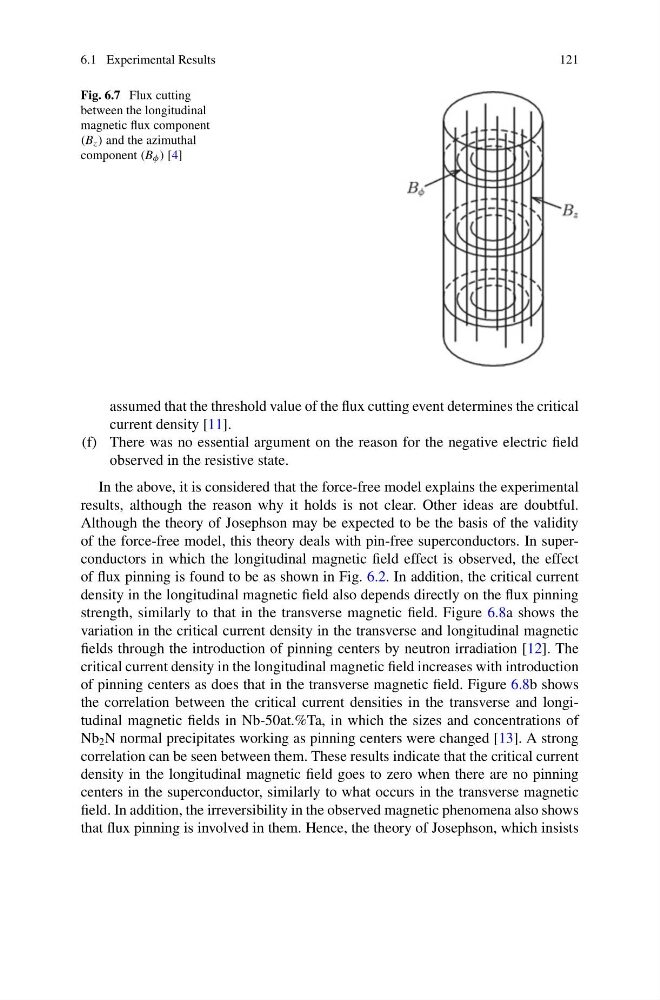
Fig. 6.7 Flux cutting
between the longitudinal
magnetic flux component
(B z ) and the azimuthal
component (B φ ) [4]
assumed that the threshold value of the flux cutting event determines the critical
current density [11].
(f) There was no essential argument on the reason for the negative electric field
observed in the resistive state.
In the above, it is considered that the force-free model explains the experimental
results, although the reason why it holds is not clear. Other ideas are doubtful.
Although the theory of Josephson may be expected to be the basis of the validity
of the force-free model, this theory deals with pin-free superconductors. In superconductors in which the longitudinal magnetic field effect is observed, the effect
of flux pinning is found to be as shown in Fig. 6.2. In addition, the critical current
density in the longitudinal magnetic field also depends directly on the flux pinning
strength, similarly to that in the transverse magnetic field. Figure 6.8a shows the
variation in the critical current density in the transverse and longitudinal magnetic
fields through the introduction of pinning centers by neutron irradiation [12]. The
critical current density in the longitudinal magnetic field increases with introduction
of pinning centers as does that in the transverse magnetic field. Figure 6.8b shows
the correlation between the critical current densities in the transverse and longitudinal magnetic fields in Nb-50at.%Ta, in which the sizes and concentrations of
Nb 2 N normal precipitates working as pinning centers were changed [13]. A strong
correlation can be seen between them. These results indicate that the critical current
density in the longitudinal magnetic field goes to zero when there are no pinning
centers in the superconductor, similarly to what occurs in the transverse magnetic
field. In addition, the irreversibility in the observed magnetic phenomena also shows
that flux pinning is involved in them. Hence, the theory of Josephson, which insists
121
Fig. 6.7 Flux cutting
between the longitudinal
magnetic flux component
(B z ) and the azimuthal
component (B φ ) [4]
assumed that the threshold value of the flux cutting event determines the critical
current density [11].
(f) There was no essential argument on the reason for the negative electric field
observed in the resistive state.
In the above, it is considered that the force-free model explains the experimental
results, although the reason why it holds is not clear. Other ideas are doubtful.
Although the theory of Josephson may be expected to be the basis of the validity
of the force-free model, this theory deals with pin-free superconductors. In superconductors in which the longitudinal magnetic field effect is observed, the effect
of flux pinning is found to be as shown in Fig. 6.2. In addition, the critical current
density in the longitudinal magnetic field also depends directly on the flux pinning
strength, similarly to that in the transverse magnetic field. Figure 6.8a shows the
variation in the critical current density in the transverse and longitudinal magnetic
fields through the introduction of pinning centers by neutron irradiation [12]. The
critical current density in the longitudinal magnetic field increases with introduction
of pinning centers as does that in the transverse magnetic field. Figure 6.8b shows
the correlation between the critical current densities in the transverse and longitudinal magnetic fields in Nb-50at.%Ta, in which the sizes and concentrations of
Nb 2 N normal precipitates working as pinning centers were changed [13]. A strong
correlation can be seen between them. These results indicate that the critical current
density in the longitudinal magnetic field goes to zero when there are no pinning
centers in the superconductor, similarly to what occurs in the transverse magnetic
field. In addition, the irreversibility in the observed magnetic phenomena also shows
that flux pinning is involved in them. Hence, the theory of Josephson, which insists