

5.5 Pinning Loss Energy Density
99
where T = a f /v is the period and the other constants are given by
K 1 = δ +
a f
f p + f pt
4f pt
+
η
∗ va f f p
4f pt
f p + f pt
, τ 1 =
η
∗ a f
4
f p + f pt
,
(5.73)
K 2 = δ + vt 1 −
a f
f p + f pt
4f pt
+
η
∗ va f f p
4f pt
f p − f pt
, τ 2 =
η
∗ a f
4
f p − f pt
.
(5.74)
The conditions at t = t 1 and t = T are respectively given by
vt 1 + K 1
1 − exp
−
t 1
τ 1
=
a f (f p + f pt )
2f pt
,
(5.75)
vt 1 + K 2
exp
a f − vt 1
vτ 2
− 1
=
a f (f p + f pt )
2f pt
.
(5.76)
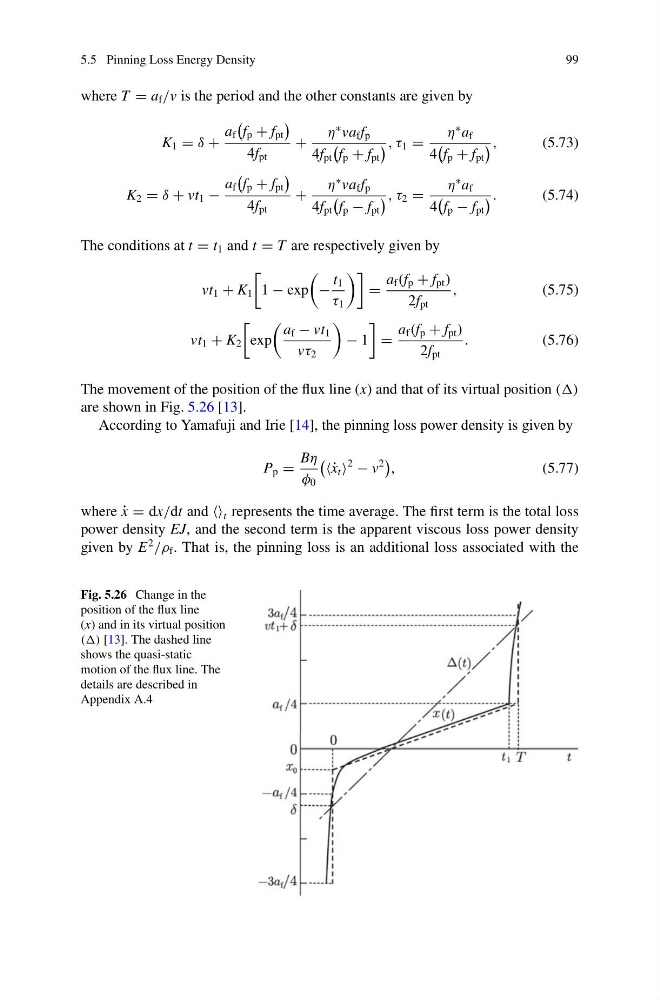
The movement of the position of the flux line (x) and that of its virtual position ()
are shown in Fig. 5.26 [13].
According to Yamafuji and Irie [14], the pinning loss power density is given by
P p =
Bη
φ 0
˙ x t
2
− v
2
,
(5.77)
where ˙
x = dx/dt and t represents the time average. The first term is the total loss
power density EJ, and the second term is the apparent viscous loss power density
given by E
2
/ρ f . That is, the pinning loss is an additional loss associated with the
Fig. 5.26 Change in the
position of the flux line
(x) and in its virtual position
() [13]. The dashed line
shows the quasi-static
motion of the flux line. The
details are described in
Appendix A.4
99
where T = a f /v is the period and the other constants are given by
K 1 = δ +
a f
f p + f pt
4f pt
+
η
∗ va f f p
4f pt
f p + f pt
, τ 1 =
η
∗ a f
4
f p + f pt
,
(5.73)
K 2 = δ + vt 1 −
a f
f p + f pt
4f pt
+
η
∗ va f f p
4f pt
f p − f pt
, τ 2 =
η
∗ a f
4
f p − f pt
.
(5.74)
The conditions at t = t 1 and t = T are respectively given by
vt 1 + K 1
1 − exp
−
t 1
τ 1
=
a f (f p + f pt )
2f pt
,
(5.75)
vt 1 + K 2
exp
a f − vt 1
vτ 2
− 1
=
a f (f p + f pt )
2f pt
.
(5.76)
The movement of the position of the flux line (x) and that of its virtual position ()
are shown in Fig. 5.26 [13].
According to Yamafuji and Irie [14], the pinning loss power density is given by
P p =
Bη
φ 0
˙ x t
2
− v
2
,
(5.77)
where ˙
x = dx/dt and t represents the time average. The first term is the total loss
power density EJ, and the second term is the apparent viscous loss power density
given by E
2
/ρ f . That is, the pinning loss is an additional loss associated with the
Fig. 5.26 Change in the
position of the flux line
(x) and in its virtual position
() [13]. The dashed line
shows the quasi-static
motion of the flux line. The
details are described in
Appendix A.4