

98
5 Flux Pinning Phenomena
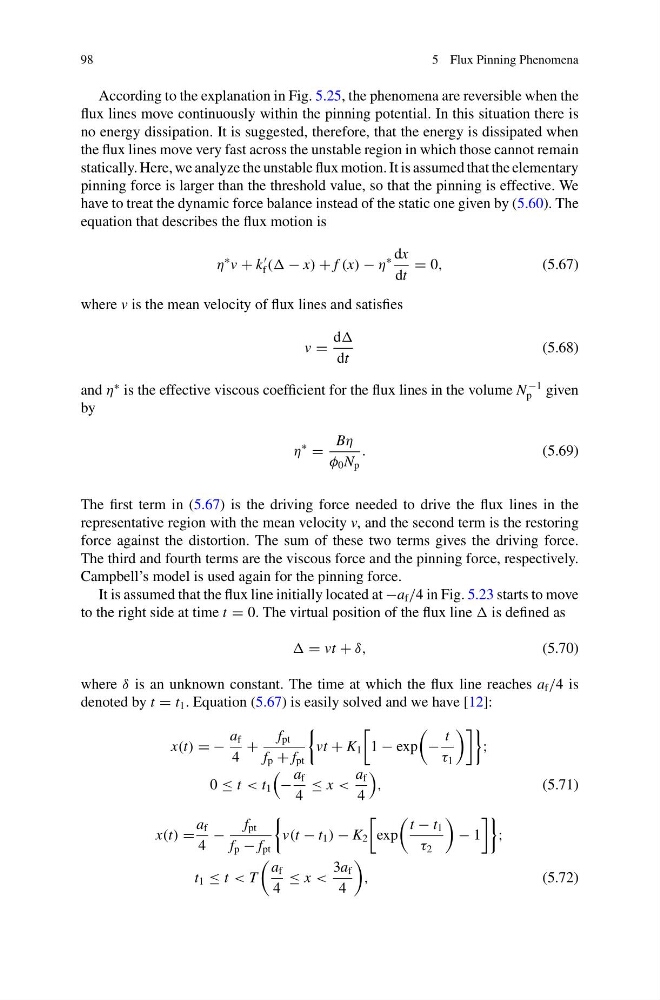
According to the explanation in Fig. 5.25, the phenomena are reversible when the
flux lines move continuously within the pinning potential. In this situation there is
no energy dissipation. It is suggested, therefore, that the energy is dissipated when
the flux lines move very fast across the unstable region in which those cannot remain
statically. Here, we analyze the unstable flux motion. It is assumed that the elementary
pinning force is larger than the threshold value, so that the pinning is effective. We
have to treat the dynamic force balance instead of the static one given by (5.60). The
equation that describes the flux motion is
η
∗ v + k
f ( − x) + f (x) − η
∗ dx
dt
= 0,
(5.67)
where v is the mean velocity of flux lines and satisfies
v =
d
dt
(5.68)
and η
∗ is the effective viscous coefficient for the flux lines in the volume N
−1
p given
by
η
∗
=
Bη
φ 0 N p
.
(5.69)
The first term in (5.67) is the driving force needed to drive the flux lines in the
representative region with the mean velocity v, and the second term is the restoring
force against the distortion. The sum of these two terms gives the driving force.
The third and fourth terms are the viscous force and the pinning force, respectively.
Campbell’s model is used again for the pinning force.
It is assumed that the flux line initially located at −a f /4 in Fig. 5.23 starts to move
to the right side at time t = 0. The virtual position of the flux line is defined as
= vt + δ,
(5.70)
where δ is an unknown constant. The time at which the flux line reaches a f /4 is
denoted by t = t 1 . Equation (5.67) is easily solved and we have [12]:
x(t) = −
a f
4
+
f pt
f p + f pt
vt + K 1
1 − exp
−
t
τ 1
;
0 ≤ t < t 1
−
a f
4
≤ x <
a f
4
,
(5.71)
x(t) =
a f
4
−
f pt
f p − f pt
v(t − t 1 ) − K 2
exp
t − t 1
τ 2
− 1
;
t 1 ≤ t < T
a f
4
≤ x <
3a f
4
,
(5.72)
5 Flux Pinning Phenomena
According to the explanation in Fig. 5.25, the phenomena are reversible when the
flux lines move continuously within the pinning potential. In this situation there is
no energy dissipation. It is suggested, therefore, that the energy is dissipated when
the flux lines move very fast across the unstable region in which those cannot remain
statically. Here, we analyze the unstable flux motion. It is assumed that the elementary
pinning force is larger than the threshold value, so that the pinning is effective. We
have to treat the dynamic force balance instead of the static one given by (5.60). The
equation that describes the flux motion is
η
∗ v + k
f ( − x) + f (x) − η
∗ dx
dt
= 0,
(5.67)
where v is the mean velocity of flux lines and satisfies
v =
d
dt
(5.68)
and η
∗ is the effective viscous coefficient for the flux lines in the volume N
−1
p given
by
η
∗
=
Bη
φ 0 N p
.
(5.69)
The first term in (5.67) is the driving force needed to drive the flux lines in the
representative region with the mean velocity v, and the second term is the restoring
force against the distortion. The sum of these two terms gives the driving force.
The third and fourth terms are the viscous force and the pinning force, respectively.
Campbell’s model is used again for the pinning force.
It is assumed that the flux line initially located at −a f /4 in Fig. 5.23 starts to move
to the right side at time t = 0. The virtual position of the flux line is defined as
= vt + δ,
(5.70)
where δ is an unknown constant. The time at which the flux line reaches a f /4 is
denoted by t = t 1 . Equation (5.67) is easily solved and we have [12]:
x(t) = −
a f
4
+
f pt
f p + f pt
vt + K 1
1 − exp
−
t
τ 1
;
0 ≤ t < t 1
−
a f
4
≤ x <
a f
4
,
(5.71)
x(t) =
a f
4
−
f pt
f p − f pt
v(t − t 1 ) − K 2
exp
t − t 1
τ 2
− 1
;
t 1 ≤ t < T
a f
4
≤ x <
3a f
4
,
(5.72)