

100
5 Flux Pinning Phenomena
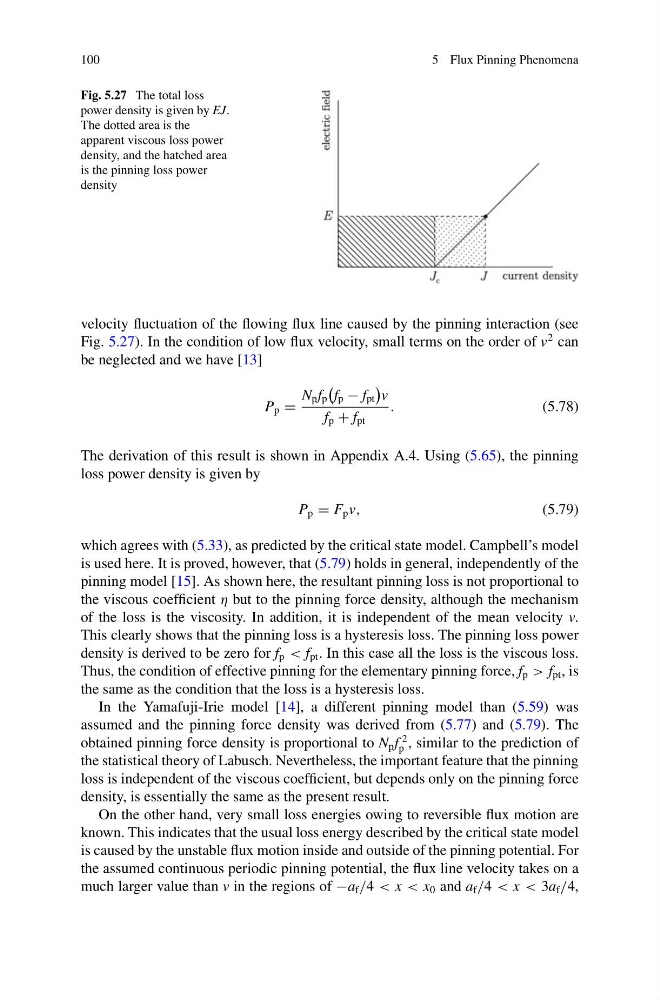
Fig. 5.27 The total loss
power density is given by EJ.
The dotted area is the
apparent viscous loss power
density, and the hatched area
is the pinning loss power
density
velocity fluctuation of the flowing flux line caused by the pinning interaction (see
Fig. 5.27). In the condition of low flux velocity, small terms on the order of v
2 can
be neglected and we have [13]
P p =
N p f p
f p − f pt
v
f p + f pt
.
(5.78)
The derivation of this result is shown in Appendix A.4. Using (5.65), the pinning
loss power density is given by
P p = F p v,
(5.79)
which agrees with (5.33), as predicted by the critical state model. Campbell’s model
is used here. It is proved, however, that (5.79) holds in general, independently of the
pinning model [15]. As shown here, the resultant pinning loss is not proportional to
the viscous coefficient η but to the pinning force density, although the mechanism
of the loss is the viscosity. In addition, it is independent of the mean velocity v.
This clearly shows that the pinning loss is a hysteresis loss. The pinning loss power
density is derived to be zero for f p < f pt . In this case all the loss is the viscous loss.
Thus, the condition of effective pinning for the elementary pinning force, f p > f pt , is
the same as the condition that the loss is a hysteresis loss.
In the Yamafuji-Irie model [14], a different pinning model than (5.59) was
assumed and the pinning force density was derived from (5.77) and (5.79). The
obtained pinning force density is proportional to N p f
2
p , similar to the prediction of
the statistical theory of Labusch. Nevertheless, the important feature that the pinning
loss is independent of the viscous coefficient, but depends only on the pinning force
density, is essentially the same as the present result.
On the other hand, very small loss energies owing to reversible flux motion are
known. This indicates that the usual loss energy described by the critical state model
is caused by the unstable flux motion inside and outside of the pinning potential. For
the assumed continuous periodic pinning potential, the flux line velocity takes on a
much larger value than v in the regions of −a f /4 < x < x 0 and a f /4 < x < 3a f /4,
5 Flux Pinning Phenomena
Fig. 5.27 The total loss
power density is given by EJ.
The dotted area is the
apparent viscous loss power
density, and the hatched area
is the pinning loss power
density
velocity fluctuation of the flowing flux line caused by the pinning interaction (see
Fig. 5.27). In the condition of low flux velocity, small terms on the order of v
2 can
be neglected and we have [13]
P p =
N p f p
f p − f pt
v
f p + f pt
.
(5.78)
The derivation of this result is shown in Appendix A.4. Using (5.65), the pinning
loss power density is given by
P p = F p v,
(5.79)
which agrees with (5.33), as predicted by the critical state model. Campbell’s model
is used here. It is proved, however, that (5.79) holds in general, independently of the
pinning model [15]. As shown here, the resultant pinning loss is not proportional to
the viscous coefficient η but to the pinning force density, although the mechanism
of the loss is the viscosity. In addition, it is independent of the mean velocity v.
This clearly shows that the pinning loss is a hysteresis loss. The pinning loss power
density is derived to be zero for f p < f pt . In this case all the loss is the viscous loss.
Thus, the condition of effective pinning for the elementary pinning force, f p > f pt , is
the same as the condition that the loss is a hysteresis loss.
In the Yamafuji-Irie model [14], a different pinning model than (5.59) was
assumed and the pinning force density was derived from (5.77) and (5.79). The
obtained pinning force density is proportional to N p f
2
p , similar to the prediction of
the statistical theory of Labusch. Nevertheless, the important feature that the pinning
loss is independent of the viscous coefficient, but depends only on the pinning force
density, is essentially the same as the present result.
On the other hand, very small loss energies owing to reversible flux motion are
known. This indicates that the usual loss energy described by the critical state model
is caused by the unstable flux motion inside and outside of the pinning potential. For
the assumed continuous periodic pinning potential, the flux line velocity takes on a
much larger value than v in the regions of −a f /4 < x < x 0 and a f /4 < x < 3a f /4,